

Standard California homeowners policies cover foundation damage only when a sudden, covered peril causes it, while gradual settling, flooding, and earth movement are excluded. That's the answer most homeowners need, but it's not the answer most of them get when they're staring at a new crack in the garage slab and trying to figure out whether insurance will pay.
A Sacramento homeowner sees a diagonal crack after the last atmospheric-river season, notices a sticking door, and assumes the policy will step in because the damage looks serious. That's where claims go sideways. Insurance doesn't pay based on how bad the crack looks. It pays based on what caused it, whether that cause is covered, and whether the claim has to compete with the rest of the house inside the same dwelling limit.
Table of Contents
- The Short Answer for California Homeowners
- How Insurers Decide What Counts as a Covered Foundation Loss
- Standard Earthquake and Flood Policies Compared
- When California Wildfire Damage Reaches the Foundation
- Filing a Foundation Claim the Right Way
- Three Foundation Coverage Myths California Homeowners Still Believe
- Closing the Gap With Endorsements and Standalone Policies
- Your Next Step Toward the Right Foundation Coverage
The Short Answer for California Homeowners
A homeowner in Sacramento finds a fresh diagonal crack after a winter of heavy storms. The instinct is simple. The house is damaged, so insurance should pay. Usually, that instinct is wrong.
Standard California homeowners policies cover foundation damage only when a sudden, covered peril caused the loss. In standard U.S. homeowners insurance, foundation damage is typically covered only when it results from a sudden, accidental, covered peril such as fire, lightning, explosion, a vehicle striking the home, vandalism, or a burst pipe. Gradual problems like settling, aging, poor construction, or lack of maintenance are usually excluded, even though the foundation is generally part of the dwelling itself under Coverage A, as explained in Allstate's foundation repair coverage overview.
What covered peril actually means
A covered peril is the trigger. Not the crack. Not the repair bill. The trigger.
That means a slab crack caused by a burst pipe under the home may be covered. A slab crack caused by years of soil movement usually isn't. The foundation isn't a separate line item with its own bucket of money. It sits inside the Coverage A dwelling limit, right beside the roof, framing, walls, and interior finishes.
Bottom line: California homeowners shouldn't ask whether the foundation is covered in the abstract. They should ask whether the event that damaged it is covered and whether enough dwelling limit remains to rebuild the rest of the structure too.
The exclusions that matter most in California
California homeowners also need to stop assuming one policy handles every disaster. It doesn't.
- Earthquake losses: Standard homeowners insurance generally excludes earth movement. Earthquake protection usually requires separate coverage.
- Flood losses: Standard homeowners insurance also doesn't function as flood insurance. Flood usually sits in a separate policy.
- Maintenance issues: Long-running drainage problems, ordinary settlement, aging, and construction defects usually land on the homeowner, not the carrier.
That's why the fight in a foundation claim usually turns on causation, wildfire aftermath, and whether earthquake or flood protection was purchased separately.
How Insurers Decide What Counts as a Covered Foundation Loss
A California adjuster deciding your foundation claim is not asking, “Is this crack expensive?” The adjuster is asking, “What caused it, when did it happen, and is that cause covered under this policy?”
That is the whole fight.
If the file shows a sudden, provable event, the claim has a path. If the file suggests slow movement, deferred drainage work, old settlement, or long-term soil problems, the carrier will push the loss into an exclusion.
What insurers actually look at first
Insurers usually sort foundation claims through four practical questions.
What was the trigger? A fire, a burst pipe, a vehicle impact, or another sudden event gives you a real coverage argument. Ordinary settling does not.
Was the damage sudden or progressive? Foundation claims get denied every day because the photos show staining, prior patching, old crack lines, or other signs the condition existed well before the reported date of loss.
Can the cause be documented? A plumber, engineer, or restoration contractor can make or break the claim file. If their reports connect the foundation damage to one specific event, your odds improve. If the reports waffle, the insurer will use that against you.
Does the policy exclude the cause? California homeowners get burned. The visible damage may be to the foundation, but the excluded cause may be earth movement, flood, seepage, poor drainage, or construction defects.
Three claim patterns that show how this works
A wildfire scorches the structure, weakens load-bearing components, and leaves the slab or footing damaged as the house shifts under heat stress. That usually falls inside a covered dwelling loss under a standard homeowners policy because the triggering peril is fire. In California, this issue matters more than many homeowners realize because the foundation is competing with the rest of the rebuild for the same dwelling limit. If the house, garage, and code upgrades already consume most of Coverage A, the foundation repair is not drawing from a separate pot.
A supply line breaks under the slab and washes out supporting soil. That can be covered if the claim is presented as sudden accidental water discharge and the reports tie the void or movement to that event. Courts and insurers have long treated this as a causation fight, not a simple crack question. The exclusion for settling or cracking may still appear in the denial letter, but the water-damage exception can still matter depending on the policy wording and the facts, as discussed in this Insurance.com analysis of foundation repair coverage.
An old diagonal crack in a slab-on-grade home widens after seasons of dry weather, rain swings, and expansive soil movement. That claim usually dies fast. The carrier will classify it as long-term settlement, drainage failure, or earth movement. Those are homeowner problems, not covered sudden losses, under standard homeowners forms.
Why earthquake edge cases trip up California homeowners
This is one of the biggest mistakes I see. A homeowner reports “foundation damage after the quake,” but the standard homeowners policy excludes earth movement. Then the homeowner points to a later crack spread, jammed doors, or a utility-line break and assumes the sequence creates coverage under the homeowners policy.
Usually, it does not.
Insurers focus on the original cause. If the quake started the movement, the homeowners carrier will usually stand on the earth movement exclusion. If you bought earthquake coverage, that claim belongs there instead. If you did not, arguing about the severity of the crack will not fix the coverage gap.
Documentation wins or loses these claims
A dramatic crack proves damage. It does not prove coverage.
What helps is a clean chain of evidence: pre-loss condition if available, a narrow date of loss, photos taken right away, leak detection results, an engineer's opinion on causation, and repair invoices that match the reported event. The claim gets weaker every time the homeowner describes a sudden event with maintenance language such as “we've been watching this for a while” or “it has slowly gotten worse.”
Be disciplined. Report the event. Document the trigger. Get the right expert early.
The foundation claim is usually won or lost on cause, not appearance.
That rule gets even harsher after a wildfire loss in California. Even when the foundation damage is covered, it still has to compete inside the dwelling limit with everything else needed to rebuild the home.
Standard Earthquake and Flood Policies Compared
California homeowners often ask the wrong comparison question. They compare homeowners insurance to “extra coverage” in the abstract. The better question is simpler: which policy responds to which kind of ground-related damage?
Foundation Coverage by California Policy Type
| Policy Type | Foundation Covered? | Typical Deductible | Key Exclusion |
|---|---|---|---|
| Standard homeowners | Sometimes, if a sudden covered peril damages the foundation | Varies by policy | Gradual settling, ordinary wear, flooding, and earth movement are commonly excluded |
| Earthquake policy | Depends on the policy terms and trigger | Often structured separately from standard homeowners | Flood is not part of earthquake coverage, and pre-existing or unrelated work may still be excluded |
| Flood policy | Sometimes, for direct physical flood loss to covered property | Varies by policy | Subsurface land destabilization and earth movement tied to water below the surface are excluded |
What standard homeowners insurance does
Standard homeowners coverage is the middle lane. It isn't earthquake insurance and it isn't flood insurance. It may pay when a non-excluded, sudden peril damages the dwelling, including the foundation.
Examples often cited by insurers include fire, lightning, or explosion, while gradual settling is treated differently from a covered event, as noted in Kin's explanation of when homeowners insurance may cover foundation damage.
What flood insurance does not fix
Many homeowners assume any water-related foundation problem is a flood claim. That's sloppy thinking, and it leads to ugly surprises.
Flood-related foundation damage is handled separately from standard homeowners coverage. The National Flood Insurance Program standard flood form covers direct physical loss from flooding, but FEMA guidance and the SFIP do not cover subsurface land destabilization or earth movement, including settlement caused by water accumulation in subsurface areas, as discussed in this review of flood-event foundation damage and flood form limits.
Flood water at the surface and soil instability below the surface aren't the same claim. Homeowners need to separate those ideas before a loss happens.
The practical California view
For many California properties, one policy isn't enough. Standard homeowners may respond to fire or a burst pipe. Separate earthquake coverage may address shaking-related structural loss. Separate flood coverage may address rising water, within its own limits and exclusions.
That layered approach matters most in high-hazard zones, where the foundation can be threatened by fire, seismic movement, and water in completely different ways.
When California Wildfire Damage Reaches the Foundation
A wildfire tears through the neighborhood. The roof is gone, windows are blown out, framing is charred, and weeks later an engineer finds slab cracking and movement tied to heat, collapse, or heavy suppression water. Homeowners usually ask one question first: is the foundation covered?
The better question is whether enough Coverage A money is left to pay for it.
Coverage usually turns on cause, but payment turns on limits
In a California wildfire claim, the foundation is part of the dwelling. It does not get its own protected bucket of money. It competes with debris removal, engineering, framing, roofing, windows, insulation, interior rebuild, and ordinance or law work under the same dwelling limit.
That is the part many wildfire explainers miss. You can win the coverage argument and still lose the money argument.
The California Department of Insurance wildfire residential insurance guide makes the larger point clearly. Fire damage is generally handled under the homeowners policy, subject to the policy's terms and limits. For foundation damage, that means the fight is often not whether fire is a covered peril. The fight is whether the dwelling limit can carry the full rebuild, including hidden structural work below the house.
A common post-fire foundation dispute
After a major fire, visible damage gets priced first because it is obvious and urgent. Then the engineer report arrives. It says structural failure above shifted loads into the slab, or extreme heat compromised concrete, or suppression water contributed to soil change that left parts of the foundation unstable.
That can still fit inside a wildfire dwelling claim if the foundation damage flows from the covered fire loss. But insurers and their experts will examine timing and cause hard, especially when the damage was not obvious on day one.
If a later mudslide, debris flow, or slope failure hits the same property after the fire, the analysis changes fast. Same foundation. Different cause. Different coverage result.
Why wildfire foundation claims become a budgeting contest
California homeowners in burn areas need to treat the foundation as a limit-management problem, not just a causation problem.
Large wildfire claims burn through Coverage A fast:
- Roof and framing repairs: These usually absorb major dollars early.
- Interior systems and finishes: Electrical, plumbing, insulation, drywall, cabinets, and flooring add cost quickly.
- Code-triggered work: Rebuild requirements can push costs far past the homeowner's rough estimate.
- Foundation stabilization or replacement: Underpinning, reinforcement, excavation, and engineer-directed repairs are expensive and often discovered after the first scope is written.
A valid foundation claim can still leave a homeowner short when the policy limit was set too close to the house's real rebuild cost.
That is the California edge case people need to understand. After wildfire, the foundation is not just a coverage question. It is a competition inside the dwelling limit, and hidden structural damage often enters that competition late.
Filing a Foundation Claim the Right Way
Foundation claims are won or lost early. Not at appraisal. Not in a complaint letter months later. Early.
A homeowner who finds cracking, heaving, separation, or sudden slab movement needs an evidence plan immediately. The insurer is already deciding whether the loss looks sudden or gradual. The file should force that decision in the homeowner's favor if the facts support it.
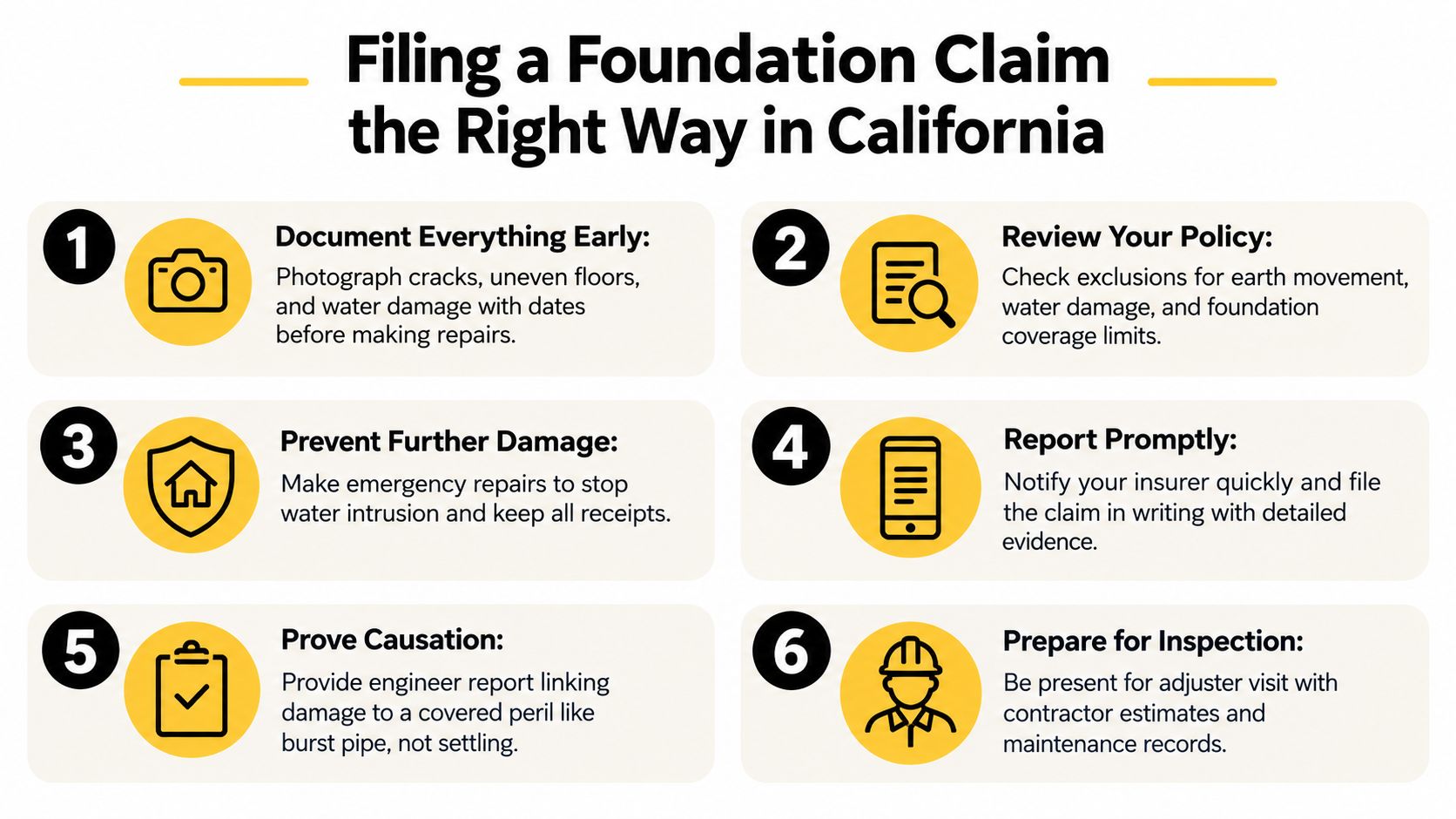
The claim sequence that gives the file a chance
- Photograph first: Use clear photos of cracks, floor slope indicators, wall separation, water staining, and affected exterior areas before repairs begin. A ruler in the photo helps show scale.
- Lock down the timeline: Write down when the problem was first noticed, what happened right before it, and whether there was fire, plumbing failure, vehicle impact, or another sudden event.
- Pull prior records: Plumbing invoices, leak reports, retrofit records, foundation inspections, and seller disclosures matter. They show whether the problem is new or pre-existing.
- Hire the right expert: A licensed structural engineer usually carries more weight on causation than a repair contractor whose business model depends on selling the work.
- Report promptly in writing: Phone notice is fine to start. Written notice is better. The description should stay factual and avoid casual guesses.
- Wait before signing away rights: Assignment-of-benefits paperwork from contractors can create trouble before the adjuster has even inspected the home.
The wording matters
Homeowners say damaging things without realizing it. “It's probably been there a while” is the kind of sentence insurers love. “The crack appeared after the under-slab plumbing leak” is better if it's true and documented.
Adjusters also read cracking patterns differently. Horizontal movement, moisture evidence, and sudden displacement may raise different causation questions than cosmetic vertical hairlines. The visible pattern isn't final proof, but it shapes the investigation.
Practical rule: The claim report should describe facts, timing, and observed changes. It shouldn't diagnose the cause before the engineer does.
What to do after a partial denial
Sometimes the carrier sends a reservation-of-rights letter or pays part of the claim while excluding foundation stabilization, soil work, or related items. That isn't the end of the road.
- Ask for the exact exclusion cited: Vague denial language isn't enough.
- Match facts to policy wording: If the insurer agrees there was a covered leak but denies all slab movement as settling, the file may need a tighter causation opinion.
- Get the engineer to address trigger and sequence: The report should separate covered damage from excluded conditions if both are present.
- Keep repair proposals specific: “Foundation repair” is too broad. Scope should identify what damage arose from the claimed event.
Most bad foundation claims don't fail because the policy was impossible. They fail because the homeowner let the carrier define the story first.
Three Foundation Coverage Myths California Homeowners Still Believe
A California homeowner gets through a wildfire claim, sees new cracking at the slab edge, and assumes the foundation has its own bucket of money. That assumption costs people real money. Foundation repairs compete inside the same dwelling limit that also has to pay for framing, finishes, smoke damage, and rebuild work.
Myth one says any foundation crack is covered
Coverage does not turn on how alarming the crack looks. It turns on cause.
If the carrier ties the damage to settling, earth movement, long-term moisture, shrinkage, or ordinary wear, the claim often stalls or gets denied under standard policy exclusions. A wide crack can still be excluded. A smaller crack tied to a covered fire-related collapse, burst pipe, or other insured event may have a better path.
That is the mistake homeowners keep making. They look at severity first. The policy looks at trigger first.
Myth two says earthquake insurance picks up everything the homeowners policy leaves behind
It does not.
Earthquake coverage is its own lane, and flood is a different lane again. In California, that distinction matters most after wildfire. A burned hillside can later fail, shed water, or destabilize soil around the home. Homeowners then learn the hard way that fire, quake, and flood do not blend into one broad foundation benefit just because the same slab was damaged.
Deductibles matter too. A policy can cover shaking-related foundation damage on paper and still leave the homeowner paying most of the bill because the deductible is high. Buy earthquake coverage with your eyes open. Focus on the deductible structure, not just the fact that the policy exists.
Myth three says prior repairs and prior knowledge are minor details
They are claim-defining facts.
Old engineering reports, seller disclosures, drainage complaints, underpinning work, and patched cracks give the insurer a ready-made argument that the condition predated the current loss. If your house had prior foundation work, keep the permits, invoices, photos, and engineer findings in one file. If you cannot show the before condition, you make it easier for the carrier to say the new damage was old movement with fresh paint on it.
California owners need to be more disciplined than the average insurance article suggests. The question is not whether the foundation is important. Of course it is. The question is which policy, which exclusion, and which part of the dwelling limit is supposed to pay for this specific damage. That is the coverage fight.
Closing the Gap With Endorsements and Standalone Policies
A California foundation claim often turns into a fight over which policy is supposed to respond, and whether the dwelling limit is already spoken for.
That matters most in wildfire country. If fire destroys large parts of the home and also leaves the foundation cracked, heat-damaged, or exposed after slope failure and water intrusion, the same dwelling bucket may have to pay for both the rebuild above grade and the structural work below it. Homeowners who buy only a higher base policy and skip the other layers often find out they did not buy broader foundation protection. They bought a bigger limit for the same narrow triggers.
California Foundation Coverage Layers
| Coverage Option | Foundation Trigger | Typical California Use | Rough Annual Cost |
|---|---|---|---|
| Standard homeowners dwelling coverage | Fire, burst pipe, and other sudden covered perils | Baseline coverage for the structure | Varies by carrier, home, and risk |
| Water backup or related water endorsement | Water-related incidents if the endorsement applies | Homes with drainage or backup concerns | Varies by carrier and location |
| Equipment breakdown endorsement | Mechanical failure causing certain covered damage pathways | Homes with aging equipment near living areas | Varies by carrier and form |
| Earthquake policy | Shaking and related seismic damage if covered by the form | Homes in seismic zones | Varies by home and deductible selection |
| Flood policy | Surface flooding and other covered flood events | Homes in mapped flood-prone or water-exposed areas | Varies by location and policy type |
Shop the stack, not one policy at a time.
A water endorsement may help with a narrow plumbing or backup scenario. It does not replace flood insurance. An earthquake policy may address shaking damage. It does not fix the wildfire rebuild-cost problem inside the dwelling limit. These products fill different holes, and insurers treat them that way when the claim file opens.
DwellQuote is one tool California homeowners use to compare home insurance options across carriers and review how dwelling coverage, earthquake protection, and other layers fit together. That is a better approach than asking a vague yes-or-no question about foundation coverage, because the issue is whether the policy set matches the way your property is likely to fail.
What actually closes the gap
- Separate earthquake coverage: Buy it if seismic movement is a real threat to the structure. Review the deductible before you buy.
- Separate flood coverage: Get it if runoff, overflow, or surface water exposure is part of the property risk. The homeowners policy is not your flood policy.
- Targeted water endorsements: Review these for slab leak exposure, drain backup concerns, or water damage pathways tied to equipment and plumbing.
- Enough dwelling limit: In wildfire areas, carry a limit that can absorb both major structural rebuild costs and foundation work without forcing those expenses to compete for too small a pot.
The right setup is property-specific, but the rule is simple. Buy coverage based on the cause of loss that is most likely to damage your foundation, then make sure the dwelling limit is large enough to survive a California rebuild.
Your Next Step Toward the Right Foundation Coverage
A California homeowner gets a denial letter after a fire, then learns the harder truth. Even when the foundation damage is covered, it still has to compete with the rest of the rebuild inside the dwelling limit. That is the part many articles miss, and it is the part that leaves people short.
Start with one question. If your house suffered a major wildfire loss, an earthquake-related failure, or a covered water event tomorrow, would your current policy set pay for the cause of loss and still leave enough dwelling coverage to rebuild the structure and repair the foundation? If you cannot answer yes, your setup is not finished.
A practical review list
- Read the declarations page first: Confirm the dwelling limit before you read anything else. Foundation work does not sit in its own protected bucket under a standard homeowners policy.
- Read the exclusions next: Look for earth movement, settling, wear, deterioration, repeated seepage, and flood language. Those exclusions decide many foundation claims before the adjuster ever discusses repair cost.
- Verify separate policies are active: Earthquake and flood coverage need to be in force, not sitting in an email thread or a past quote.
- Match coverage to the property's failure points: Slab-on-grade homes, hillside lots, older plumbing, prior wildfire exposure, expansive soil, and bad drainage each change what can damage the foundation and what policy has to respond.
- Organize proof now: Keep engineering reports, repair invoices, plumbing records, photos, and seller disclosures in one file. A messy paper trail makes a hard claim harder.
- Fix weak limits before renewal closes: Once cracking appears, your buying options shrink fast.
The right question is not whether foundation issues are covered in the abstract. The right question is whether your policy stack covers the specific event that can damage your foundation, and whether your dwelling limit is high enough to survive a California rebuild after that event.
DwellQuote is one option California homeowners use to compare carriers, limits, and separate earthquake or flood protection before renewal. Use any comparison process you trust, but be strict about the review. Check the cause of loss, check the exclusions, and check whether the dwelling limit is big enough to handle a real rebuild without forcing the foundation to compete for too small a pot.