

Minneapolis auto insurance full coverage typically runs $2,577 to $3,235 per year, while minimum coverage is often $720 to $938 per year. Minneapolis drivers also pay about 7% more than the Minnesota average, so a clean record does not guarantee a low bill in this city.
That gap surprises a lot of careful drivers. Minnesota has long been a relatively moderate insurance state, but Minneapolis now sits inside a market where city pricing, mandatory no-fault protections, and neighborhood-level risk all push the bill higher than many people expect.
Table of Contents
- Why Minneapolis Auto Insurance Costs More (And What You Can Do About It)
- Understanding Minnesota's No-Fault Auto Insurance Requirements
- What Makes Minneapolis Auto Insurance Rates Unique
- Minneapolis Auto Insurance Costs by Coverage Type
- Discounts and Strategies to Lower Your Minneapolis Premium
- How to Compare Auto Insurance Quotes in Minneapolis
- Filing an Auto Insurance Claim in Minnesota
- Next Steps and Resources for Minneapolis Drivers
Why Minneapolis Auto Insurance Costs More (And What You Can Do About It)
Minnesota auto insurance premiums rose 29% between 2022 and 2024, which was the ninth-highest increase among U.S. states and slightly above the 27% national increase over the same period, according to the Minneapolis Fed. For many Minneapolis drivers, that kind of increase turns a routine renewal into a budget shock.
A clean driving record still helps, but it does not cancel out local pricing pressure. Minneapolis drivers are consistently priced about 7% above the Minnesota average, so the starting point is already higher than in many other parts of the state.
Why the bill can rise even when the driver hasn't changed
A lower-risk driver can still get a higher bill because insurers do not price only the person behind the wheel. They also price the car's address, the cost of claims in the area, and the way Minnesota's required coverage works together after a crash.
A simple way to think about it is this. Your driving record is one ingredient, but the final premium comes from the full recipe. If the Minneapolis address, claim environment, and coverage obligations all point upward, the price can rise even if your habits stay the same.
Practical rule: a safer driver can still see a higher premium if the address, coverage structure, and local claim costs all point upward.
That is why this guide focuses on more than cheap quotes. It explains the legal coverage rules, the local reasons Minneapolis prices stay high, the difference between minimum and fuller protection, and the shopping steps that can move the number. It also addresses the affordability gap for drivers who have done everything right but still cannot get the price into a comfortable range, including the policy discussion around a possible state-run program.
Understanding Minnesota's No-Fault Auto Insurance Requirements
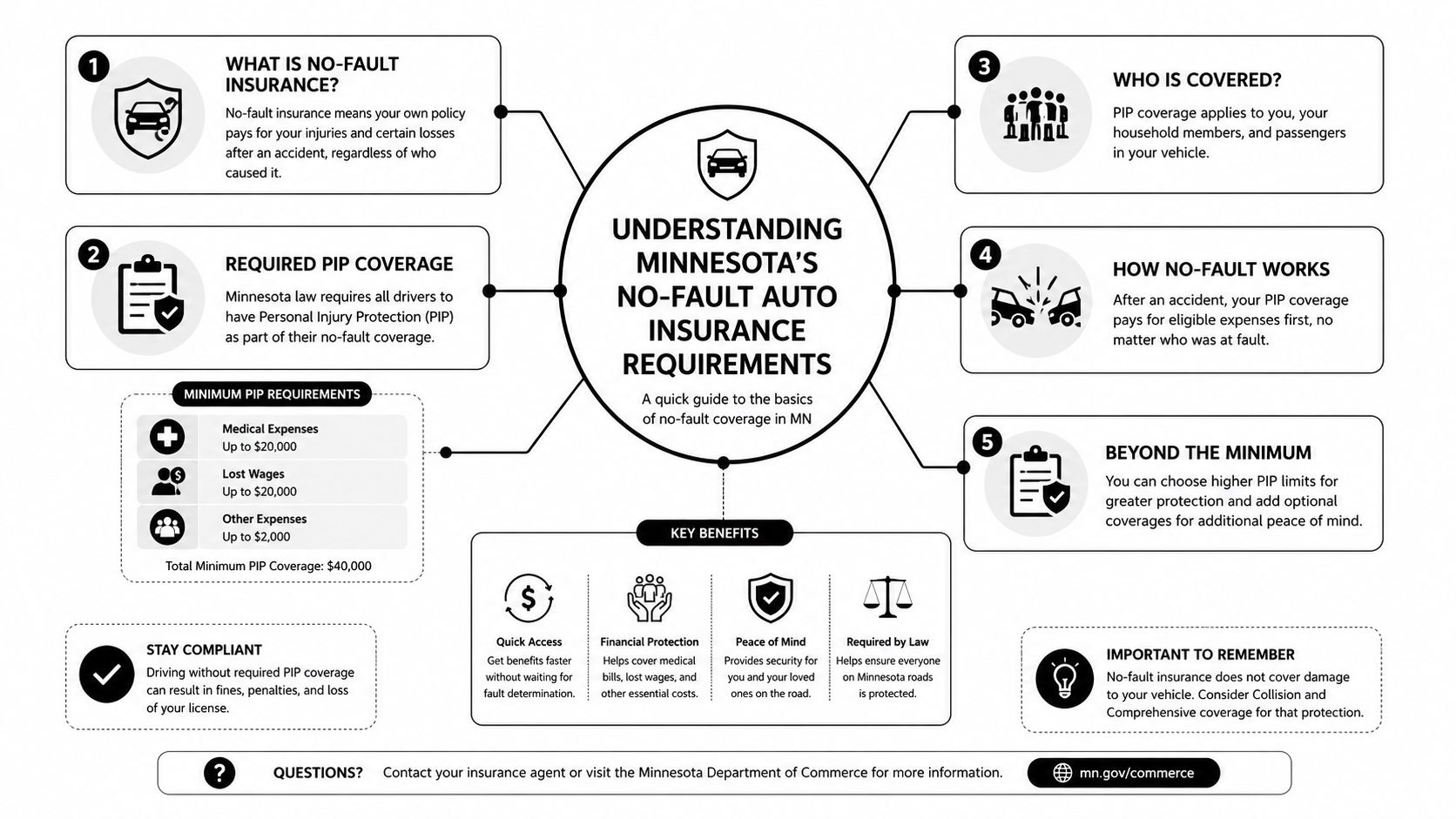
A Minneapolis driver can meet the law and still feel the cost in the monthly bill. Minnesota uses a no-fault system, so your own insurance pays certain injury costs first after a crash, no matter who caused it (Minnesota Department of Commerce). That changes both the coverage you have to buy and the amount you are really paying for protection.
The minimum coverage every Minnesota driver must carry
Minnesota's required auto insurance package includes 30/60/10 liability coverage, $40,000 in PIP, and 25/50 uninsured and underinsured motorist bodily injury coverage (Minnesota Department of Commerce consumer guidance). In plain English, that means:
- $30,000 per person / $60,000 per accident bodily injury liability. This helps pay for injuries you cause to other people.
- $10,000 property damage liability. This helps pay for damage you cause to someone else's car, fence, building, or other property.
- $40,000 PIP. This is your own first-party injury protection.
- $25,000/$50,000 UM/UIM bodily injury coverage. This helps if the other driver does not have enough insurance.
The $40,000 PIP minimum is not one single bucket. It can be divided into $20,000 for medical expenses and $20,000 for non-medical economic losses such as lost wages (Policygenius explanation of Minnesota PIP). That matters because even a bare-bones legal policy in Minnesota still has to fund meaningful injury protection before the claim ever reaches the other driver's coverage.
Why this structure affects price
No-fault coverage raises the starting point because insurers must price first-party medical payments and uninsured motorist protection into every policy from the outset. In Minneapolis, that floor sits on top of city traffic, winter driving hazards, and the claim patterns that come with a larger metro area. The result is straightforward, even if the rules are not. Minnesota's system makes the cheapest legal policy more expensive than a liability-only setup in many other states.
Your cheapest legal policy in Minnesota can still leave gaps if a crash causes serious injuries, especially if the claim runs beyond what the minimums were built to absorb.
What Makes Minneapolis Auto Insurance Rates Unique
A Minneapolis driver can follow the rules, keep a clean record, and still pay more than someone in a quieter part of Minnesota. The reason is local risk. Denser traffic, more stop-and-go driving, tighter parking, winter damage, and a higher chance of theft or vandalism all feed into what insurers expect to pay out. Those costs do not fall evenly across the city, so two drivers with similar profiles can still receive very different quotes.
Why address-level pricing matters
That ZIP code difference is real. Recent market estimates show comparable full coverage in some Minneapolis ZIP codes ranging from about $1,590 to $1,875 per year (Insure.com Minneapolis data). For shoppers, that means the insurer is pricing more than the vehicle and the driver. It is also pricing where the car spends the night, where it is driven, and how often that area tends to produce claims.
A garage near a busy corridor can create a different risk picture than a car parked on a quieter block. Street parking can raise the odds of break-ins or minor impacts. An area with heavier claim activity can also affect repair expectations, because insurers are looking at how often losses happen and how expensive those losses tend to be. In practice, the same sedan can cost less to insure a few neighborhoods away, even before the driver changes anything about the policy.
How Minnesota's structure interacts with urban risk
Minnesota's no-fault system adds another layer to the price. Every policy has to include PIP and UM/UIM, so those protections are part of the base policy from the start, not optional extras. That matters in Minneapolis because urban claim conditions are built into the mandatory floor. It helps explain why a basic legal policy here can feel pricier than liability-only coverage in many other states.
The city's premium profile also reflects the broader state pressures noted earlier by the Minneapolis Fed. Severe weather and higher repair costs have pushed rates up across Minnesota, and Minneapolis sits in the middle of that pressure because metro areas concentrate vehicles, crashes, and repair demand. For a local driver, that often means the bill is shaped by both the state's required coverage rules and the city's day-to-day risk.
For low-income drivers, the gap is harder to ignore. The same no-fault structure that protects injured drivers can also make the entry price harder to afford, especially if someone is trying to stay legal while keeping monthly costs low. That is why some policy discussions have turned toward the idea of a state-run program that could give lower-cost options to drivers who struggle to buy private coverage. It is a practical question for Minneapolis households, because the legal minimum still has to fit a real budget.
Minneapolis Auto Insurance Costs by Coverage Type
The biggest price choice for Minneapolis drivers is whether to stop at the legal minimum or buy fuller protection for the car. The difference is large enough to change a monthly budget. Recent market estimates place minimum coverage around $720 to $938 per year, while full coverage runs about $2,577 to $3,235 per year. The broader market summaries from Minneapolis Fed market summary and Insure.com point in the same direction.
Insurify also reported that Minnesota's average full-coverage price reached $2,600 in 2024, which fits the pattern seen across the state. Farmers' Minnesota car insurance page, summarizing that data, gives the same general picture through its Farmers' Minnesota car insurance page summarizing Insurify data.
Minneapolis Auto Insurance Cost Comparison
| Coverage Type | Annual Cost Range | Includes |
|---|---|---|
| Minimum coverage | $720 to $938 | Required liability, PIP, UM/UIM, property damage liability |
| Full coverage | $2,577 to $3,235 | Minimum required coverages plus collision and other-protection coverage, with higher liability limits in many quoted setups |
The gap between those tiers is roughly $2,297 per year at the high end of the cited comparison, and that spread reflects more than one thing. Collision coverage pays for crash damage to the policyholder's car, other protections cover non-crash losses like theft or hail, and higher liability ceilings raise protection on the other side of the policy.
What minimum coverage buys, and what it leaves out
Minimum-only coverage keeps the policy legal, but it does not protect the car itself from a crash or a weather event. In a no-fault state, that matters because injury costs can move through PIP first, while vehicle damage still needs another layer of protection if the driver wants repair help.
Full coverage usually makes more sense for a newer car, a financed vehicle, or a driver who could not absorb a major repair bill without stress. Minimum coverage can work for an older car with little market value, but only if the owner understands the tradeoff clearly and has room for the risk.
Discounts and Strategies to Lower Your Minneapolis Premium
The fastest savings usually come from controlling the parts of the policy the driver can influence. That starts with comparing carriers, then layering in discounts that fit the household, the vehicle, and the way the policy is billed. Bundling can help if the household already carries other insurance, and a clean driving record still matters because insurers reward lower expected claim frequency.

What to ask about first
The best shopping order is practical, not glamorous:
- Bundling options. Ask whether the carrier discounts auto coverage when another policy sits in the same household.
- Safe-driver treatment. A clean record still matters, even in a pricey city market.
- Multi-policy or household discounts. Some carriers price more favorably when several vehicles or policies sit together.
- Usage and garaging questions. Where the car is parked and how it is used can affect the quote.
- Payment structure. Paying in a way the insurer prefers can sometimes change the total cost.
The affordability gap deserves equal attention. Minnesota policymakers have documented that auto rates can reflect socioeconomic factors unrelated to driving record, which can leave low-income drivers and drivers of color paying more even when they drive safely (House handout on auto insurance affordability). That is why discount hunting alone does not solve the Minneapolis problem for every household.
Why policy debates matter to the shopper
Legislators are considering a state-run low-cost auto-insurance program for eligible low-income residents, and the goal is to reduce the number of uninsured drivers. That proposal matters because it signals a broader attempt to solve a market problem that private shopping cannot fully fix for some households.
Priority rule: focus first on discounts the driver can verify, then on household structure, then on comparison timing. Policy changes may help later, but they do not replace a careful quote review today.
For a Minneapolis driver, the practical mix is usually simple. Keep the record clean, ask about every available household discount, and do not assume one carrier's opening number is final. The quote only becomes useful after the coverage terms and deductible structure are comparable.
How to Compare Auto Insurance Quotes in Minneapolis
In Minneapolis, two quotes can look close on price and still protect you very differently. That happens because auto insurance is built from several parts, liability limits, PIP, UM/UIM, collision, and deductibles, and each carrier can arrange those pieces a little differently. A shopper who compares only the dollar amount can miss the actual cost of a thinner policy.
Start with the documents that matter
Gather your current policy, the vehicle identification number, an estimate of annual mileage if you have one, and the list of household drivers. Those details help insurers quote the same risk instead of guessing at it. It also helps to confirm the state minimums first, since Minnesota requires the 30/60/10 liability package, PIP, and UM/UIM coverage as detailed in the no-fault requirements section.
Then compare quotes like-for-like. A $600 minimum-coverage quote from one company is not the same deal as a $900 minimum-coverage quote from another if the deductible structure or coverage limits differ. The same idea applies to full coverage, because collision coverage and deductible choices can change the price quickly, just like changing the size of a safety net changes how much protection it offers.
When to shop and what to watch
The best time to compare is before renewal, after moving, after adding a vehicle, or after a major life change that can affect how the policy is rated. Fine print matters more than the headline number. A quote can look inexpensive and still cost more later if the policy leaves out protections you need or assumes the car is used differently from real life.
A practical comparison also means checking how each company treats the same driver profile. One insurer may price a commuter, a low-mileage driver, or a household with multiple cars differently from another, even when the policy form looks similar at first glance. That is why the cheapest first page is only the starting point, not the answer.
DwellQuote is one option for homeowners who want to request a home insurance quote online through a simple shopping flow.
The safest comparison is the one that matches limits, deductibles, drivers, and vehicle details before anyone tries to judge price.
A careful Minneapolis shopper should leave the process with three things. A quote sheet, a coverage checklist, and a clear sense of what each carrier is promising. That keeps the decision grounded in the policy, not the pitch.
Filing an Auto Insurance Claim in Minnesota
A claim in Minnesota usually starts with your own insurer, not the other driver's. That is the practical side of no-fault coverage, and it matters most right after a crash when the scene is noisy and people want quick answers. PIP handles certain injury costs first, while property damage still follows the more traditional fault-based path.
What to do at the scene
Safety comes first. Check for injuries, call 911 if anyone needs emergency help, and exchange insurance and contact information with the other driver. Photos help too, especially of the vehicles, the road surface, any visible damage, and street signs or traffic signals.
After that, contact the insurer as soon as practical and open the claim. The company will usually ask for the date, location, vehicle information, and a basic description of what happened. Keep the police report number, medical bills, repair estimates, and any communication from the adjuster in one place.
What PIP and property damage mean in practice
PIP is the part of the policy that responds first for medical-related losses, while property damage claims still depend on fault and the facts of the crash. That split confuses a lot of drivers because they expect one claim process to handle everything. It usually does not.
A simple checklist helps after a Minneapolis crash:
- Get medical help first. Even minor symptoms can matter later.
- Document the scene. Photos and notes save time when details blur.
- Report the accident promptly. Delay creates problems for claims handling.
- Track expenses. Tow bills, medical visits, and repair invoices should all be saved.
- Review the coverage terms. The policy will determine what responds and when.
The goal is to keep the claim orderly, not perfect. A clean paper trail makes the adjuster's job easier and protects the driver if a dispute develops.
Next Steps and Resources for Minneapolis Drivers
Minneapolis drivers face a higher baseline for a few simple reasons. Minnesota's no-fault structure requires coverage that responds before many other parts of a policy do, and the city's dense traffic, theft risk, weather, and repair costs all feed into what insurers charge. That means a careful driver can still pay more than expected, even with a clean record.
That gap matters most for people trying to keep a car on the road without stretching a budget. The practical takeaway is to focus on what you can control, not just the premium itself. Review your liability limits, check whether your PIP and UM/UIM amounts fit your situation, and compare quotes before renewal so you are not renewing blindly. If you are comparing policies, use the rate context discussed earlier rather than chasing the cheapest number on a screen.
The affordability problem is also broader than one household. Lower-income drivers are more exposed when required coverage eats into rent, groceries, or transit costs, and that is why the conversation about a possible state-run low-cost program keeps coming up. For some residents, the question is not whether better coverage would be nice, it is whether staying insured is realistic at all.
For official guidance, the Minnesota Department of Commerce insurance division is the clearest place to check state rules and consumer resources. It can help with minimum coverage questions, claims basics, and policy compliance. If a claim gets confusing, return to the coverage terms first, then confirm the state's requirements before making changes.
DwellQuote can also be useful if you are looking at coverage for the rest of the household. If auto insurance in Minneapolis has you reviewing your broader protection needs, visit DwellQuote to compare home insurance options and keep both your car and your home protected with less hassle.