

California's FAIR Plan had 696,562 policies in force by June 2026, with total exposure reaching $768 billion, according to the California FAIR Plan's key statistics. That's not a niche safety net for remote cabins anymore. It's a central part of how hundreds of thousands of California homeowners are keeping properties insured after private carriers retreat from wildfire-prone areas.
For a stressed homeowner, the practical question isn't whether California high risk insurance is available. The better question is which market can offer the right combination of coverage, price, mortgage compliance, and renewal stability. Private admitted carriers, surplus lines insurers, and the FAIR Plan each serve a different role, and treating them as interchangeable can leave serious gaps.
Table of Contents
- The New Reality of California High Risk Insurance
- Navigating the Three Distinct Insurance Markets
- Understanding Cost Drivers and Recent Rate Hikes
- Wildfire Moratoriums and Consumer Protections
- Property Mitigation Strategies to Lower Premiums
- How to Compare Quotes and Bind Coverage Efficiently
- Securing Your Home and Next Steps
The New Reality of California High Risk Insurance
A home can become high risk even in a familiar suburban neighborhood. Insurers assess wildfire models, vegetation, emergency access, roof materials, ember exposure, regional losses, reinsurance costs, and the number of policies already concentrated nearby. Brush is one factor, not the entire decision.
The FAIR Plan's recent growth shows how broadly underwriting has tightened. Policies in force rose 8% since September 2025 and 157% since September 2022, while exposure increased 11% since September 2025 and 250% since September 2022. Written premium reached $2.04 billion, up 6% since September 2025 and 212% since September 2022, according to FAIR Plan data published for June 2026.
Those figures describe a residual market that now serves many ordinary homeowners. The FAIR Plan remains an insurer of last resort, so its expansion indicates that standard carriers are writing or renewing fewer properties in wildfire-exposed ZIP codes. It does not prove that every policyholder owns an unusually dangerous home. It shows that private underwriting has narrowed across a broad range of addresses.
What makes a home high risk
Risk may come from the structure, the surrounding community, or the insurer's overall portfolio. A carrier can treat nearby properties as an accumulation concern even when one home has defensible space and a maintained roof. Reinsurance expenses and catastrophe models also shape decisions homeowners cannot judge from the street.
That makes California high risk insurance a layered market. A qualifying home may still obtain admitted coverage. Another may need surplus lines protection. A third may use the FAIR Plan for fire coverage and add a separate policy for liability, water damage, or other needs. Mitigation work can change which options are available at renewal.
Consider a homeowner who receives a non-renewal notice. The practical response is to request quotes from admitted carriers, ask a broker to test surplus lines, and use the FAIR Plan only for the risks other markets will not accept. This approach can preserve broader protection and avoid paying for a last-resort policy when a private option remains available.
Practical rule: Treat a non-renewal notice as a signal to shop every eligible market, not as proof that the FAIR Plan is the only choice.
Buyers, lenders, and real estate professionals must also evaluate insurability before a transaction depends on coverage. A well-maintained, financeable property can still require a specialized plan. Start with accurate construction and mitigation details, realistic replacement-cost limits, and a written comparison of what each policy covers and excludes.
Navigating the Three Distinct Insurance Markets
California homeowners generally encounter three insurance tiers. Each resembles a different route up a mountain. An admitted carrier is the standard road with extensive regulatory guardrails. A surplus lines insurer is a specialized route that may reach harder locations but operates under different rules. The FAIR Plan is the emergency road, built to keep a property from becoming completely uninsured when other routes are closed.
| Market Tier | Regulatory Status | Best For |
|---|---|---|
| Admitted private carriers | Licensed California insurers subject to state insurance regulation and approved policy forms and rates | Homes that meet a carrier's underwriting guidelines and can obtain broader conventional coverage |
| Surplus lines | Private specialty coverage placed through eligible surplus lines insurers under a different regulatory framework | Properties that private admitted carriers won't accept but still need a private-market alternative |
| FAIR Plan | California's last-resort fire insurer for properties traditional insurers won't write | High-risk homes that cannot secure appropriate fire coverage elsewhere |
Admitted private carriers
An admitted carrier is usually the first market to test because it can offer a familiar homeowners policy with broader coverage, subject to its underwriting rules. Coverage may include the dwelling, other structures, personal property, liability, and additional living expenses, but the exact terms vary by policy.
A carrier can decline a new application or issue a non-renewal when the property no longer fits its risk guidelines. That decision may reflect wildfire modeling, property condition, regional concentration, or changes in company appetite. It isn't necessarily a judgment that the homeowner failed to maintain the property.
Surplus lines options
Surplus lines insurers fill difficult coverage niches. They can be useful when an admitted carrier won't write the home, but the policy needs careful review. Forms, exclusions, deductibles, claims procedures, and financial protections may differ from what a homeowner expects from a standard admitted policy.
A lower premium isn't automatically a better result. The comparison should focus on dwelling replacement cost, wildfire treatment, debris removal, ordinance or law coverage, personal property, liability, additional living expenses, and any exclusions that could create a major uninsured loss.
The FAIR Plan
The FAIR Plan provides basic fire protection for eligible high-risk properties when traditional insurers won't offer coverage. It is not automatically a complete homeowners policy, and many homeowners need separate coverage for liability, water damage, theft, or other risks.
That distinction matters for mortgage borrowers. A lender may require proof of specific protections beyond the FAIR Plan's fire coverage. A broker should review the lender's insurance conditions before binding anything, rather than discovering a coverage mismatch after closing.
The most cost-effective strategy is to treat the tiers as a sequence to investigate, not a ranking to assume. Start with admitted options, examine surplus lines, and use the FAIR Plan when necessary. Then keep shopping after mitigation improvements or underwriting changes create a path back into a broader private policy.
Understanding Cost Drivers and Recent Rate Hikes
High-risk premiums rise when insurers face costlier, harder-to-manage losses. Wildfire severity, rebuilding costs, catastrophe models, reinsurance, claims expenses, and concentration in exposed areas all shape a quote. ZIP code matters, but roof condition, construction, access, and the cost to rebuild often matter just as much.
A FAIR Plan rate increase reflects pressure across the residual market, but homeowners should not treat it as the only pricing option. The practical response is to compare the FAIR Plan with admitted carriers and surplus lines insurers, then measure each option against the protection it provides.
Why one home receives a sharper increase
Two nearby homes can receive very different quotes. Underwriters may distinguish between roof age, construction materials, slope, vegetation, access roads, water supply, defensible space, prior claims, and the replacement cost of the structure. A fire-resistant roof can help, yet the surrounding terrain or regional concentration may still produce a difficult quote.
Rebuilding cost is a major driver. A dwelling limit based on sale price or tax assessment can fall short because neither figure reliably reflects labor, materials, debris removal, code upgrades, and current construction requirements. Reinsurance costs and catastrophe-model assumptions also affect how carriers price wildfire exposure across an entire portfolio.
Recent FAIR Plan filings show how quickly that pressure can reach policyholders. The plan's rate filing received approval for a 35.8% statewide average increase on the dwelling line, followed by a 29.1% average dwelling-line increase scheduled to take effect October 15, 2026, as described in the California Assembly Insurance Committee FAIR Plan background document. The KQED report on the FAIR Plan rate change explains that higher increases are concentrated in wildfire-exposed properties and that some policyholders may see the wildfire portion of premiums double.
Judge a quote by its coverage limits and exclusions, not by a neighbor's premium.
Compare the dwelling limit with a realistic rebuild estimate. Check coverage for code upgrades, debris removal, temporary housing, contents replacement, liability, and deductibles. A lower limit may reduce the bill while leaving the homeowner responsible for a severe gap after a total loss.
After a rate shock, request quotes from private admitted carriers and surplus lines insurers, then use the FAIR Plan as a fallback when those markets cannot provide suitable coverage. Document mitigation work and ask whether it changes underwriting or pricing. A cheaper policy that removes necessary protection is transferred risk, not savings.
Wildfire Moratoriums and Consumer Protections
California law provides an important temporary shield after certain declared wildfire emergencies. When the Governor declares a state of emergency, insurers can't cancel or refuse to renew residential property policies for one year in ZIP codes within or adjacent to the fire perimeter, according to the California Department of Insurance explanation of the mandatory moratorium.
The rule applies to all in-force residential property policies in qualifying ZIP codes. It doesn't erase the policyholder's duties, prevent every form of underwriting action, or guarantee that a policy will remain available forever. It does give homeowners time to document damage, understand notices, correct property information, and search for replacement coverage without assuming an immediate post-fire cancellation is lawful.
What a homeowner should do after a fire
A non-renewal notice deserves prompt attention, but panic can lead to bad decisions. The homeowner should take these steps:
- Verify the location. Check whether the property falls within or adjacent to the declared fire perimeter and whether the applicable ZIP code is covered by the moratorium.
- Read the notice carefully. Identify whether it is a cancellation, non-renewal, underwriting request, or another communication.
- Keep every record. Save the policy, declarations page, notices, photographs, inspection reports, and correspondence.
- Contact the insurer and regulator. Ask the carrier for a written explanation and contact the California Department of Insurance if the notice appears inconsistent with the protection.
- Shop before protection expires. The moratorium creates breathing room, not permanent insurability.
The Department of Insurance says this protection can cover at least 1 million homes in disaster areas, making it a major consumer safeguard rather than a narrow benefit tied to one event, as explained in its wildfire non-renewal information.
The strongest strategy combines legal awareness with early shopping. Homeowners shouldn't wait until the final renewal date to investigate admitted carriers, surplus lines, and FAIR Plan arrangements. A moratorium can prevent an abrupt withdrawal, but it doesn't solve pricing, coverage gaps, or long-term portfolio decisions.
Property Mitigation Strategies to Lower Premiums
Property hardening won't guarantee a private quote, but it can improve the underwriting story and support eligibility for rate relief. California's wildfire mitigation rating regulation took effect October 14, 2022 and requires insurers that use wildfire risk in pricing to offer relief for homes in designated Fire Risk Reduction Communities and Firewise USA sites in Good Standing, as well as homeowners who complete specified property-level mitigation steps, according to Milliman's explanation of California wildfire rating requirements.
Start with the work that reduces ember entry and structure ignition. A carrier may ask for photographs, permits, inspection records, or other documentation, so homeowners should preserve evidence instead of relying on verbal descriptions.
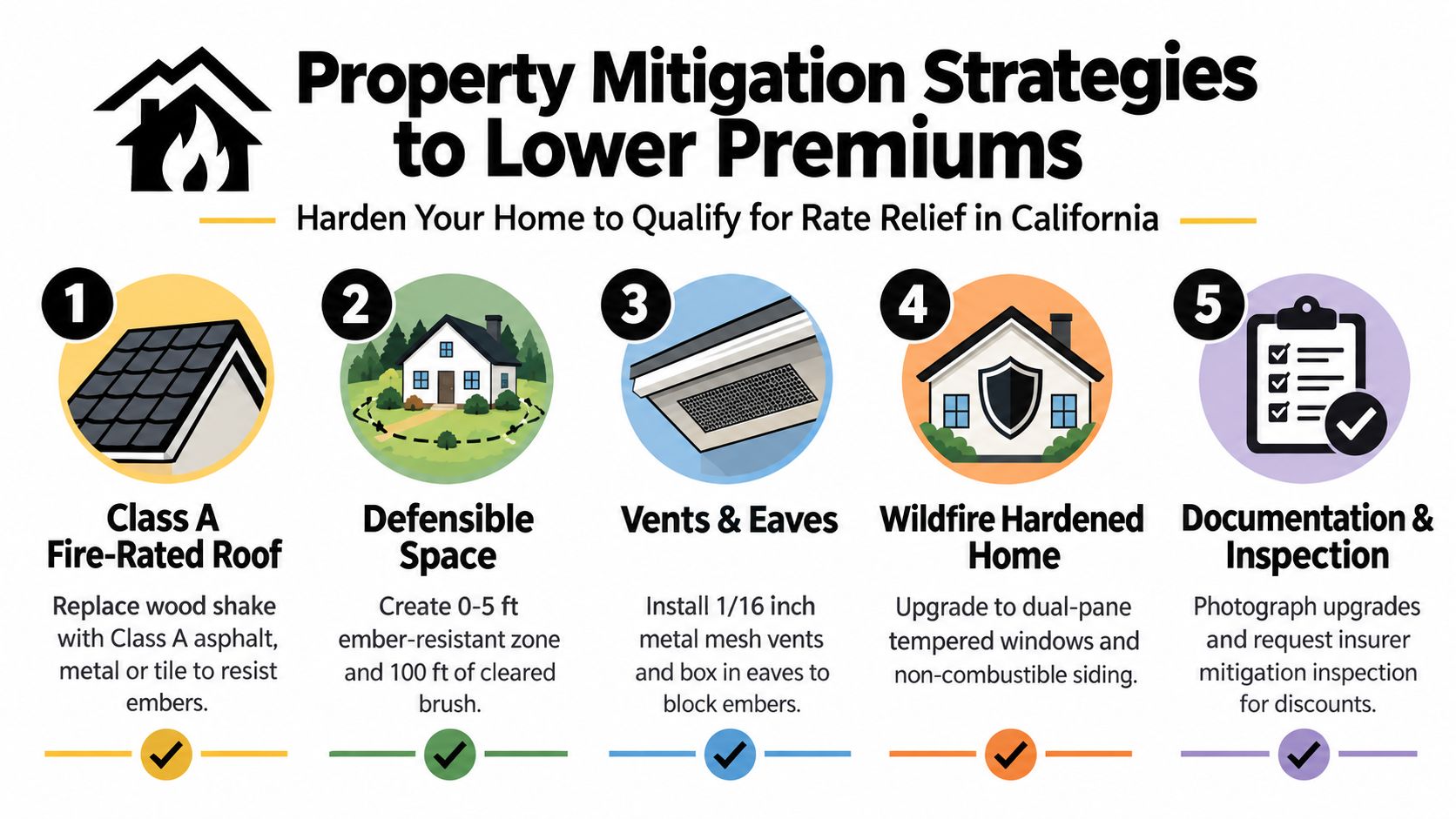
A practical hardening checklist
- Roof first: Replace combustible wood shake roofing with a Class A fire-rated asphalt, metal, or tile roof when replacement is due. The roof is a major ember exposure point, and its condition can affect both inspection results and underwriting decisions.
- Create defensible space: Maintain the zone immediately around the home with ember-resistant materials and remove accumulated leaves, dead vegetation, and combustible storage. Keep the broader defensible-space area clear according to applicable fire-safety requirements.
- Block ember entry: Install fine metal-mesh vent protection, address vulnerable eaves, and inspect gaps around rooflines, decks, and attached structures. Small openings can matter during wind-driven fire conditions.
- Harden windows and exterior walls: Dual-pane tempered windows and non-combustible siding can reduce vulnerability, particularly when combined with a protected roof and clean surroundings.
- Document the result: Photograph completed work from multiple angles, retain invoices, and request an insurer mitigation inspection. Underwriters need verifiable information before they can apply eligible relief.
Broker's recommendation: Homeowners should ask the carrier what evidence it accepts before starting expensive work. A completed project helps only when the insurer recognizes it and records it correctly.
Mitigation should be treated as both a safety investment and a market-access tool. It can support a request for rate relief, improve a private application, and make the property easier to evaluate. It shouldn't be presented as a promise of a specific discount, because each insurer still applies its own underwriting and documentation standards.
How to Compare Quotes and Bind Coverage Efficiently
A high-risk quote is useful only when the underlying property facts are correct. Prepare one complete profile, identify which market tiers will consider the address, and compare every option with matching limits, deductibles, and exclusions.
A quoting platform such as DwellQuote can retrieve public and proprietary property data to prefill application details. Confirm the roof, construction, occupancy, and other information before reviewing quotes. The platform presents options from available carriers, including homes in high fire risk areas, so homeowners can compare coverage side by side. Fulfillment and binding are handled through Somerset Agency, California license 0H91219, as described in the DwellQuote home insurance platform information.
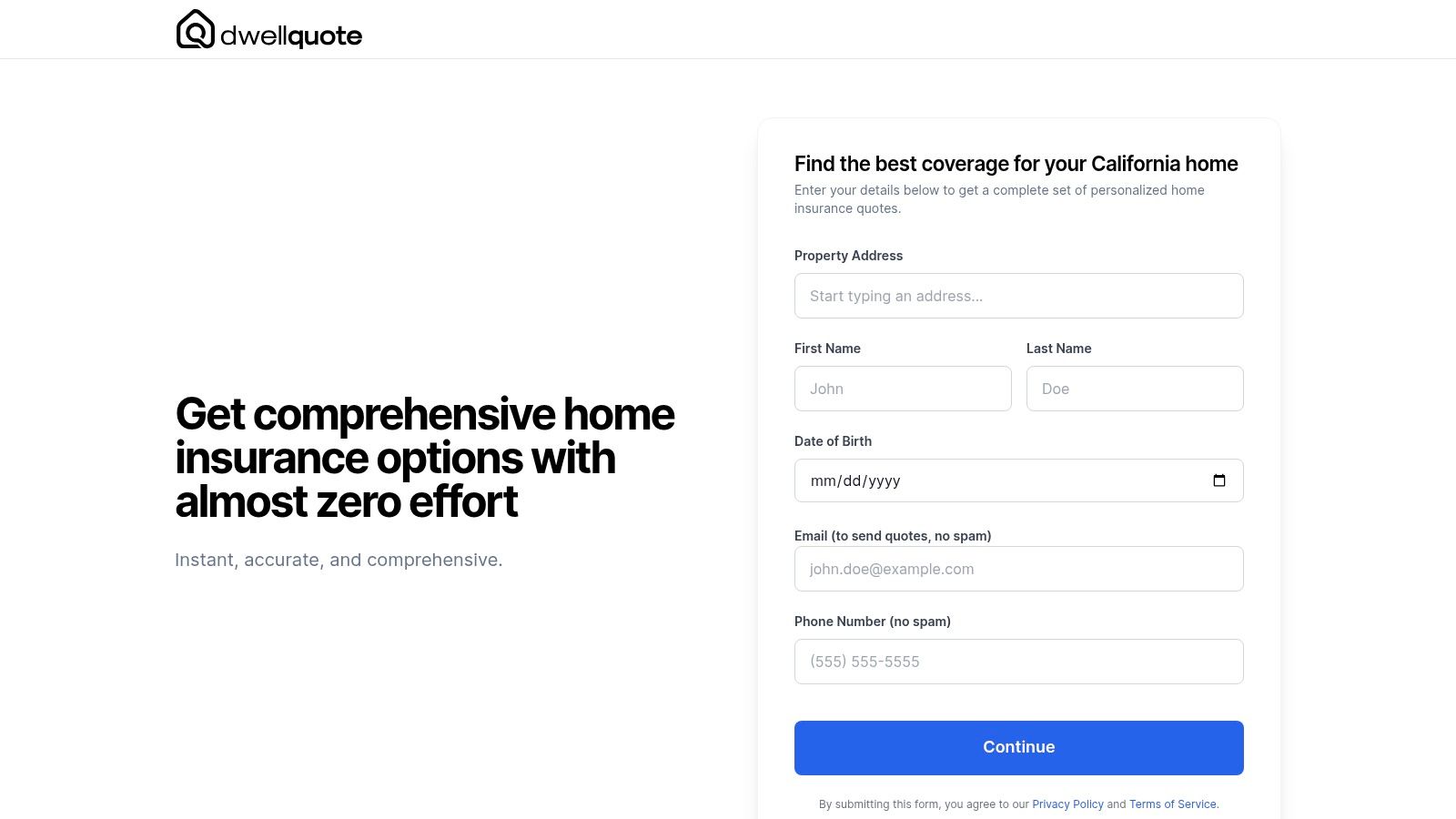
The quote workflow that avoids mistakes
Start with the declarations page. Check the current dwelling limit, deductibles, endorsements, renewal date, and other policy terms. This gives you a reliable baseline for comparing a private carrier, surplus lines option, or FAIR Plan combination.
Verify the property profile. Review the year built, square footage, roof details, construction, heating, renovations, detached structures, swimming pools, and other material facts. An incorrect roof age or dwelling limit can produce a quote that changes during underwriting.
Compare the full coverage package. Place dwelling, other structures, personal property, liability, additional living expenses, deductibles, wildfire treatment, and exclusions in one comparison. Premium alone cannot show whether the policy will respond adequately after a total loss.
Identify the market tier. Confirm whether each option comes from an admitted carrier, a surplus lines insurer, or the FAIR Plan. That distinction affects regulatory treatment, policy forms, claims protections, and whether supplemental coverage is required.
Check the lender's conditions. Mortgage lenders may require specific limits, deductibles, endorsements, and proof of binding. Send the selected declarations page to the lender promptly, then resolve any objections before the effective date.
Bind after reviewing the documents. Confirm the effective date, payment terms, exclusions, inspection conditions, and cancellation provisions. Keep the binder, policy documents, and proof of payment together.
Speed matters when a renewal deadline, home purchase, or lender condition creates pressure. Accuracy matters more. A fast quote based on wrong property data is not a solution, and a low premium paired with a major wildfire exclusion can leave the homeowner exposed when protection is needed most. Compare the entire available market first, then bind the option whose limits and exclusions you can explain clearly.
Securing Your Home and Next Steps
California high risk insurance requires a layered market strategy. Start with admitted private carriers, then examine surplus lines options, and use the FAIR Plan when those markets cannot provide the needed protection. A rejection from one insurer does not close every path to coverage.
After completing mitigation work, update your property file and ask insurers to reconsider the risk. Keep inspection records, photographs, contractor invoices, and defensible-space documentation together. Shop before renewal, not after a non-renewal notice arrives, so you have time to correct inaccurate property data and compare policy terms.
Your priority is clear: shop the entire available market before accepting a residual-market policy. The final policy must protect the dwelling, satisfy lender conditions, address personal liability, and provide realistic support for rebuilding or temporary housing. Review it again after mitigation work or a new renewal decision changes your options.
For a difficult renewal, request quotes, confirm the property profile, compare limits, deductibles, exclusions, and wildfire treatment, then bind only when the documents make sense. Keep the binder, declarations page, and payment record where you can retrieve them quickly.
Request a California home insurance comparison through DwellQuote to review applicable private-market options for a high-risk property. Confirm the property details, compare coverage and pricing, and secure protection that fits the home and lender's requirements.