

A California homeowner opens a renewal letter and sees a sharp price change, or worse, a notice that the policy won't continue. Another buyer gets all the way to mortgage approval and then learns the lender needs proof of insurance before closing. In California, those moments are common because the rules around home insurance don't work like they do in many other states.
That's why understanding California home insurance laws matters beyond the shopping stage. Key questions usually come later. What happens if an insurer won't renew? What if private carriers won't write the home at all? What rights exist after a wildfire or other declared emergency? And how does a homeowner make sure the policy protects the house, not just satisfies escrow?
Table of Contents
- Is Home Insurance Legally Required in California
- The Foundation of California Insurance Law Proposition 103
- Your Consumer Rights on Cancellations and Rate Hikes
- Navigating High-Risk Areas Wildfire Rules and the FAIR Plan
- After Disaster Strikes Claims and Rebuilding Laws
- Finding Compliant Coverage in a Tough Market
- Your Next Step Get Clarity on Your Coverage Options
Is Home Insurance Legally Required in California
The short answer is no. California doesn't require a homeowner to carry home insurance merely because they own a house.
The practical answer is usually yes, if there's a mortgage. The California Department of Insurance homeowners guide states that if a homeowner has a mortgage, the servicer will require enough insurance to protect the lender's collateral. That means insurance is often a financing condition, even though it isn't a direct ownership law.
The easiest way to think about it
A useful comparison is car ownership versus a car loan.
Owning a car and registering it with the state involves legal rules. Financing a car involves lender rules. Home insurance in California works more like the second category. The state doesn't say a homeowner must insure the house just to own it, but the lender almost always says the house must be insured to protect the loan.
That distinction matters because people often ask the wrong question. They ask, “Is it legally required?” when the more important question is, “Can the loan close, fund, or stay in good standing without it?” In most mortgaged situations, it can't.
Practical rule: If the house secures a mortgage, insurance usually functions like a required closing document.
What this means during a purchase or refinance
This affects several real-life moments:
- Buying a home: The lender will usually want proof of coverage before closing.
- Refinancing: A refinance can stall if the replacement coverage doesn't meet the lender's requirements.
- Escrow changes: If a policy lapses or becomes inadequate, the servicer may step in because the home is the loan's collateral.
Some homeowners without a mortgage still choose to carry coverage because the home may be their largest asset. But that's a risk decision, not a California ownership requirement.
Where people get confused
Many people mix up required by law with required in practice. California home insurance laws don't force every owner to buy a standard homeowners policy. But the financial system around homeownership often does.
That's why a homeowner can be technically legal without insurance and still be unable to close a purchase, keep a lender satisfied, or replace a canceled policy without disruption. In California, the law and the mortgage process are related, but they aren't the same thing.
The Foundation of California Insurance Law Proposition 103
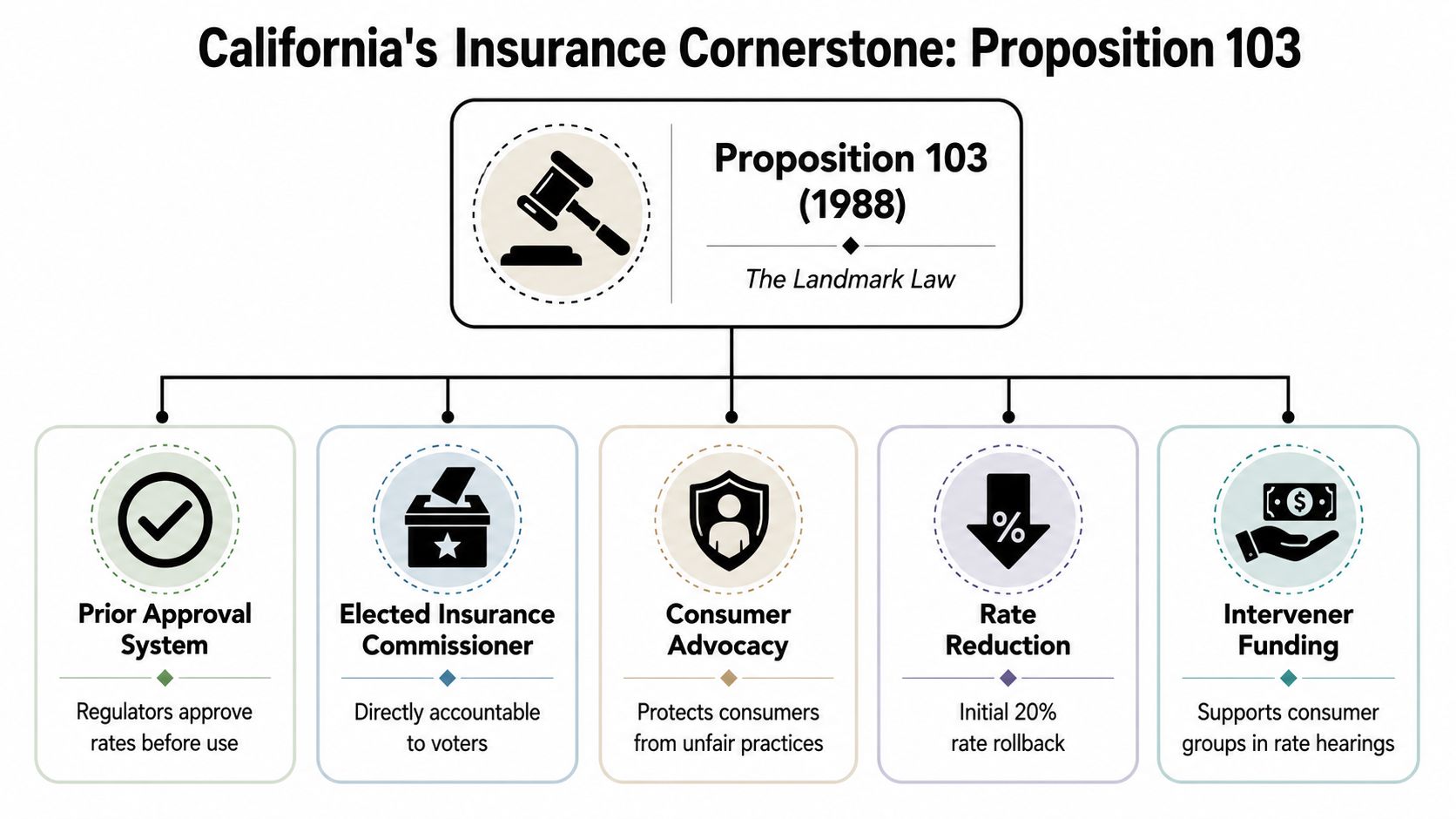
California's home insurance system rests on one major rule set: Proposition 103. It shapes how insurers change rates, how consumers can challenge those changes, and why California's market often feels more regulated than markets in other states.
The Milliman analysis of California homeowners insurance and wildfire pressures explains that Proposition 103 created a prior-approval system. That means insurers can't decide to change property and casualty rates and start using them right away. The Insurance Commissioner must approve those rate changes first. The same source notes that if a requested increase is above 7%, a hearing can be triggered when challenged.
What prior approval means in plain language
A simple analogy helps. Think of a restaurant that can't raise menu prices until a regulator reviews the change first. That's not how most businesses operate, but California insurance isn't treated like a normal retail product.
In this system, insurers have to justify rate changes before putting them into effect. That was designed to protect homeowners from excessive or unfair pricing. It also means rate changes can become legal and public issues, not just business decisions inside an insurance company.
Why this matters in 2026
The same Milliman source says California is a very large insurance market. The NAIC data cited there says total direct premium written in the state rose 61% since 2015, and California holds 11.11% of the U.S. market. The source also cites the Terner Center's finding that the typical California homeowner paid about $1,200 per year for home insurance in 2023, only 2.2% higher than in 2013.
Those figures matter because they show two things at once. California kept homeowner prices relatively moderate for long stretches. At the same time, the state remained a huge market where insurers had to operate under tight rate rules.
California's system was built to protect consumers from excessive or discriminatory pricing, but those same guardrails now sit at the center of the availability debate in wildfire-exposed areas.
The tension homeowners should understand
For a homeowner, Proposition 103 isn't just a legal history lesson. It helps explain why California home insurance laws often produce a different market experience than expected.
A homeowner might assume rising risk leads directly to faster pricing changes. In California, the process is slower and more structured. That can help on affordability. It can also create tension when insurers argue they can't adjust quickly enough to changing catastrophe exposure.
A concise way to frame it is this:
| Issue | What Proposition 103 does | What a homeowner feels |
|---|---|---|
| Rate changes | Requires approval before use | Fewer purely free-market price moves |
| Large increases | Can trigger a hearing above 7% when challenged | More public scrutiny of big changes |
| Consumer protection | Limits excessive or discriminatory pricing | Stronger procedural protections |
| Market pressure | Can complicate insurer response to catastrophe risk | Fewer straightforward private-market options in some areas |
That's why California home insurance laws can feel contradictory. The system tries to restrain pricing and protect consumers, while the market pushes back when wildfire risk makes coverage harder to offer.
Your Consumer Rights on Cancellations and Rate Hikes
A nonrenewal notice often lands like a legal document and an eviction warning at the same time. Homeowners usually want one answer first: Can anything be done to keep the policy?
One overlooked issue in California is that the most important question isn't always how to buy a policy. It's what rights exist when an insurer decides not to continue one.
What proposed SB 1301 would require
The Consumer Watchdog summary of proposed SB 1301 says the bill would require six months' notice for nonrenewal, disclosure of the specific underwriting reasons and wildfire-risk information used, and an explanation of repairs that could qualify a homeowner for renewal.
That matters because a vague nonrenewal letter leaves a homeowner stuck. A more detailed notice gives the homeowner something usable. It answers whether the insurer is focused on brush clearance, roof condition, defensible space, prior loss concerns, or some other underwriting issue.
Why detail matters more than reassurance
A homeowner who gets only a broad explanation can't fix the problem intelligently. A homeowner who gets the actual underwriting reasons has a roadmap.
That's the value of the proposal. It treats nonrenewal less like a dead end and more like a process with defined information rights.
- Specific reasons: The homeowner can see what factor triggered the decision.
- Wildfire data disclosure: The homeowner can better understand what risk inputs were used.
- Repair guidance: The homeowner can determine whether corrective work might reopen a path to renewal.
A nonrenewal notice shouldn't be read only as a rejection. It should be read as a checklist for the next phone call, inspection, and quote request.
How to respond if a notice arrives
A calm response usually works better than a rushed one. Homeowners often benefit from organizing the issue into three tracks.
First, confirm the reason for the action. The underwriting basis matters because a property-condition issue is different from a broad company pullback in a region.
Second, gather proof if repairs or mitigation steps are possible. Photos, invoices, contractor notes, and inspection records can all help clarify whether the property profile has changed.
Third, start replacement shopping early rather than waiting for the final week. In a strained market, timing matters. If one insurer is stepping back, other options may involve narrower forms of coverage or layered policies.
Rate hikes and practical expectations
When premium changes arrive without a cancellation, homeowners still need to look beyond the total price. The important questions are whether coverage limits remain adequate, whether exclusions have changed, and whether the insurer is signaling a broader underwriting shift.
A homeowner worried about a higher bill should compare the policy's actual structure before making a switch. A cheaper replacement that omits important protection can create a bigger problem later.
Navigating High-Risk Areas Wildfire Rules and the FAIR Plan
A common California scenario goes like this: your insurer will not renew, you call around, and every quote request hits the same wall because your home sits in a wildfire-exposed area. At that point, many homeowners assume the state offers a substitute that works just like a regular homeowners policy.
That is usually where confusion starts.
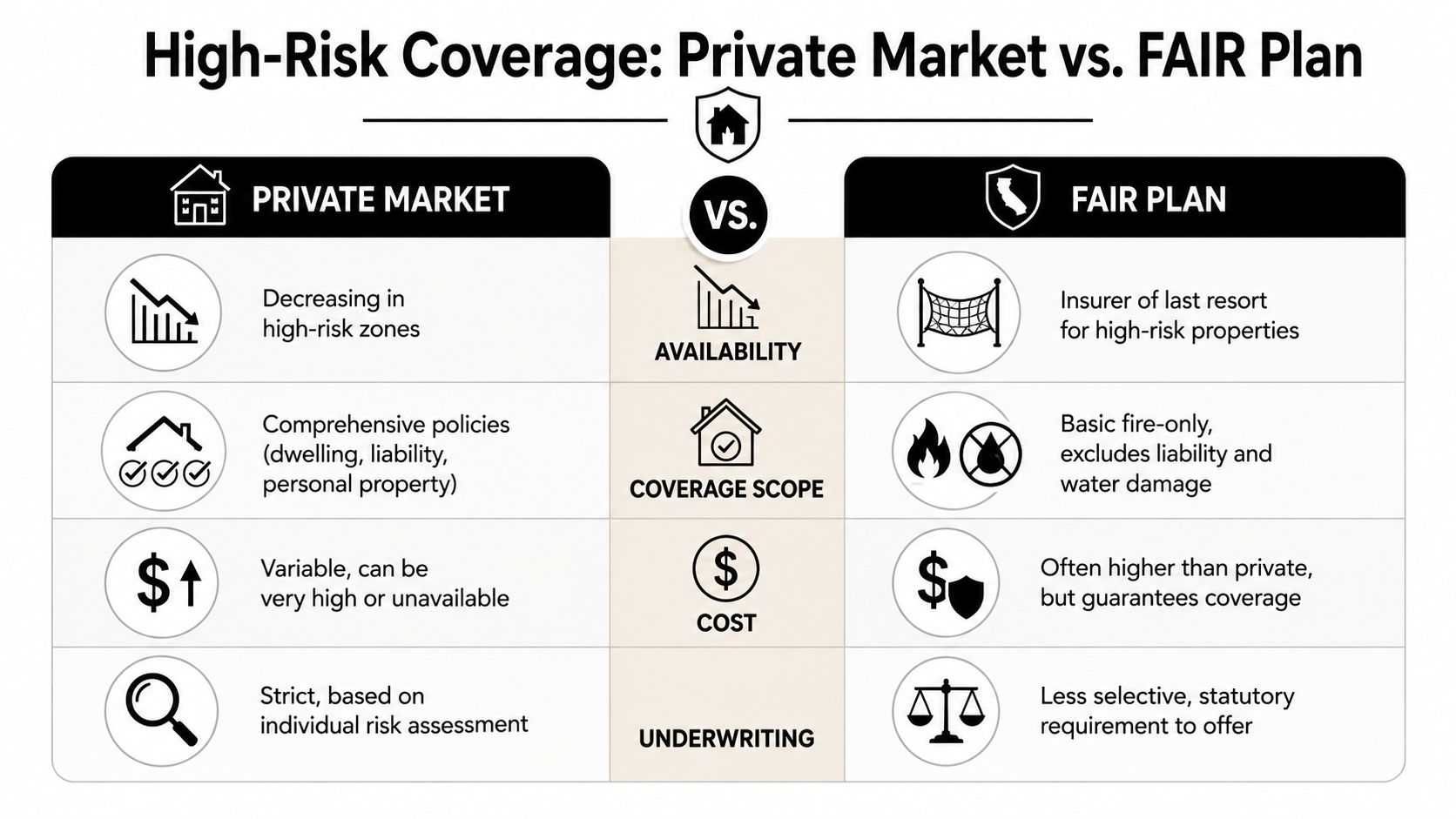
California does have a backstop. It is the California FAIR Plan, and it exists for homeowners who cannot get fire coverage through the voluntary market. But a FAIR Plan policy usually does not mirror the policy you had before. It is closer to a safety net than a full replacement.
What the FAIR Plan is and isn't
The Bankrate explanation of the California FAIR Plan says the FAIR Plan generally covers named perils such as fire, lightning, internal explosion, and smoke, pays at actual cash value, and does not include liability coverage.
For a homeowner, that difference matters immediately. A standard homeowners policy often bundles property protection, liability coverage, and other features into one package. The FAIR Plan is narrower. It mainly addresses specific property risks, especially fire-related ones, and leaves other parts of your protection unfinished.
A simple way to view it is this: a standard homeowners policy is more like a fully furnished toolkit. The FAIR Plan is one of the most important tools in that box, but not the whole box.
Standard policy versus FAIR Plan
This side-by-side view makes the gap easier to see:
| Coverage question | Standard homeowners policy | FAIR Plan |
|---|---|---|
| Fire protection | Usually included | Included |
| Liability protection | Usually included | Not included |
| Broad package design | Yes | No |
| Claims valuation approach | Varies by policy terms | Generally actual cash value |
| Need for extra policy layers | Sometimes | Often |
That last row is the practical takeaway.
For many homeowners in wildfire-prone areas, coverage becomes a layered plan. The FAIR Plan may supply basic fire and dwelling protection, while a second policy or endorsement is used to add liability coverage and, in some cases, broader property protection. If you are used to buying one policy from one company, this can feel awkward at first. It is more like patching together winter gear for a storm. One coat may keep out the wind, but you still need gloves and boots.
Why the FAIR Plan matters more now
The California Department of Insurance FAIR Plan market fact sheet shows that FAIR Plan use has grown sharply in recent years, and the same fact sheet describes a major increase in written premium and exposure. That growth reflects a broader market shift. More homeowners who once could buy standard coverage are being pushed toward fallback options.
This is why the FAIR Plan matters beyond the question of "Can I get any policy at all?" It also raises a second question. "What gaps will I need to fill after I get it?"
What homeowners often miss in high-risk areas
Homeowners dealing with wildfire underwriting problems often need to check more than one path at the same time:
- FAIR Plan coverage: Basic fire-focused protection when admitted insurers decline the risk.
- Surplus lines options: In some cases, these may offer alternatives for homeowners who cannot find the coverage they want in the standard market.
- Supplemental liability or broader property protection: Often needed because FAIR Plan coverage is narrower than a standard homeowners package.
California law can help you get access to some form of coverage, but it does not promise a duplicate of your old policy after private insurers pull back. That is the key point to remember. If you live in a high-risk area, your job may shift from finding one replacement policy to building a workable insurance setup to cover the biggest gaps before the next fire season begins.
After Disaster Strikes Claims and Rebuilding Laws
After a declared emergency, the most important insurance question changes. It's no longer “How much is the premium?” It becomes “What does the law require the insurer to do right now?”
California gives homeowners several post-disaster protections that directly affect cash flow, temporary housing, and rebuilding timelines.
Immediate living expense protections
The NAMIC summary of California homeowner protections after declared emergencies states that insurers must pay at least two weeks of additional living expense benefits to evacuees, must advance at least four months of ALE without an itemized inventory, and must give homeowners up to three years to rebuild.
That matters because displaced families often need money before they can produce perfect paperwork. California's rule recognizes that disaster claims unfold in chaos, not in neat folders.
A practical post-disaster checklist
When a covered loss follows a state-declared emergency, homeowners should pay attention to these rights:
- Temporary housing support: ALE benefits must start quickly for evacuees.
- Advance payments: An insurer must advance at least four months of ALE without demanding a full itemized inventory first.
- Rebuilding time: The homeowner has up to three years to rebuild.
- Premium breathing room: The same legal framework includes a 60-day premium grace period in the affected area, according to the same NAMIC summary.
- Coverage adequacy rules: Insurers must provide updated dwelling replacement-cost estimates every two years and at least 10% additional building-code upgrade coverage, also noted in that source.
Why these rules matter in real life
Disaster claims usually break down in three places. Families need housing immediately. Rebuilding takes longer than expected. Local code requirements add costs the original house didn't have when it was first built.
California's rules address all three. They create minimum cash-flow protections for displacement, a longer rebuilding runway, and some required support for code upgrades.
A homeowner shouldn't assume the claim is only about the structure. The claim is also about time, habitability, and whether the policy can keep the household functioning during recovery.
The practical takeaway is that policy comparison in California shouldn't stop at premium. Post-loss usability matters. A policy that looks acceptable on paper may feel very different when a family needs living-expense advances, time to rebuild, and enough protection for code-related work.
Finding Compliant Coverage in a Tough Market
A common California problem looks like this. A homeowner gets a nonrenewal notice, calls a few insurers, and learns that a single standard policy may no longer be available for that address. Instead, the workable solution may come in pieces.
That can feel strange at first, but it helps to treat home insurance like a system rather than one document. One policy may insure the structure against certain risks. Another policy may fill a gap such as liability or theft. In higher-risk areas, the question is often whether the coverage setup is complete, acceptable to the lender, and usable if a claim happens.
As noted earlier, California law does not promise that a departing private insurer will be replaced by another carrier offering the same package. In practice, some homeowners end up choosing between an admitted insurer, a surplus lines option, the FAIR Plan, or a combination of these.
What to evaluate before picking a policy
Start with the house and the policy structure. Price comes after that.
- Replacement cost fit: The dwelling limit should match what it would likely cost to repair or rebuild the home under current local conditions.
- Ordinance or law coverage: Rebuilding often triggers newer code requirements. This coverage helps with those added costs.
- Liability protection: If the FAIR Plan is part of the solution, check whether liability coverage must be added through a separate policy.
- Lender acceptance: The coverage arrangement still has to satisfy the mortgage servicer, especially if the policy is layered.
Why comparison gets harder, and more important
In a tight market, the hard part is not just finding a quote. The hard part is confirming that the quote solves the actual problem. A low premium does not help much if the policy leaves out liability, fails lender review, or covers fewer perils than the homeowner assumed.
Layered coverage works like using more than one lock on a door. Each lock serves a purpose, but the door is only protected if all the pieces are in place and working together. That is why side by side comparison matters more in California than in a simpler market.
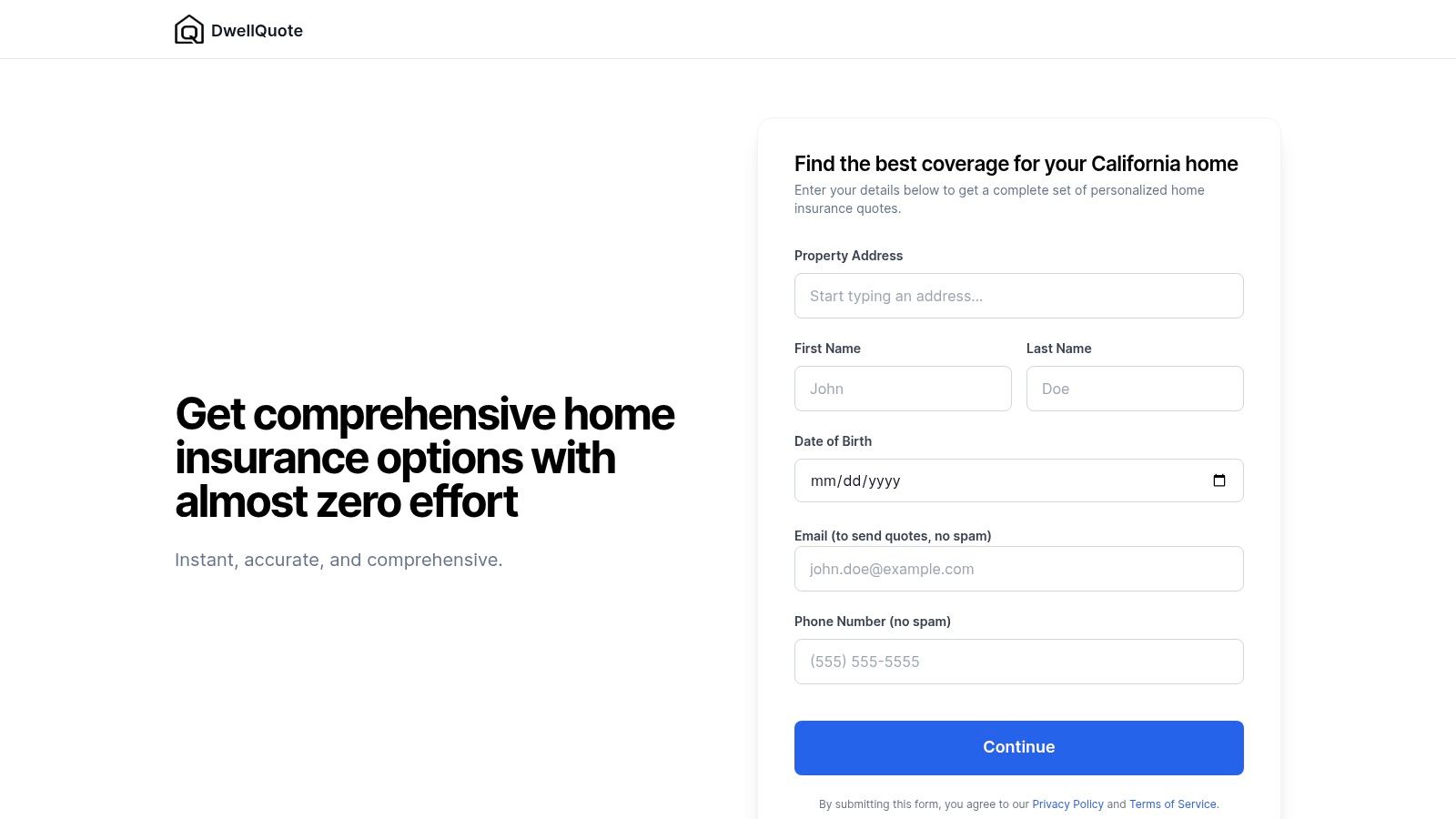
One practical option is DwellQuote, which collects a property address, prefills available property data, and returns California home insurance quote options for available carriers. That can help a homeowner review different policy structures in one place instead of piecing them together through separate calls.
A simple decision framework
A useful quote review usually answers four questions:
- Does this policy structure match the home's actual risk?
- Is any major protection missing, especially liability or common non-fire coverage?
- Will the lender accept the arrangement without delays or added conditions?
- If private market choices are limited, which combination of policies creates the most workable fit for this property?
The goal is to secure coverage that functions effectively during a claim, refinance, or renewal challenge.
Your Next Step Get Clarity on Your Coverage Options
California home insurance laws create a market that can feel confusing even for careful homeowners. A house may not be legally required to carry insurance under state ownership law, but the mortgage process usually makes coverage unavoidable. Rate changes run through a regulated system. Nonrenewals can raise detailed rights questions. And in high-risk areas, the replacement for a lost policy may be narrower and more layered than expected.
That complexity doesn't mean a homeowner is powerless. It means the decision has to be made with clearer information. The right next step is to compare real options for the specific property, review whether the structure of coverage is complete, and check that any lender requirements can still be met.
A homeowner who is worried about renewal, buying a first home, or replacing lost coverage should request a home insurance quote through a comparison platform built for California so the available options are visible before a deadline creates pressure.
Request a California home insurance quote through DwellQuote to see available coverage options for a specific address, compare policy structures side by side, and get clarity before closing, renewal, or nonrenewal deadlines force a rushed decision.