

A healthy 30-year-old can usually get a $1 million, 20-year term policy for roughly $24 to $49 per month, while the same face amount in whole life is typically $700 to $1,115 per month. That gap is the core story behind the cost of a million dollar life insurance policy, because policy type drives the bill more than the headline coverage amount does.
The popular advice sounds simple, buy a million-dollar policy and it's cheap. That advice only works for a narrow buyer profile, young, healthy, nonsmoking, and choosing term coverage. Once age, policy structure, and underwriting class change, the quote changes fast.
Table of Contents
- Why Advertised Life Insurance Quotes Mislead Most Buyers
- Term vs Whole Life Premium Comparison for $1 Million Coverage
- Sample Quotes by Age and Term Length
- Key Factors That Drive Your Premium Up or Down
- Proven Strategies to Lower Your Life Insurance Premium
- How to Shop for and Compare Million Dollar Policy Quotes
- Your Action Plan for Securing the Right Coverage
Why Advertised Life Insurance Quotes Mislead Most Buyers
The cheapest million-dollar life insurance quote is usually built for a very specific buyer, a young, healthy, nonsmoking person buying term coverage. That's why a headline price can look almost absurdly low, then jump hard once the applicant is older or the policy shifts from term to permanent coverage. A quote without context is not a quote you can plan around.
The market examples prove the point. For a 20-year, $1 million term policy, MoneyGeek's analysis put the average at $86 per month for 40-year-old women and $109 per month for 40-year-old men, while Forbes Advisor reported $41 and $49 per month for the same age and term length, which shows how underwriting assumptions and insurer mix can move the number materially. WSJ's Buy Side summary said a 30-year-old can average about $30 per month for women and $37 per month for men for the same coverage, which is why young buyers see the cheapest ads first. MoneyGeek's million-dollar policy analysis
Practical rule: never compare a quote until the policy type, term length, age, and health class are all visible on the page.
What to check first
A smart buyer should scan four details before reacting to a low premium. First, confirm whether the quote is for term or whole life. Second, check the term length. Third, verify the age used in the illustration. Fourth, see whether the quote assumes a preferred or standard health class.
The “cheap” quote often disappears the moment a buyer leaves the narrowest underwriting lane. Guardian Life's million-dollar policy examples make that clear, since the low-end numbers people talk about usually assume a young, healthy term buyer rather than the average applicant. Guardian Life's million-dollar policy guide
The right mindset is blunt. A million-dollar policy is not one product with one price. It's a pricing range that changes with the buyer's age, health, and policy structure.
Term vs Whole Life Premium Comparison for $1 Million Coverage
Term and whole life are not close substitutes on price. Term coverage mostly pays for mortality risk during a fixed period, while whole life also funds a cash-value reserve and lifelong coverage. That difference is why the premium gap is so large for the same $1 million face amount.
Aflac's rate table is the cleanest way to see the spread. A healthy 30-year-old woman can pay about $54 per month for a 20-year, $1 million term policy, while a healthy 40-year-old woman is at about $545 per month. For men, the same source shows $67 per month at age 30 and $771 per month at age 40 for the same term structure. On the whole life side, the same $1 million policy is about $783 per month for women at age 30, $815 per month for men at age 30, and rises to $1,065 and $1,115 per month at age 40. Aflac's rate table
Whole life isn't “bad.” It's expensive because it's doing more. Buyers should not expect permanent coverage to price anywhere near term.
The WSJ's Buy Side summary reinforces the scale of the gap, noting that a healthy, nonsmoking 30-year-old can buy $1 million of 20-year term coverage for roughly $24 to $49 per month, while the same coverage in whole life is typically around $700 to $1,115 per month at age 30 and about $1,065 to $1,335 per month at age 40. That's why permanent coverage commonly costs roughly 20x to 30x more per month than term for the same face amount. WSJ Buy Side summary
| Policy Type | Age 30 Women | Age 30 Men | Age 40 Women | Age 40 Men |
|---|---|---|---|---|
| Term, 20 years | $54/month | $67/month | $545/month | $771/month |
| Whole life | $783/month | $815/month | $1,065/month | $1,115/month |
The decision comes down to purpose. If the goal is to protect income during working years, term is usually the sensible buy. If the goal is permanent coverage and cash-value accumulation, whole life serves a different job, but it should be purchased with eyes open because the premium is radically higher.
Sample Quotes by Age and Term Length
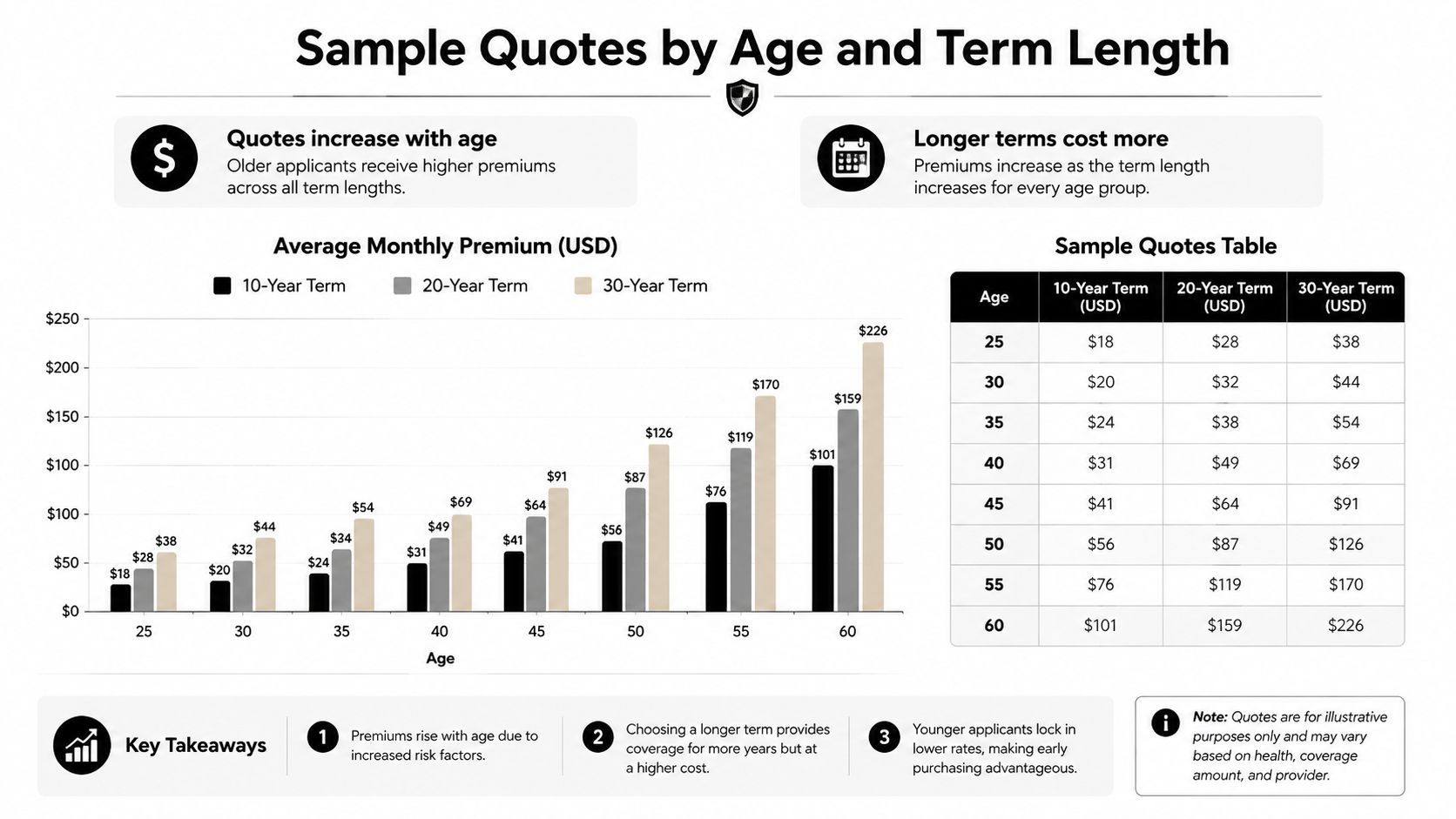
The cheapest million-dollar quotes usually come from a narrow profile, young, healthy, nonsmoking buyers choosing term coverage. That is the quote people see advertised. It is not the quote most applicants receive.
For a healthy, non-smoking 30-year-old, USA Today's Blueprint coverage example shows a $1 million policy with a 10-year term costs about $306 per year, while a 20-year term costs about $482 per year. USA Today's Blueprint coverage example
That gap is real money. Extending the term from 10 to 20 years adds about $176 per year even when the applicant profile stays the same. Buyers who need coverage through a mortgage payoff, child-rearing period, or income replacement window pay more because they are buying more years of guaranteed protection.
How age changes the quote curve
Age pushes the premium up fast, and waiting is expensive. The charted pricing pattern shows that a healthy woman in a 20-year, $1 million term policy moves from $54 per month at age 30 to $545 per month at age 60, while a healthy man moves from $67 per month to $771 per month over the same ages. That is not a small adjustment.
| Age | 10-Year Term Monthly | 20-Year Term Women Monthly | 20-Year Term Men Monthly |
|---|---|---|---|
| 30 | $306/year | $54/month | $67/month |
| 40 | not provided | $545/month | $771/month |
| 60 | not provided | $545/month | $771/month |
The table mixes annual and monthly figures because that is how the verified pricing examples are reported. The direction is what matters. Buying earlier is cheaper, and longer terms cost more because the insurer is taking on a bigger stretch of risk. If you know you need coverage for 20 years, do not compare that need against a 10-year quote and call it the same product.
Bottom line: a low monthly quote only stays low when the buyer is young, healthy, and picking a short term. Stretch any of those variables, and the price moves up quickly.
Key Factors That Drive Your Premium Up or Down
Age and policy type set the frame, but underwriting decides the actual quote. Insurers sort applicants by health classification, smoking status, occupation, hobbies, family medical history, and body composition, then price the policy around that risk. Two people the same age can still land in very different premium buckets.
Health class matters because insurers price expected risk
The usual ladder runs from preferred plus to preferred, standard, and substandard. Better health classes get the cheapest pricing because the insurer expects fewer claims over the policy term. A lower class does the opposite, and the premium rises to offset the added risk.
Smoking status is one of the clearest dividing lines. Tobacco use usually pushes a buyer into a more expensive class because nicotine use changes expected mortality risk. Occupation and hobbies work the same way, just through different channels. A person with a risky job or hazardous hobby gives the insurer less comfort than someone with a low-risk desk role and routine lifestyle.
Family medical history and body mass index also matter. Those factors help an underwriter estimate how likely a future health event is, which is why the final quote can move even when the face amount stays fixed. The policyholder can't change family history, but a healthier profile can still improve pricing if the insurer sees better current risk.
Why different insurers quote different numbers
One carrier may be stricter on a health issue, another may be more forgiving on a hobby or occupation. That's why shopping only one company is a mistake. The quoted rate reflects not just the buyer, but the insurer's own risk model and appetite.
A healthy 30-year-old who gets a good class at one carrier and a weaker class at another can see a meaningful spread, even before comparing term length or policy type. The smart move is to treat underwriting as a market, not a fixed price list.
Proven Strategies to Lower Your Life Insurance Premium
The cheapest cost of a million dollar life insurance policy usually goes to the buyer who fits a narrow profile, young, healthy, and applying for term coverage. Everyone else pays more, sometimes a lot more. If you want the lowest quote you can realistically get, start by improving the parts of your profile that insurers reward.
Start with the highest-return moves
- Shop multiple carriers: Insurers do not price the same applicant the same way, so a few quotes can reveal a better offer for identical coverage.
- Improve your health class before applying: Better blood pressure, lower weight, and cleaner lab results can move you into a stronger rating and lower the premium.
- Choose the shortest term that fits the need: A 10-year policy costs less than a 20-year policy for the same buyer. A longer term should only be used when the household needs that extra protection window.
- Use annual billing when available: Monthly billing is often priced less favorably than paying once a year, so annual payment can be the better deal if your cash flow allows it.
Timing matters more than buyers expect. If you are close to a better health class after a checkup, weight loss, or quitting tobacco, wait until the profile improves before applying. That single decision can change the rate for the full policy term.
Don't buy more coverage than the household needs just because the monthly quote looks manageable. Over-insuring is still overpaying.
Medical exam policies deserve a close look when the buyer is healthy and wants the best pricing. No-exam policies are faster, but speed usually comes with weaker pricing because the insurer has less information to work with. Buyers who can handle the exam often get the cleaner offer.
How to Shop for and Compare Million Dollar Policy Quotes
Good shopping starts with one number, the amount of coverage the household needs. That number should reflect income replacement, debts, children's needs, and the time period those obligations will exist, not a vague fear of “not enough insurance.”
A clean comparison process
- Define the purpose. A policy should match a real financial obligation, not an arbitrary headline amount.
- Gather accurate personal details. Age, height, weight, nicotine use, medical history, and job details all affect the quote.
- Request multiple quotes. More than one carrier is necessary because underwriting models differ.
- Compare like with like. Check term length, health class, and policy type on every quote.
- Read the fine print. A low premium means little if the policy has features the buyer doesn't need, or exclusions that weaken the protection.
The best quote is not always the lowest monthly number. It is the quote that matches the same coverage period, the same underwriting assumptions, and the same policy structure. An online estimate can be useful, but a fully underwritten offer is what matters when the policy is being bound.
Use quotes as decision tools, not trophies
A quote should answer one question, how much does this specific coverage cost for this specific buyer under these specific conditions. If the answer arrives without those conditions, it's marketing, not pricing.
For homeowners who are reviewing broader protection needs at the same time, it also makes sense to coordinate life coverage with property coverage instead of treating every policy as a separate scramble. A clean quote process saves time and avoids duplicate coverage choices.
Your Action Plan for Securing the Right Coverage
The right move is simple. Buy term if the goal is income protection during a defined window. Consider whole life only if the buyer needs lifelong coverage and accepts the much higher monthly cost. For most first-time buyers, term is the practical choice because it keeps the premium manageable and the coverage goal clear.
A disciplined buyer should follow three priorities. First, calculate the actual coverage need. Second, shop at least three carriers on the same terms. Third, improve any modifiable health factor before applying if the timing is on the buyer's side. Waiting too long is expensive, because age pushes the premium up fast.
Locking in coverage while young and healthy is the cleanest way to control cost. Once the policy is in force, the buyer can stop worrying about the market and keep the protection in place for the term that matters.
DwellQuote helps California homeowners compare insurance options quickly and clearly when protection decisions need to be made without wasting time. If you're reviewing life coverage alongside your home protection, visit DwellQuote to request a home insurance quote and keep your financial safety net organized in one place.