

Yes, homeowners insurance usually does cover theft, and theft-related losses are part of standard coverage rather than a niche add-on. But the amount a homeowner gets depends on the policy's personal property limit, any sub-limits, and the deductible, especially since standard policies often set personal property protection at about 50% to 75% of the home's insured value.
That matters because the moment after a break-in feels chaotic. A back door is splintered, a laptop is gone, drawers are dumped out, and the first question is simple: does homeowners insurance cover theft, or is this about to become an out-of-pocket loss?
For most homeowners, the answer is reassuringly straightforward. Theft is commonly built into a standard policy. The confusing part is what counts as damage to the house, what counts as stolen belongings, what happens if the theft happened away from home, and why two people with “theft coverage” can receive very different claim payments.
A first-time homebuyer doesn't need to become an insurance adjuster overnight. It helps to think of a homeowners policy as a set of separate money buckets, each with its own job. Once that clicks, the fine print becomes much easier to understand.
Table of Contents
- Your Home Was Burglarized Now What
- How Home Insurance Responds to a Theft
- Understanding Your Payout Limits and Deductibles
- Common Exclusions and Coverage Pitfalls
- How to Document and File a Successful Theft Claim
- Protecting High-Value Items with Special Coverage
- Shopping for Theft Coverage in California
Your Home Was Burglarized Now What
You open the front door after work, and something feels off. The deadbolt is splintered. A drawer is open. Your laptop and jewelry box are gone. In that moment, the insurance question is not abstract anymore. You need to know what to do first, and what mistakes could make a claim harder later.
A standard homeowners policy often covers theft, but the first few hours after a burglary matter more than many first-time buyers expect. Insurance works a lot like a reimbursement process with rules, not an instant cash replacement service. If you skip steps, throw away damaged items too soon, or fail to document what was taken, you can make a valid claim harder to prove.
Start with safety.
If there is any chance someone is still inside or nearby, leave and call 911. Once police say the home is secure, your next job is to preserve the scene and create a paper trail. A burglary claim is easier to handle when the timeline is clear from the beginning.
A practical response order helps:
- Make sure everyone is safe. Do not search the house if you suspect the intruder may still be there.
- Call the police. Ask how to get a copy of the report or report number for your insurer.
- Take photos and video before cleaning up. Capture broken locks, damaged doors, disturbed rooms, and any empty spaces where items were kept.
- Stop additional loss. Board up a window, replace a lock, or secure a garage door so the home is not exposed to another break-in.
- Start a missing-items list right away. Include brand names, model numbers, purchase dates, receipts, photos, and serial numbers if you have them.
- Notify your insurance company promptly. Early notice helps start the claim and lets the adjuster explain what documents they will want.
Many homeowners focus first on the forced entry. That makes sense because it is visible. The harder part of many theft claims is proving the personal property loss. A broken door is easy to photograph. A stolen watch, camera, or cash gift from three years ago is harder to document unless you have records.
A grocery receipt analogy helps here. If you leave the store and later realize a bag is missing, the store can respond more easily when you still have the receipt and know what was in the bag. Insurance claims work the same way. The clearer your list, the fewer disputes you are likely to have about what existed, what it cost, and what the insurer owes.
Do not assume every stolen item will be paid in full. Policies often have category limits, off-premises limits, and settlement rules that affect the final check. Those details come later, but they shape what you should gather now. If a wedding ring, firearm, collectible, or laptop was taken, flag it early because those items often get closer review.
If you live in California, this is also a useful reminder for your next policy review. Two policies can both say they cover theft but handle payout rules very differently in practice. Comparing those differences side by side through DwellQuote can help you spot limits and settlement terms that are easy to miss before a loss happens.
How Home Insurance Responds to a Theft
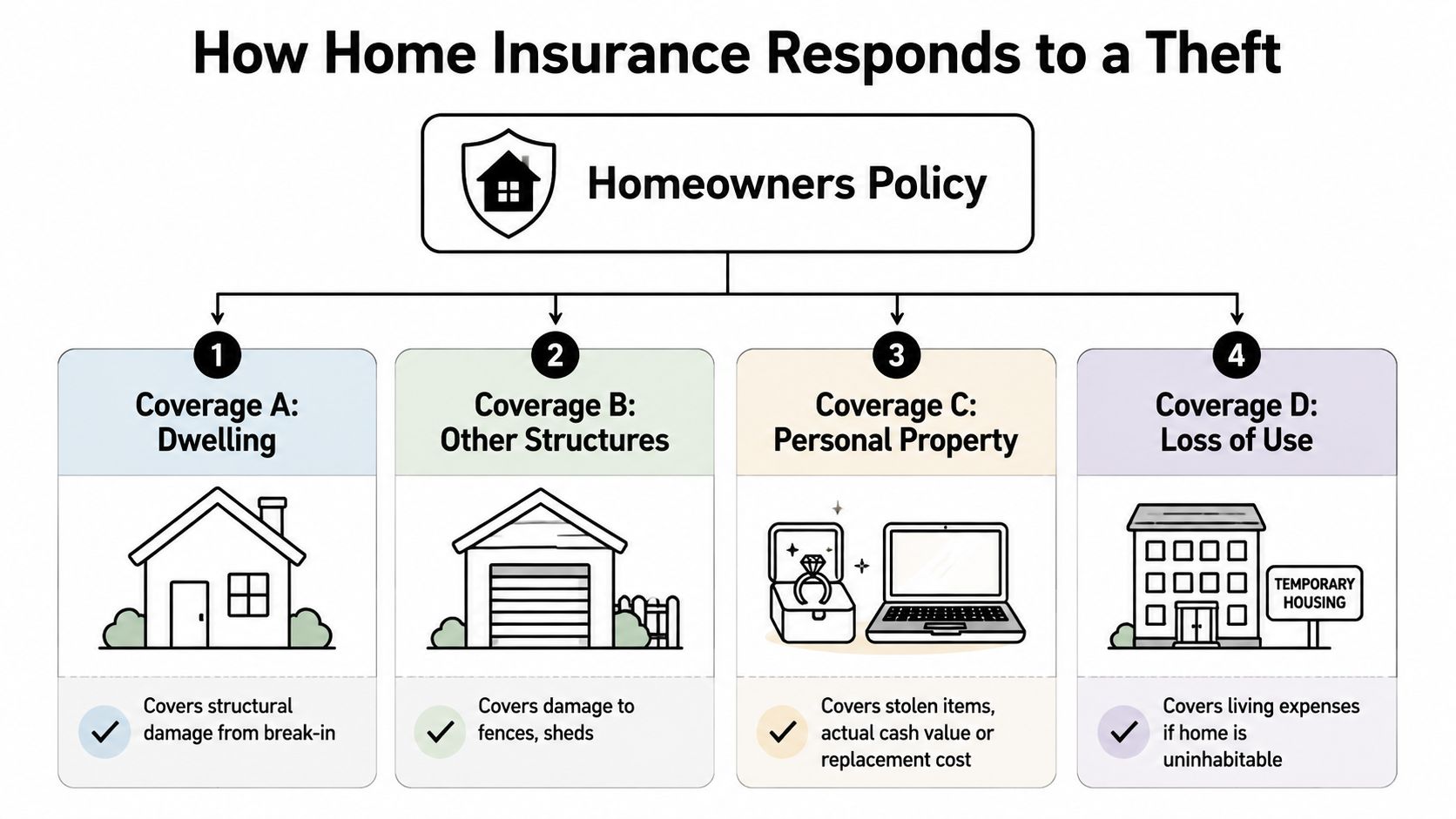
Homeowners insurance responds to theft by splitting the loss into different coverage buckets. That's the easiest way to understand it.
The policy has separate buckets
A standard policy usually covers theft through personal property coverage, also called Coverage C, while dwelling coverage and other structures coverage may pay for the physical damage caused during the break-in. The Kin explanation of theft coverage buckets puts it plainly: a stolen TV and a broken door aren't handled the same way.
A useful analogy is a kitchen sink with separate labeled containers underneath. One container is for the house itself. Another is for detached structures like a shed or fence. Another is for belongings. Water from the same leak may reach all three, but each container has its own capacity. Theft claims work the same way.
If someone kicks in the front door and steals a laptop from the living room, the door repair usually falls under the part of the policy that covers damage to the structure. The laptop usually falls under personal property coverage.
Burglary and theft are related but not identical
People often use burglary and theft interchangeably, and in everyday conversation that's fine. In claim terms, the distinction matters less than many buyers think. What matters more is what was damaged, what was taken, and where the loss happened.
A break-in can trigger multiple parts of coverage at once:
- Damage to the main house: A smashed window, broken lock, or damaged wall may fall under dwelling coverage.
- Damage to detached property: A forced-open shed or damaged detached garage may involve other structures coverage.
- Missing belongings: Electronics, clothing, kitchenware, furniture, and similar items are usually handled through personal property coverage.
- Temporary living costs: If the damage is severe enough to make the home uninhabitable, loss of use coverage may come into play, depending on the policy terms.
A homeowners policy isn't one pile of money. It's a set of compartments, and the claim outcome depends on which compartment the loss belongs to.
That's why two losses from the same burglary can produce different reimbursement results. The broken sliding door might be fully addressed under one coverage part, while the stolen contents payment could run into a deductible, a lower limit, or an actual-cash-value settlement.
This is also why a homeowner shouldn't stop reading after seeing “theft covered” on a declarations page. The word covered is only the starting point. The essential question is how each part of the loss is categorized.
Understanding Your Payout Limits and Deductibles
A theft claim can feel straightforward until the payout math starts. That is usually the moment a homeowner realizes that "covered" does not mean "fully reimbursed for every dollar lost."
Start with the personal property limit. This is the maximum available for stolen belongings under that part of the policy. Many homeowners discover this limit is a percentage of the dwelling amount, not a custom tally of everything they own. So if your house is insured for one number, your belongings may be insured for a smaller, related number.
The deductible works like the amount you agree to absorb before the insurance money begins. Progressive's overview of theft claim settlement explains that covered theft losses are generally paid up to the policy limit, minus the deductible. If $6,000 of property is stolen and your deductible is $1,500, the claim does not start at $6,000. It starts at $4,500, assuming no other limit changes the result.
Two homeowners can suffer similar burglaries and receive very different checks.
One reason is the settlement method for personal property. Some policies pay actual cash value (ACV). Others offer replacement cost value (RCV) for contents. That difference is easy to miss when comparing quotes, but it changes what the coverage is worth in real life.
ACV works like the resale value of your item right before it was stolen. RCV works more like the cost to buy a new version of a similar item today, subject to the policy terms. A three-year-old laptop, an older sofa, or a used television may be expensive to replace, but ACV can reduce the payment because the insurer factors in age and wear.
| Feature | Actual Cash Value (ACV) | Replacement Cost (RCV) |
|---|---|---|
| How value is measured | Depreciated value at the time of loss | Cost to replace with a new similar item |
| Effect of age and wear | Lowers the payment | Does not reduce the replacement amount in the same way, subject to policy terms |
| Likely result for older items | Lower reimbursement | Higher reimbursement |
| Why it matters after theft | You may need more out-of-pocket money to replace what was stolen | You are closer to the cost of buying replacements now |
A simple example shows why this matters. If a burglar steals a five-year-old TV, ACV asks what that used TV was worth on the day it disappeared. RCV asks what it costs to buy a comparable new TV now. Same loss. Different payout logic.
There is another limit many buyers miss until claim time. Sub-limits can apply to specific categories of property, even if your overall personal property limit looks generous. Jewelry, watches, firearms, cash, silverware, and certain collectibles often have tighter caps for theft. You might have plenty of total contents coverage on paper and still run into a much smaller limit for one category of stolen items.
For a first-time buyer, the easiest way to read this is to treat the policy like a bucket with smaller cups inside it. The bucket is your overall contents limit. Some belongings, especially high-value or easily stolen items, may only fit into a much smaller cup.
That is why a smart policy review in California should look at four numbers together: your personal property limit, your deductible, your settlement method for contents, and any category sub-limits. Looking at only the premium can hide expensive gaps.
This is also where comparing policies side by side helps. If you are shopping in California, DwellQuote can help you compare these differences across quotes so you can see whether a lower premium comes with ACV contents, a higher deductible, or tighter theft limits that may matter more than the price difference.
Common Exclusions and Coverage Pitfalls
The phrase “covered anywhere in the world” sounds broad, but theft coverage has practical limits that many buyers miss.
Off-premises theft catches many owners by surprise
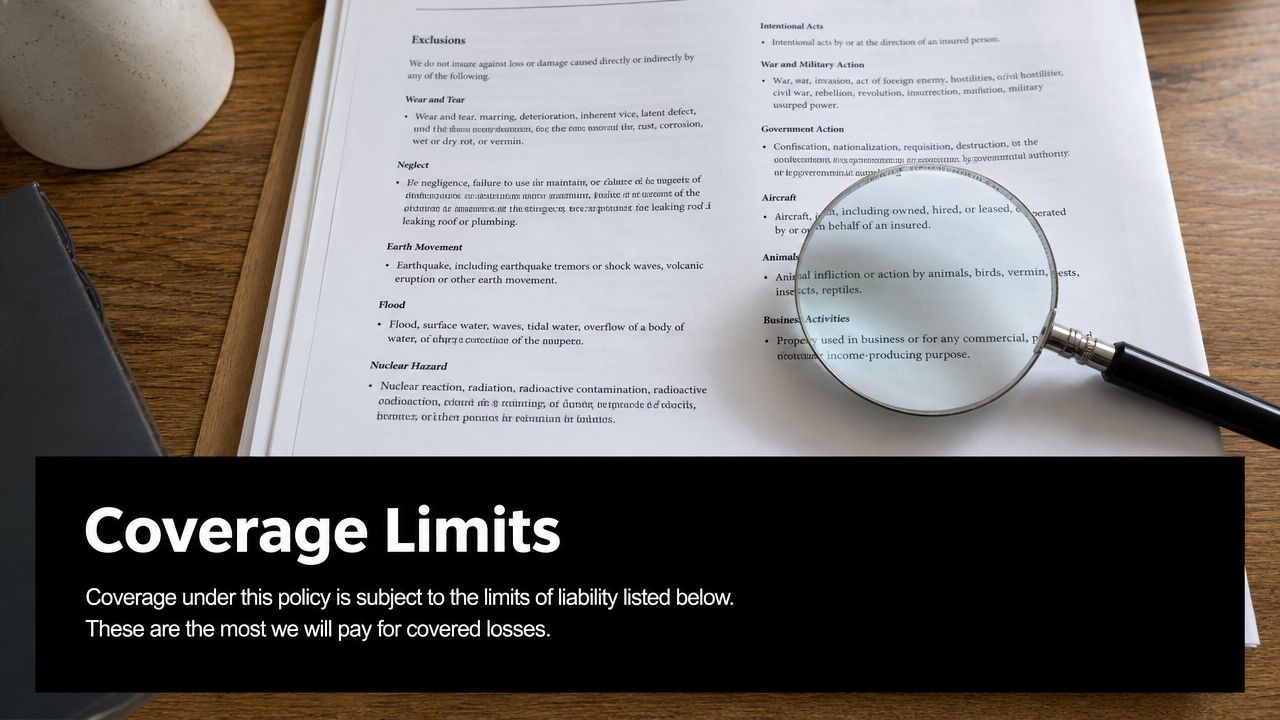
Many policies extend some protection to belongings stolen away from the residence, but that protection is often much smaller than people expect. The Travelers explanation of off-premises theft limits notes that many policies limit off-premises theft coverage to 10% of the total personal property limit. For a homeowner with $200,000 in personal property coverage, that could mean only $20,000 for items stolen from a car, storage unit, or vacation rental.
That can create a mismatch between expectation and reality. A homeowner may assume the same coverage follows belongings everywhere at the same level. In practice, the policy may place a much smaller cap on losses that happen away from home.
A few common off-premises examples include:
- Car theft losses: Items taken from a parked car may be covered, but only up to the off-premises limit.
- Storage unit losses: Coverage may exist, yet the lower cap can leave expensive belongings underinsured.
- Travel theft: Luggage, laptops, cameras, or jewelry stolen at a hotel may still run into the smaller limit.
Small print that deserves a close read
Off-premises limits aren't the only place where homeowners get tripped up. Policies may also contain special category limits, eligibility conditions, and exclusions that narrow the practical value of theft coverage.
Common trouble spots include:
- High-value categories: Jewelry, collectibles, fine art, and similar items may have special limits that are lower than the overall personal property limit.
- Theft by someone in the household: Some policies treat this differently from theft by an outside burglar.
- Vacancy issues: If a home sits vacant for an extended period, coverage terms may change.
- Proof problems: A homeowner may know an item existed, but the insurer still needs enough evidence to verify ownership and value.
The important takeaway isn't that theft coverage is weak. It's that theft coverage is structured. A policy can absolutely cover the event while still limiting what gets paid, where it gets paid, and how much evidence the insurer expects.
How to Document and File a Successful Theft Claim
Theft claims often turn on paperwork. Not because insurers are trying to be difficult, but because they need to confirm what existed, what was taken, and what the policy owes.
What to do first
The Allstate guide to theft claim documentation emphasizes that proof of ownership matters, and that a pre-existing home inventory with receipts and photos can help prevent disputes.
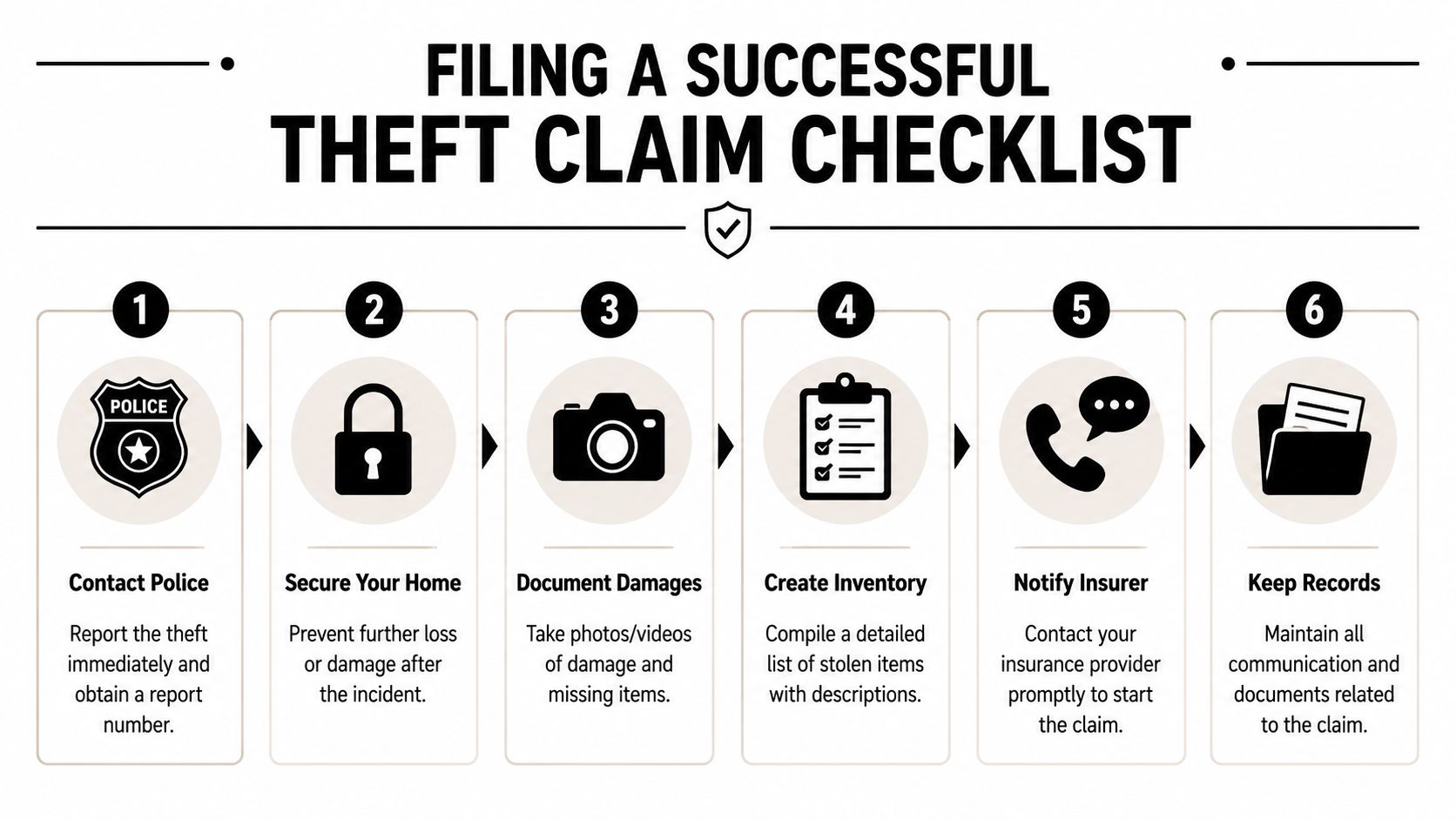
After discovering a theft, a clean sequence helps:
- Call police and get a report number. The insurer will usually ask for it.
- Secure the home. Replace locks, board broken openings, and prevent additional loss.
- Take photos and video. Capture damage, entry points, disturbed rooms, and empty spaces where items were kept.
- Notify the insurer promptly. Early notice helps start the claim process and preserves details while they're fresh.
A homeowner doesn't need a perfect inventory on day one. The goal is to build the file methodically and avoid guessing.
What makes a claim easier to prove
The strongest theft claims usually have documentation that existed before the loss. A receipt in an email folder, a product box with a serial number, a phone photo of a room, or a saved appraisal can all help.
Useful documentation includes:
- Receipts and invoices: These support purchase date and price.
- Photos of belongings in the home: Family photos in the background often become useful evidence.
- Serial numbers and model numbers: These help prove identity for electronics, tools, and appliances.
- Credit card statements: These can support proof of purchase when a receipt is missing.
- Appraisals or prior valuations: These are especially helpful for expensive or unusual items.
Keep a running home inventory before there's ever a claim. A simple spreadsheet and a phone camera can do more work than most people realize.
When submitting the stolen items list, it helps to be specific. “Black laptop” is weak. “Apple MacBook Air, silver, purchased new, serial number on prior receipt” is much stronger. Insurers can usually evaluate a detailed claim more smoothly than a vague one.
One other point matters. Documentation doesn't only prove that an item existed. It also supports the value assigned to it. That becomes especially important when the policy uses actual cash value rather than replacement cost, because the valuation method directly affects reimbursement.
Protecting High-Value Items with Special Coverage
Standard theft coverage works well for many everyday belongings. It can fall short for the items people care about most.
When standard coverage may not be enough
A wedding ring, inherited watch, camera kit, or art piece can present a problem inside an otherwise solid homeowners policy. Even when theft is covered, a policy may apply category-specific limits or off-premises limits that leave expensive items only partially protected.
That risk gets bigger when the item regularly leaves the home. Jewelry worn daily, a bike stored outside the residence, or camera gear taken on trips may face the exact scenario where standard off-premises protection feels broad in theory but narrow in payout.
What scheduling changes
A common solution is to schedule high-value items. Scheduling means listing specific valuables separately so they have dedicated protection under an endorsement or similar coverage add-on.
The Hippo explanation of theft coverage away from home notes that standard policies often extend some protection off-premises, but that coverage is commonly limited to about 10% of personal property coverage. It also notes that scheduling high-value items provides dedicated protection that isn't subject to that lower cap.
For a homeowner, the logic is simple:
- Standard coverage is designed for the household as a whole.
- Scheduled coverage is designed for specific valuables that deserve their own lane.
- Dedicated protection is often the safer choice when one item would be painful or impossible to replace out of pocket.
Relying on base coverage for a high-value item is a little like parking a sports car under a carport and assuming it's the same as a locked garage. There is some protection, just not the kind most owners expect.
A buyer doesn't need to schedule every expensive possession. But anything unusually valuable, easy to steal, or hard to replace deserves a serious review.
Shopping for Theft Coverage in California
California buyers face a version of this question that's more practical than theoretical. A home may have a high insured value, significant personal property inside it, and multiple policy options that all say “theft covered” while handling reimbursement very differently.
What California buyers should compare closely
A smart comparison starts with a few plain-language checks:
- Contents settlement type: Is personal property settled on ACV or replacement-cost terms?
- Personal property limit: Does the limit fit the actual household, not just the lender requirement?
- Off-premises protection: If belongings are often in vehicles, storage, second residences, or on trips, what does the policy allow?
- Special limits for valuables: Are jewelry, collectibles, instruments, or electronics adequately protected?
- Deductible fit: Would the deductible make a smaller theft claim impractical?
California homeowners also benefit from reviewing property details early in the quote process. Better property verification can make policy comparisons more meaningful because it helps buyers see how limits and coverages line up before they purchase.
Why side-by-side comparison matters
A single quote can make theft coverage look simple. A comparison reveals where the actual differences are.
When buyers place policies side by side, important details stand out fast. One carrier may offer a stronger personal property setup. Another may define settlement terms differently. Another may be a better fit for a homeowner with valuables, travel-heavy habits, or a property profile that needs careful underwriting.
For a first-time homebuyer, this addresses whether homeowners insurance covers theft. Yes, usually. But the better question is whether the chosen policy would pay in a way that provides meaningful help after an incurred loss.
California homeowners who want to compare theft coverage clearly can request a home insurance quote through DwellQuote. DwellQuote helps buyers review options from multiple carriers, compare personal property limits and policy details side by side, and choose coverage that fits the home, the belongings inside it, and the realities of theft claims.