

A Pasadena homeowner with a 1912 Craftsman may think a standard homeowners policy has the property covered until a kitchen fire exposes the gap. The adjuster may price replacement with modern drywall and manufactured trim, while the owner expects original lath-and-plaster walls, old-growth redwood millwork, and period-accurate craftsmanship. The claim can be technically approved and still leave the homeowner unable to restore the house.
That problem defines home insurance for historic homes. Preservation rules, rare materials, specialist labor, wildfire exposure, seismic vulnerability, and outdated building systems all affect the amount and type of coverage required. The right policy isn't a larger version of ordinary home insurance. It needs valuation language, endorsements, documentation, and underwriting support built around the property's actual rebuilding obligations.
Table of Contents
- Why Historic Homes Need a Different Kind of Policy
- The Real Cost of Insuring Older and Landmark Properties
- Replacement Cost Versus Agreed Value and Functional Equivalence
- Essential Endorsements That Close Coverage Gaps
- Wildfire Risk and Seismic Considerations in California
- Documentation and Appraisal Checklist Before You Quote
- How to Get Accurate Quotes Fast with DwellQuote
Why Historic Homes Need a Different Kind of Policy
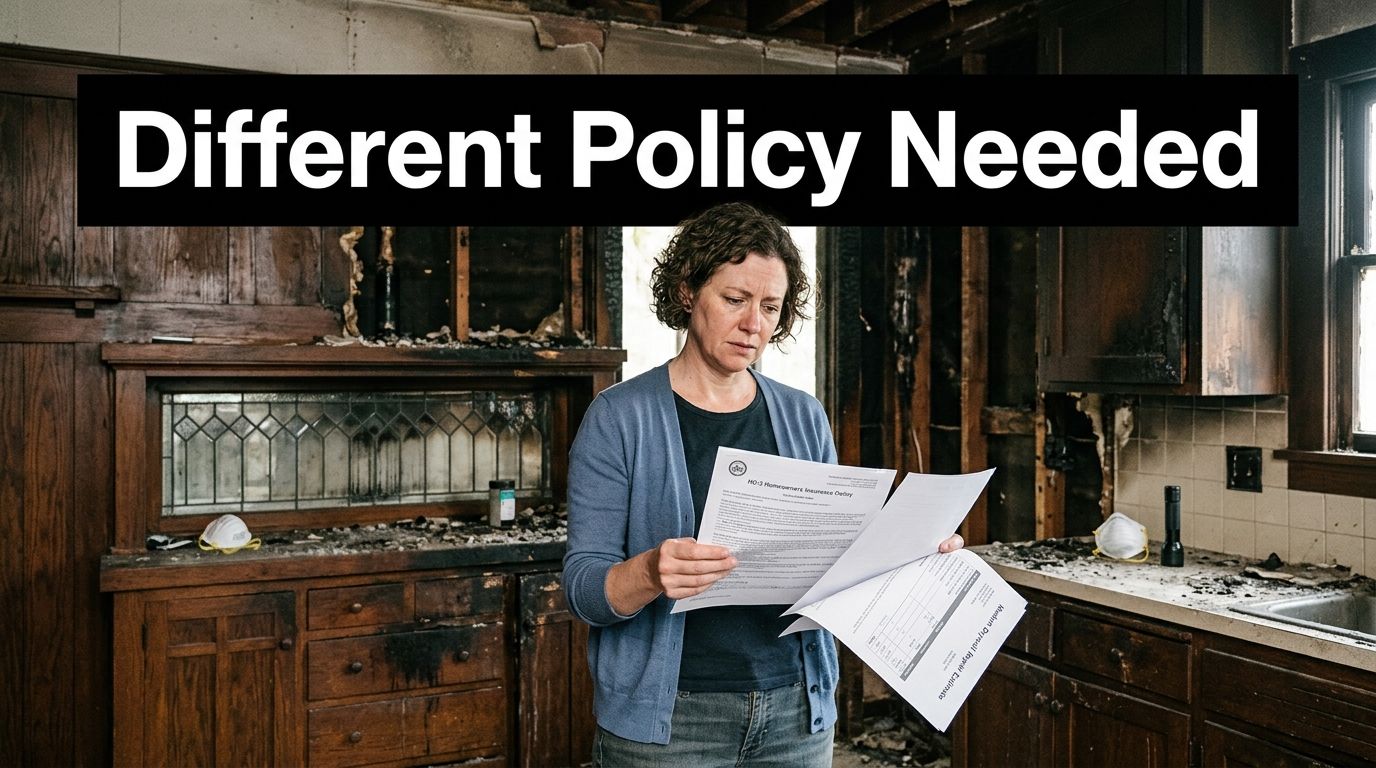
A kitchen fire in a California historic home can expose an insurance gap before the adjuster finishes inspecting the room. The carrier may approve repairs, yet price modern drywall, manufactured trim, and readily available materials. Preservation rules may require plaster, period millwork, specialty finishes, or approvals that cost far more than ordinary construction.
A standard policy is built around common residential methods. Historic properties create different obligations at claim time. Even a partial loss can require matching existing materials, preserving architectural details, and upgrading undamaged systems to current code.
In the Pasadena example, the dispute is not whether the kitchen burned. It is what “repair” means. Modern drywall can perform a similar function to plaster, and manufactured trim can resemble redwood millwork. Neither necessarily restores the home's character or satisfies preservation controls.
The partial-loss problem
Partial losses create the most misleading coverage gaps. A fire may affect one room, while the required work extends to wiring, plumbing, insulation, structural connections, or other systems that remain standing. Without sufficient ordinance-or-law coverage, those upgrades can exceed the basic dwelling limit. Consumer guidance on building-code compliance claims explains how code requirements after a partial loss can increase the final repair bill.
Original features create a second gap. Historic replacement cost should account for original-style materials and skilled craftsmanship instead of assuming modern substitutes are acceptable, as described in preservation guidance on insuring historic properties. Read the valuation wording closely. Confirm whether the policy pays for authentic restoration or only functionally equivalent construction.
What owners should expect from a proper policy
A sound program for a California historic home should address:
- The dwelling limit: Include specialist labor, period materials, demolition, debris removal, and preservation-related requirements.
- The valuation wording: State how the insurer will treat original materials and architectural features after a loss.
- The code gap: Set ordinance-or-law coverage high enough for upgrades to systems that remain intact.
- The risk profile: Disclose wildfire mitigation, roof condition, legacy wiring, foundation work, and earthquake exposure accurately.
- The evidence file: Keep photos, permits, appraisals, and inventories ready before a claim.
Practical rule: Coverage for a modern substitute may suit a non-designated older house. It can leave a landmark or preservation-controlled property short of the money required for a proper restoration.
The Real Cost of Insuring Older and Landmark Properties
Historic homes generally cost more to insure because the insurer isn't pricing only the structure's market value. The insurer is pricing the work required to repair or reproduce it. Specialist materials, skilled labor, longer reconstruction timelines, legal designation, and older building systems all influence expected claim severity and policy restrictions.
In the UK market, one comparison found an average annual premium of £547 for a period home, compared with £302 for a home built after 2000, a difference of about 81% or £245 per year, as reported in the period-home insurance comparison. A separate consumer analysis cited in the same source found average annual premiums of £347 for homes built before 1900 and £158 for new builds, meaning the older properties cost more than twice as much to insure.
Those figures aren't California quotes, but they illustrate the underwriting logic that California owners encounter. A carrier sees a more complicated reconstruction assignment, not just a higher-value residence.
Three cost drivers
| Cost Driver | Standard Home | Historic Home |
|---|---|---|
| Materials | Readily available modern products | Period-specific timber, masonry, plaster, tile, glass, and millwork |
| Labor | General residential contractors | Artisans and tradespeople with restoration experience |
| Regulation | Current construction standards | Current codes plus preservation or like-for-like requirements |
Material scarcity creates the first gap. Old-growth timber, custom-milled trim, historic masonry, slate, stained glass, and traditional plaster may require special sourcing or fabrication. The insurer must account for the possibility that a matching component won't be available through ordinary construction suppliers.
Labor specialization creates the second. A historic plaster wall, carved banister, or leaded-glass window may require a specialist rather than a general contractor. That distinction affects both the estimate and the time needed to complete repairs.
Regulatory overhead creates the third. England has approximately 400,000 listed buildings as of 2025, with about 92% Grade II, roughly 6% Grade II, and around 2.5% Grade I*, according to the listed-building insurance guide. The same guide states that reinstatement costs can be two to four times higher than an equivalent modern building, and that listed-property insurance can be 20% to 50% higher than standard home insurance. Some historic-home policies may run 10% to 20% above comparable standard coverage for similar square footage.
Market price isn't the rebuild budget
A buyer may pay for location, land, school access, neighborhood demand, and architectural appeal. Those factors shape market value. They don't tell an insurer what it will cost to demolish unsafe remains, source compatible materials, hire restoration trades, obtain approvals, and rebuild faithfully.
For that reason, an owner should never use the purchase price as a shortcut for the dwelling limit. The correct figure is tied to reinstatement cost, not what the property might sell for.
Replacement Cost Versus Agreed Value and Functional Equivalence
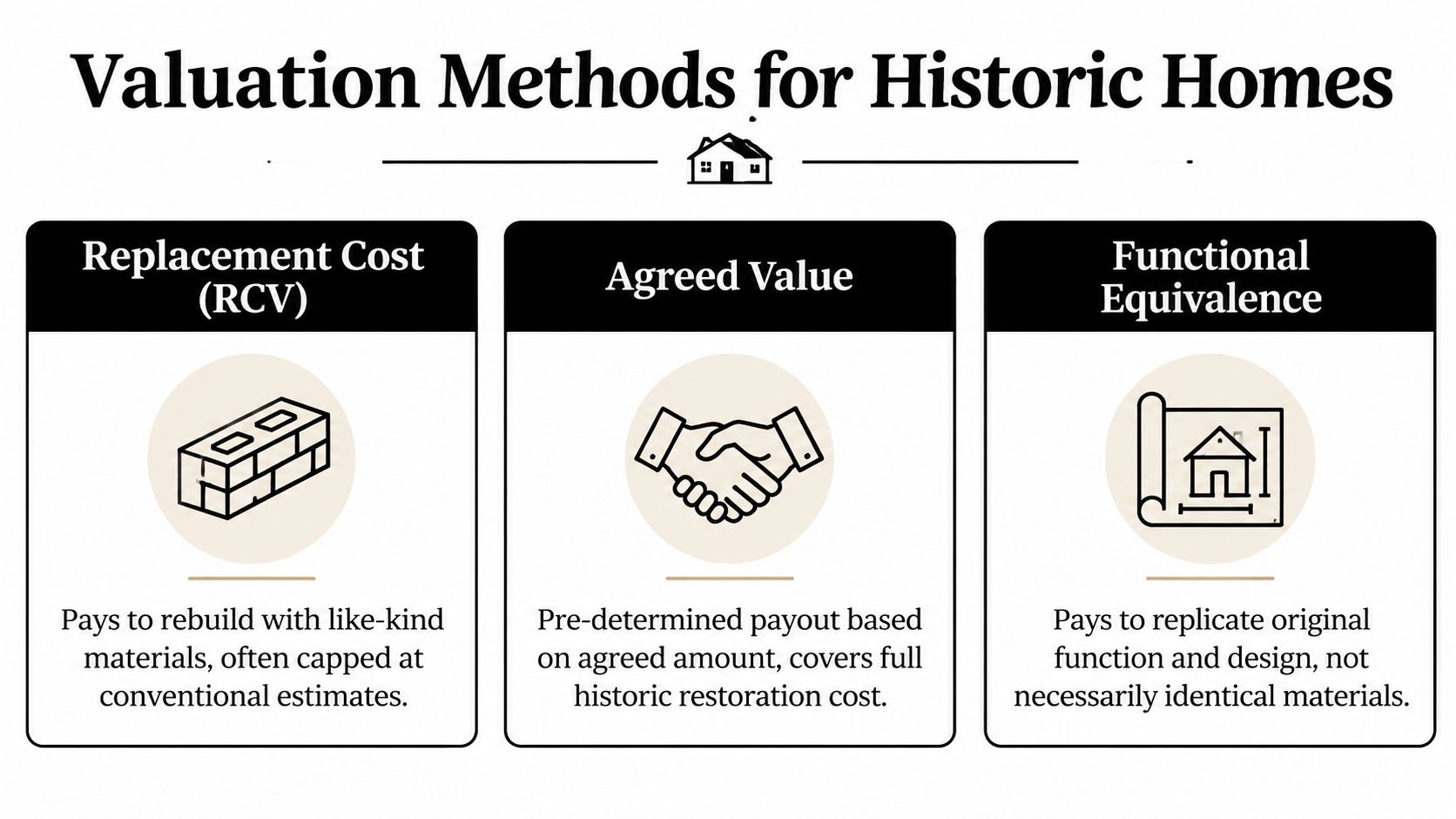
Historic-home owners need to distinguish between three ideas that sound similar but produce different claim outcomes. Replacement cost, agreed value, and functional equivalence each answer a different question.
| Valuation Method | What It Usually Addresses | Main Historic-Home Risk |
|---|---|---|
| Replacement cost | Cost to repair or rebuild with covered replacement materials | The estimate may default to conventional materials or an inadequate limit |
| Agreed value | A pre-negotiated amount accepted by the insurer | The amount must be supported and revisited as costs and property details change |
| Functional equivalence | A modern item that performs the same function | The result may not satisfy preservation requirements or restore original character |
Replacement cost
Replacement cost value can be appropriate when the policy defines replacement broadly enough and the dwelling limit reflects specialist work. The problem begins when “like kind and quality” is interpreted as a modern product with similar performance. A policy may replace plaster with drywall, custom trim with standard trim, or historic windows with contemporary units unless the contract says otherwise.
Owners should ask for the exact claim language, not a verbal assurance. The historic-property coverage discussion from Cheney Insurance notes that some policies pay for similar or functionally equivalent materials, while stronger historic coverage is designed around original materials and craftsmanship.
Agreed value
Agreed value establishes a pre-negotiated amount, typically supported by a specialized appraisal. It can reduce disputes over depreciation and the amount available after a total loss, but it isn't a substitute for accurate underwriting. The owner still needs to disclose additions, renovations, detached structures, salvage obligations, and preservation restrictions.
This approach is often most compelling for a designated landmark, a contributing structure in a historic district, or a house containing features that conventional estimating software cannot price reliably. The insurer must accept the appraisal and the policy must state how the agreed amount applies.
Functional equivalence
Functional equivalence may be acceptable for an older home without formal designation when the owner prioritizes practical rebuilding over exact restoration. It is a poor fit when a local authority requires in-kind repairs or when original features carry the property's principal significance.
Before binding coverage, the owner should ask:
- Does the policy require historic replacement cost, or only similar materials?
- Does it cover architectural features that weren't separately scheduled?
- Can the insurer choose a modern substitute?
- Does the dwelling limit include specialist labor and preservation-related costs?
- What documentation must the owner provide before restoration begins?
A carrier's answer should appear in the policy, endorsement, or agreed valuation document. If the protection exists only in a sales conversation, it isn't reliable claim language.
Essential Endorsements That Close Coverage Gaps
A generous dwelling limit can still leave a historic-home owner short after a loss. Preservation rules, specialty materials, code upgrades, and professional restoration services create costs that a standard homeowners policy may not address. Choose endorsements for those costs before a claim, not after the building department or preservation authority sets the repair requirements.
Ordinance-or-law coverage
A partial loss can trigger upgrades to undamaged wiring, plumbing, insulation, structural elements, or other systems. Standard dwelling coverage does not automatically pay every code-related expense. Consumer guidance commonly describes ordinance-or-law limits as a percentage of Coverage A, often 10%, 25%, or 30%, according to policy guidance on code-compliance coverage.
California owners should treat this coverage as a core underwriting question. Seismic requirements and local construction rules can affect repairs far beyond the visibly damaged area. Florida law, for example, requires insurers to offer replacement-cost and law-and-ordinance coverage, with additional code-upgrade coverage potentially limited to 25% or 50% of the dwelling limit, as stated in the Florida statute. California policyholders must review their own contract because available limits and conditions depend on the policy and jurisdiction.
Historic restoration coverage
This endorsement should name the materials and methods that make the property historic. Relevant examples include old-growth timber, plaster moldings, custom millwork, original tile, stained glass, masonry, and architectural salvage. The wording must state whether the insurer pays for authentic restoration or only a modern substitute with similar function.
Ask whether the endorsement covers matching materials, specialist labor, approved restoration methods, and features that were not separately scheduled. A vague promise to “restore” the home will not close a rebuilding gap.
Extended replacement cost
Extended replacement cost adds room when labor and materials exceed the scheduled dwelling limit after a regional disaster. Confirm whether the extension applies to historic restoration, code upgrades, debris removal, and professional fees. Carriers set different limits and conditions, so the endorsement language matters more than the label.
Specialty property and professional costs
Landmark or museum-grade coverage may suit a formally registered home or a property with unusually valuable architectural components. Ask specifically about heritage consultants, architects, conservators, salvage, and approved restoration methods. Ordinary dwelling coverage may not pay these expenses at the level a preservation project requires.
| Endorsement | Coverage Gap Closed | Typical Premium Impact |
|---|---|---|
| Ordinance or law | Code upgrades to damaged and undamaged systems | Varies by limit and carrier |
| Historic restoration | Period materials and specialist craftsmanship | Varies by property complexity |
| Extended replacement cost | Rebuild costs that exceed the dwelling limit | Varies by selected extension |
| Scheduled architectural features | Valuable or unusual features needing separate documentation | Varies by feature and appraisal |
| Specialty professional fees | Heritage consultants, architects, conservators, and salvage | Varies by scope |
The Sacramento Victorian example often used in policy discussions shows the exposure clearly. If code upgrades add $180,000 to a rebuild, that cost must come from a sufficient ordinance-or-law limit or from the owner's funds. The figure illustrates a possible gap, not a universal California estimate. Review each endorsement with the policy limit, preservation requirements, and the home's documented materials in front of you.
Wildfire Risk and Seismic Considerations in California
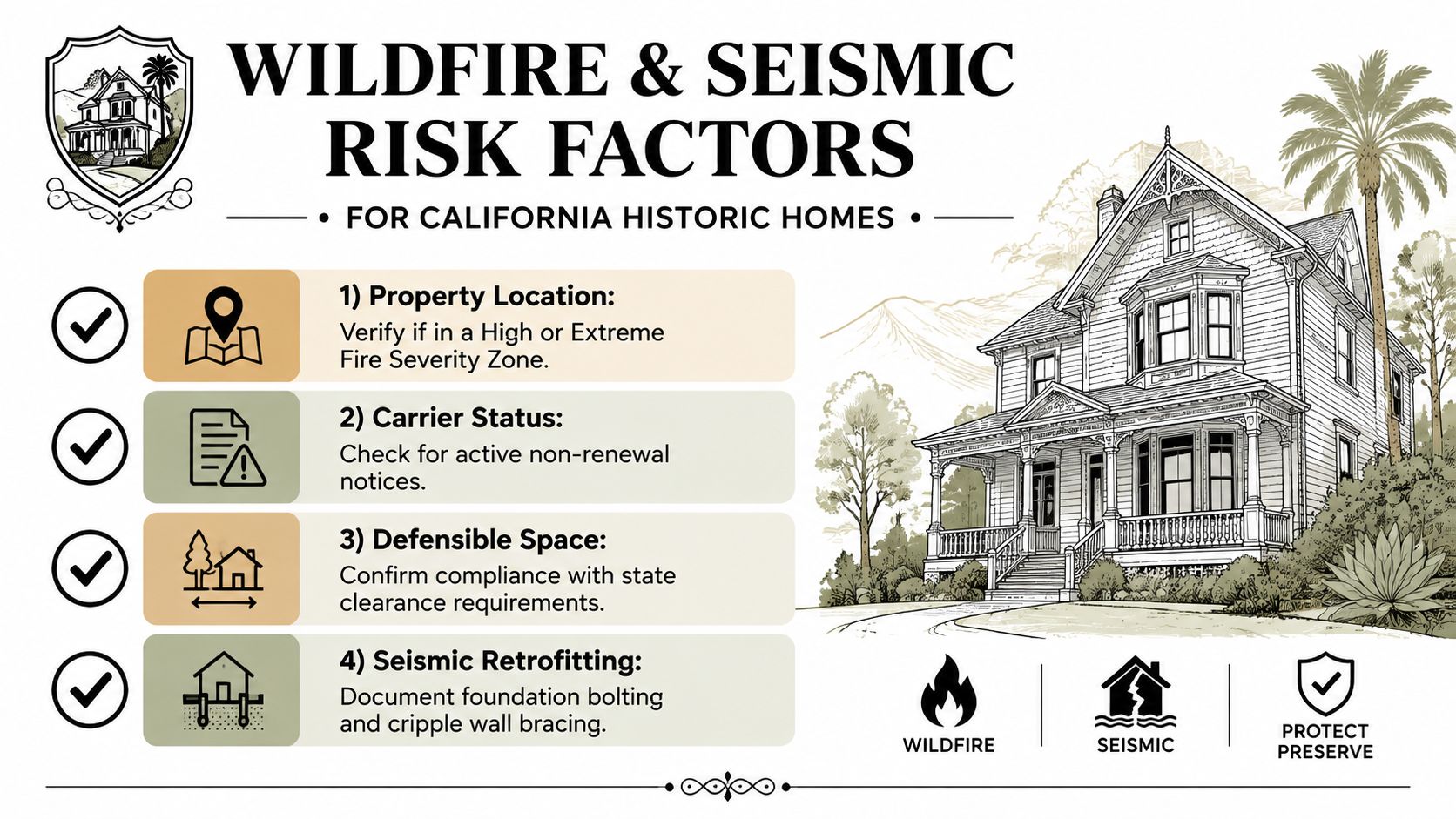
A historic home in California isn't automatically uninsurable, but its age and construction can narrow the market. The underwriting question is whether the property combines several difficult traits, such as an older roof, combustible exterior elements, legacy wiring, limited access, wildfire exposure, and incomplete mitigation records.
Roof age has become a major rating and eligibility issue. Market data cited in 2026 home insurance predictions reported that the premium gap between homes with roofs under five years old and homes with roofs aged 11 to 15 years widened from $49 in 2022 to $155 in 2025. That data isn't specific to historic homes, but it shows why roof documentation matters during underwriting.
Fire-country decisions
Wood-shake roofs, single-pane windows, balloon-frame construction, and difficult access can trigger concern. A carrier may also review defensible space, ember exposure, surrounding vegetation, local fire response, and the property's location within a fire-severity zone.
The California FAIR Plan can serve as a last-resort source of basic property coverage when the admitted market won't offer a policy. It shouldn't be treated as a complete historic-restoration solution without reviewing its limits, exclusions, deductibles, and the availability of a difference-in-conditions policy.
Owners seeking broader options should document practical mitigation:
- Roofing: Verify the existing material and ask whether a Class A roof is required or recommended.
- Vents: Install ember-resistant vents where compatible with the building's preservation requirements.
- Defensible space: Keep clearance work documented with dated photos, invoices, and inspection records.
- Access: Confirm that emergency vehicles can reach the property and that gates, bridges, and driveways won't impede response.
- Legacy systems: Replace or professionally evaluate obsolete electrical and heating components before applying.
Earthquake exposure
Earthquake coverage is normally separate from ordinary homeowners insurance. Historic masonry, unbolted foundations, and cripple walls can create serious vulnerability, so owners should document foundation bolting, bracing, and prior retrofit work. A policy's deductible structure must be read carefully because earthquake deductibles can be high and are often calculated against the dwelling limit.
A historic home can remain insurable in fire country when the owner presents a credible mitigation file and chooses a carrier that understands older construction. The wrong approach is to conceal a roof, wiring, or foundation issue until after binding. That usually produces a fragile policy and a difficult claim.
Documentation and Appraisal Checklist Before You Quote
A historic property should be presented to underwriters as a documented building, not as an address with an old year built. A standard real-estate appraisal may capture location, size, and market appeal while missing the cost of reproducing period features and craftsmanship. A specialized historic-home appraisal typically records details from the foundation to the roofline and may cost about $500 to $2,000 for a standard historic home, with higher fees for larger or more complex properties, according to historic-home appraisal guidance.
Start with the valuation file
The appraisal should identify original materials, architectural style, unusual construction, additions, and restoration obligations. It should also explain why a conventional replacement estimate doesn't reflect the actual rebuilding assignment.
Underwriting sources commonly request information about building age, construction style, listed-building category, electrical, heating, and ventilation condition, along with the proposed scope of coverage. They may evaluate insured value using net replacement value, actual cash value, demolition cost, or an agreed maximum compensation, as described in technical underwriting guidance for historic buildings.
Assemble the physical evidence
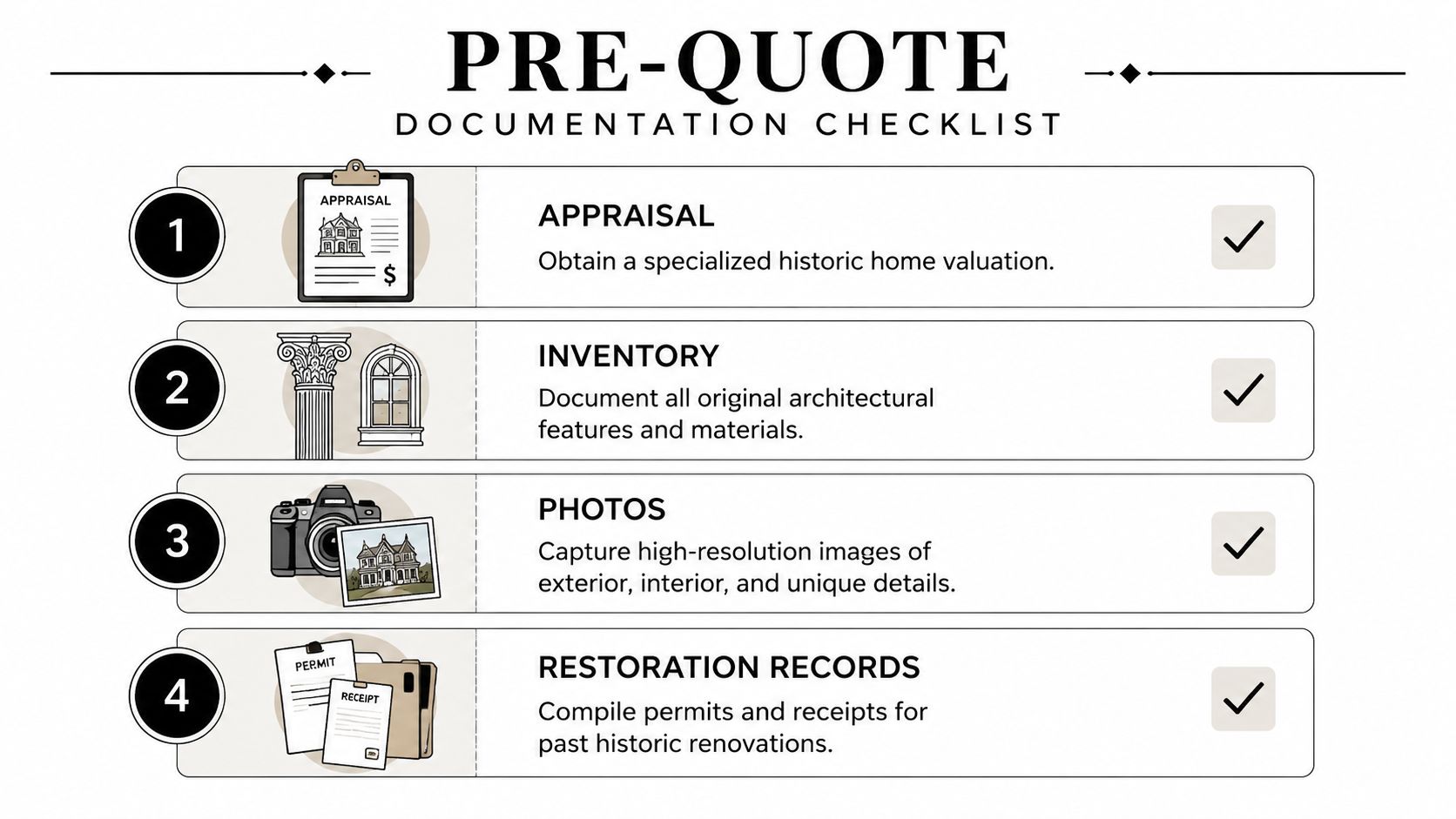
The following checklist gives an agent and carrier something concrete to review:
- Appraisal: Obtain a valuation from a professional who understands historic materials, restoration labor, and architectural significance.
- Inventory: List stained glass, hand-carved banisters, original tilework, plaster ornament, cabinetry, flooring, masonry, and detached features.
- Photos: Photograph the exterior, roof, foundation, electrical panel, plumbing, mechanical systems, interior rooms, and close details of irreplaceable features.
- Restoration records: Gather permits, plans, invoices, contractor information, engineering reports, and records of prior seismic or fire mitigation.
- Designation documents: Include historic-register, landmark, or district records and any preservation commission requirements.
- Systems report: Document the material and condition of wiring, plumbing, heating, ventilation, roof coverings, and structural elements.
Why preparation changes the quote
Incomplete applications force underwriters to make conservative assumptions. A carrier that can't verify roof condition, electrical updates, or historic status may delay the file, restrict coverage, or decline it. Organized records don't guarantee acceptance, but they demonstrate responsible stewardship and make it easier for a specialty market to price the actual risk.
The strongest submission separates what exists, what must be preserved, and what has already been upgraded. That clarity helps prevent a carrier from treating a carefully maintained Craftsman like an unknown older structure with unverified systems.
How to Get Accurate Quotes Fast with DwellQuote
Historic-home owners lose time when they submit the same property information to multiple carriers, only to discover that some carriers don't write older construction or won't offer the required endorsements. Accurate quoting starts with the address, the documented property characteristics, and a clear selection of coverage priorities.
DwellQuote is designed for California homeowners and can retrieve available property information to prefill details such as assessor records, year built, square footage, and known historic designations. The owner confirms the profile, reviews coverage options, and compares quotes from available carriers rather than repeatedly re-entering the same facts.
The practical workflow is straightforward:
- Enter the property address.
- Confirm the retrieved construction and property details.
- Identify historic features, wildfire characteristics, and prior mitigation.
- Select options such as ordinance-or-law coverage or agreed-value treatment when available.
- Compare coverage and pricing side by side.
- Review exclusions, deductibles, valuation language, and carrier eligibility before binding.
The platform helps surface carriers that write California business for challenging properties, while filtering out options that are unlikely to fit older or landmark construction. It doesn't replace a careful policy review or a specialized appraisal, but it can reduce the administrative friction that causes owners to settle for the first available quote.
For a Victorian, Craftsman, landmark, or other period home, the objective isn't the cheapest policy in isolation. The objective is a quote that reflects the complex restoration assignment and makes coverage gaps visible before a fire, wildfire, earthquake, or code-triggering partial loss.
DwellQuote helps California historic-home owners compare coverage options from carriers equipped to evaluate older construction, wildfire exposure, and specialized endorsements. Visit DwellQuote to confirm the property's details, compare quotes, and request protection that matches the home's actual rebuilding needs.