

A lot of California homeowners are in the same spot right now. They want a price for coverage, but they don't want to hand over a phone number, trigger a lead form, or give up sensitive details before they even know whether the home is affordable to insure.
That instinct is smart.
Asking for home insurance quotes without giving personal information isn't about total invisibility. It's about control. Many want a useful estimate first, then they'll decide whether a full application is worth it. That's the right sequence, especially in California, where address-level property risk matters a lot and wildfire exposure can turn a casual estimate into a very different final result.
Table of Contents
- What Anonymous Home Insurance Quotes Really Mean
- What Insurers Actually Need to Price Your Home
- How to Get Meaningful Estimates With Minimal Personal Data
- Why Anonymous Estimates Change Before You Can Buy
- Smart Privacy Tips for Shopping Home Insurance in California
- Get Your Tailored Quote Without the Hassle
What Anonymous Home Insurance Quotes Really Mean
An anonymous quote usually isn't a true quote. It's an estimate built from the property first.
That distinction matters. A homeowner in Sacramento checking prices before closing on a purchase doesn't need a bindable policy on the first click. That person needs a fast answer to a simpler question. Is this home likely to be reasonably insurable, or is it headed toward a painful surprise?
The estimate people actually want
For many homes, insurers can get surprisingly far with limited information because home insurance pricing is driven heavily by the dwelling itself. A verified industry methodology source says homeowners rate data are built from state insurance filing records that are public record, and a UK intermediary privacy notice shows quote inputs centered on contact details plus property characteristics such as construction type, security features, and rebuild value in its intermediary privacy notice.
That's why so many shoppers can start with basic information instead of highly sensitive identifiers.
A real anonymous-style estimate often starts with things like:
- Property address
- ZIP code
- Basic dwelling details
- Occupancy
- Prior claims, if disclosed
- Coverage preferences
What it usually doesn't need at the start is a Social Security number or driver's license number. Public privacy notices for quote platforms commonly list needed fields such as name, email, address, property details, prior claims, and occupancy, while explicitly stating they don't need to collect highly sensitive information like those identifiers unless a specific service requires it.
Practical rule: If a site asks for highly sensitive personal identifiers before it can even show a rough price, that's usually intake bloat, not better quoting.
What a bindable quote means
A bindable quote is different. That's the version an insurer is willing to stand behind after underwriting reviews the fuller risk file.
At that stage, the estimate stops being just a budgeting tool. The carrier starts checking details that can affect eligibility, coverage terms, and price. That's when hidden issues show up. Older roof condition. Occupancy mismatch. Prior claims. Wildfire exposure that wasn't obvious from a quick search.
For a condo in a low-complexity area, an anonymous estimate may be close enough for planning.
For a hillside home in California, it may only tell part of the story.
California changes the reliability question
Homeowners often get misled. They assume privacy and accuracy move together. Sometimes they don't.
California shoppers can absolutely use address-first quoting to screen options. That's useful and efficient. But the more wildfire-sensitive the property, the less anyone should treat an anonymous estimate as final. In higher-risk areas, the meaningful question isn't just whether a website can produce a number. It's whether the carrier will still want the home after reviewing the full property profile.
What Insurers Actually Need to Price Your Home
A carrier can price a house long before it needs your Social Security number. For an initial quote, drivers are the home itself, what it would cost to rebuild, and whether the property fits the insurer's rules.
That matters if you want privacy. Share the property facts that affect price. Hold back identity-heavy details until you are ready to buy.
What shapes the quote first
Insurers usually start with the address and the home profile tied to it. Public records and property databases often fill in a lot before you type anything else, as described in this guide to home insurance quotes without personal info.
For early pricing, these details do most of the work:
- Property address
- Construction type
- Square footage
- Year built
- Roof age and material
- Occupancy, owner-occupied, second home, or rental
- Requested dwelling coverage
- Deductible choice
- Fire protection factors, such as distance to a hydrant or station
- Visible risk flags, including brush exposure or older systems
In California, wildfire risk can distort a quick estimate fast. An address-only quote may be useful for a flat suburban home with standard features. It is less reliable for a canyon, foothill, or ridge property where defensible space, roof type, slope, access, and vegetation can change eligibility and price.
What usually can wait
Many quote forms ask for more than they need at the shopping stage. That does not make the estimate better.
These items can often wait until you move from estimate to application:
- Social Security number
- Driver's license number
- Bank or card information
- Detailed household identity information that does not affect underwriting
If a site demands highly sensitive identifiers before it will show even a rough price, treat that as a sales intake choice, not a pricing requirement.
What personal details start to matter before binding
A bindable quote is different. At that point, the insurer is checking whether the applicant and the property match the risk it wants to insure.
Consumer guidance on homeowners quoting says insurers commonly request the applicant's date of birth, contact information, claims history, and home details such as construction, square footage, age, and security features. It also notes that some carriers ask for items such as occupancy details, detached structures, renovation history, and in some cases Social Security information in this overview of what information is needed for a home insurance quote.
Use this rule of thumb:
| Data Type | Needed for Early Estimate | Needed for Binding |
|---|---|---|
| Property address | Yes | Yes |
| Basic home characteristics | Yes | Yes |
| Coverage selections | Yes | Yes |
| Date of birth | Sometimes | Often |
| Claims history | Sometimes | Often |
| Social Security number | Usually no | Sometimes |
| Driver's license number | Usually no | Sometimes |
The cleanest approach is simple. Protect your identity data early, but do not hide the property details that control price. In California, especially in wildfire-exposed areas, the missing facts that change a quote are usually about the house, not about you.
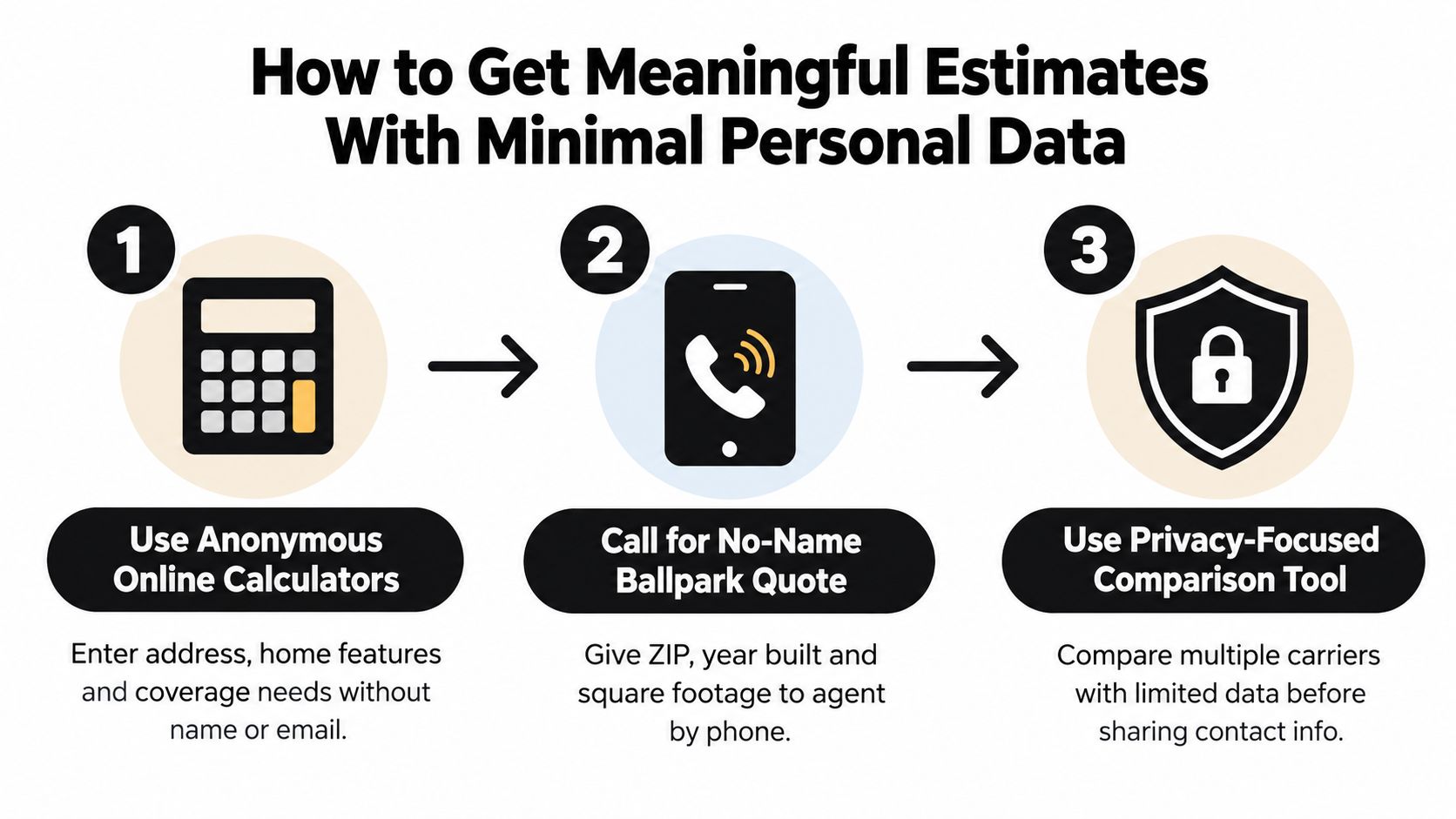
How to Get Meaningful Estimates With Minimal Personal Data
The cleanest approach is to separate shopping from binding.
A shopper trying to compare price bands has one job. Feed the system enough property detail to make the estimate meaningful, while skipping identity-heavy fields that don't improve an initial result.
Method one uses address-first estimates
The simplest path is an address-only or address-first workflow.
Large-scale home insurance data collection shows how standardized this has become. One independent methodology source reports a nationwide homeowners data call compiled roughly 216,151 test quotes across 32,978 ZIP codes, and says premium data come from insurer filings submitted to regulators and treated as public record. Statistics Canada also uses a broker service warehouse of homeowner quote profiles as a data source for insurance prices, as noted in this discussion of how quote systems rely on structured homeowner profile data.
That means a shopper can often start with:
- The property address
- Basic occupancy
- Desired effective date
- Coverage target if known
Then the system can prefill likely dwelling facts from public or commercial property sources.
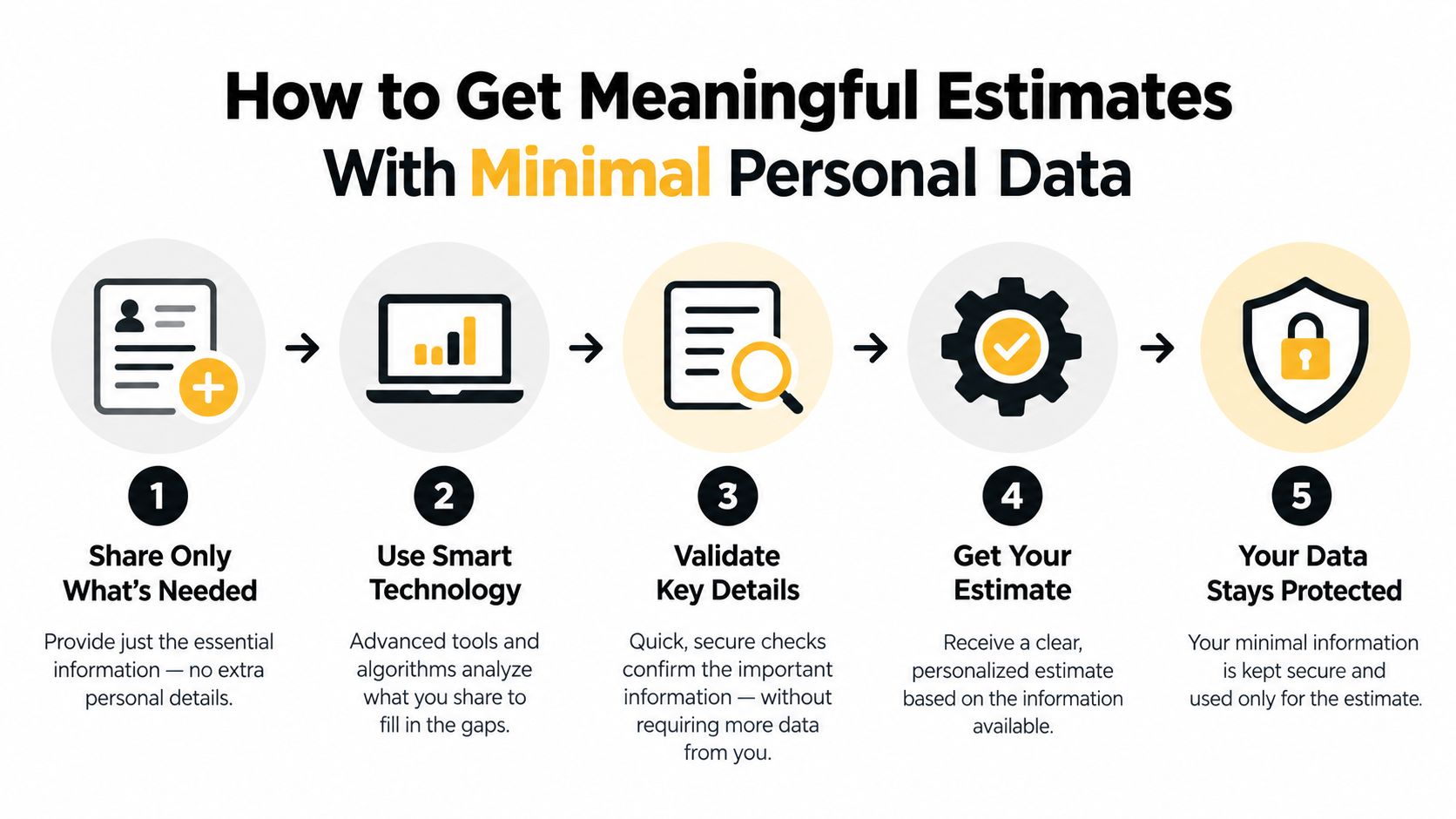
A California-specific version of this already exists in the market. One major insurer says it searches public records after the user provides the property address, date of birth, and coverage start date, then asks the customer to confirm the imported information before collecting more detailed home and personal data on its California homeowners insurance quote workflow.
Method two uses ZIP-only or sample-profile screening
ZIP-only estimates are weaker, but they still have a purpose.
They're useful when a buyer hasn't picked a home yet, or when someone wants a rough budgeting number before deciding which neighborhood makes sense. In that case, the estimate is less about exact price and more about range.
A shopper can improve a ZIP-only result by pairing it with a sample profile:
- Approximate square footage
- Likely year built
- Construction type
- Expected occupancy
- Target coverage amount
This works well for early-stage house hunting. It works poorly for final decisions.
Method three uses privacy-first comparison
A smarter workflow asks for the property first, not a full life story.
One option in that category is DwellQuote, which uses basic details to retrieve property data and prefill the rest so shoppers can confirm the property profile before reviewing carrier options. That model fits people who want home insurance quotes without giving personal information beyond what's needed to identify the house and produce a meaningful comparison.
The fastest low-friction quote flow is usually the one that lets the address do the talking first.
What to skip and what not to skip
Privacy-conscious shoppers should skip unneeded identity fields early. They should not skip risk-driving home details if the system asks for them.
Good items to provide early:
- Address
- Occupancy
- Dwelling type
- Known roof age, if available
- Square footage
- Construction details
- Prior claims, if known
Items that can often wait:
- Social Security number
- Driver's license number
- Payment information
- Excess contact details
A rough estimate becomes useful when the house profile is real. It becomes misleading when the property data are vague just because the shopper is trying to stay private.
Why Anonymous Estimates Change Before You Can Buy
You pull a quick quote with just an address, see a price that looks workable, and then the quote comes back higher. That usually happens because the first number was a screening estimate, not purchase-ready pricing.
Anonymous estimates are built from limited inputs. Bindable quotes are built from verified risk details. If the carrier learns something material later, the price changes, the coverage changes, or the home is declined.
Early estimates miss underwriting facts
At the estimate stage, the insurer may know the location and a basic property profile. It may not yet know whether the roof is near the end of its life, whether the home has prior claims, whether the occupancy is owner-occupied or tenant-occupied, or whether replacement cost features were guessed instead of confirmed.
Those details matter because they change both price and eligibility.
Common reasons the estimate moves:
- Roof age or roof condition
- Prior claims history
- Occupancy details
- Protection Class factors
- Insurance score inputs where permitted
- Replacement cost details
- Prior underwriting or coverage history
A ZIP-only estimate is the roughest version. It can help with budget planning, but little else.
An address-only estimate is better because the system can often pull public property data. Even then, it still may miss the exact roof update history, interior remodels, brush exposure, or prior loss activity that decide whether a California home is acceptable to a carrier.
California wildfire risk makes anonymous estimates less reliable
California homeowners get tripped up.
In a lower-risk state, missing details may only shift the premium. In California, especially in foothill, canyon, or brush-exposed areas, missing details can change whether you have an offer at all. Carriers often look beyond the street address and evaluate wildfire exposure, defensible space, roof characteristics, distance to responding fire protection, and other property-specific risk markers before they commit.
Insurify explains that anonymous home insurance quotes can start with limited information, but final underwriting often adds less obvious risk factors that affect both pricing and carrier willingness, especially in wildfire-sensitive markets, in this analysis of anonymous home insurance quotes and wildfire-related underwriting limits.
That is why a privacy-first estimate can be honest and still fall apart later. The estimate reflects the risk the carrier can see early. The bindable quote reflects the risk file the carrier can defend.
| Feature | Anonymous Estimate | Bindable Quote |
|---|---|---|
| Starting data | Limited property details | Full verified property and applicant details |
| Accuracy goal | Budgeting and comparison | Purchase-ready pricing |
| Underwriting review | Minimal or delayed | Active and decisive |
| Eligibility certainty | Low to moderate | Higher |
| Wildfire-area reliability | Often weaker | Stronger |
| Sensitive identifiers required | Often limited | More likely |
For a wildfire-exposed California home, treat an anonymous estimate as a first filter, not a commitment.
FAIR Plan outcomes can change the math fast
Some California homes will not fit the admitted market after full review. When that happens, shoppers may end up looking at the California FAIR Plan or a FAIR Plan plus Difference in Conditions setup instead of the private-market option they expected.
Independent reporting has noted that FAIR Plan costs are often higher in wildfire-prone areas, especially where standard-market options are limited, in this review of California FAIR Plan cost patterns.
That is the reason anonymous estimates change before purchase. The first number may be based on partial data. The final offer is based on whether the house clears underwriting.
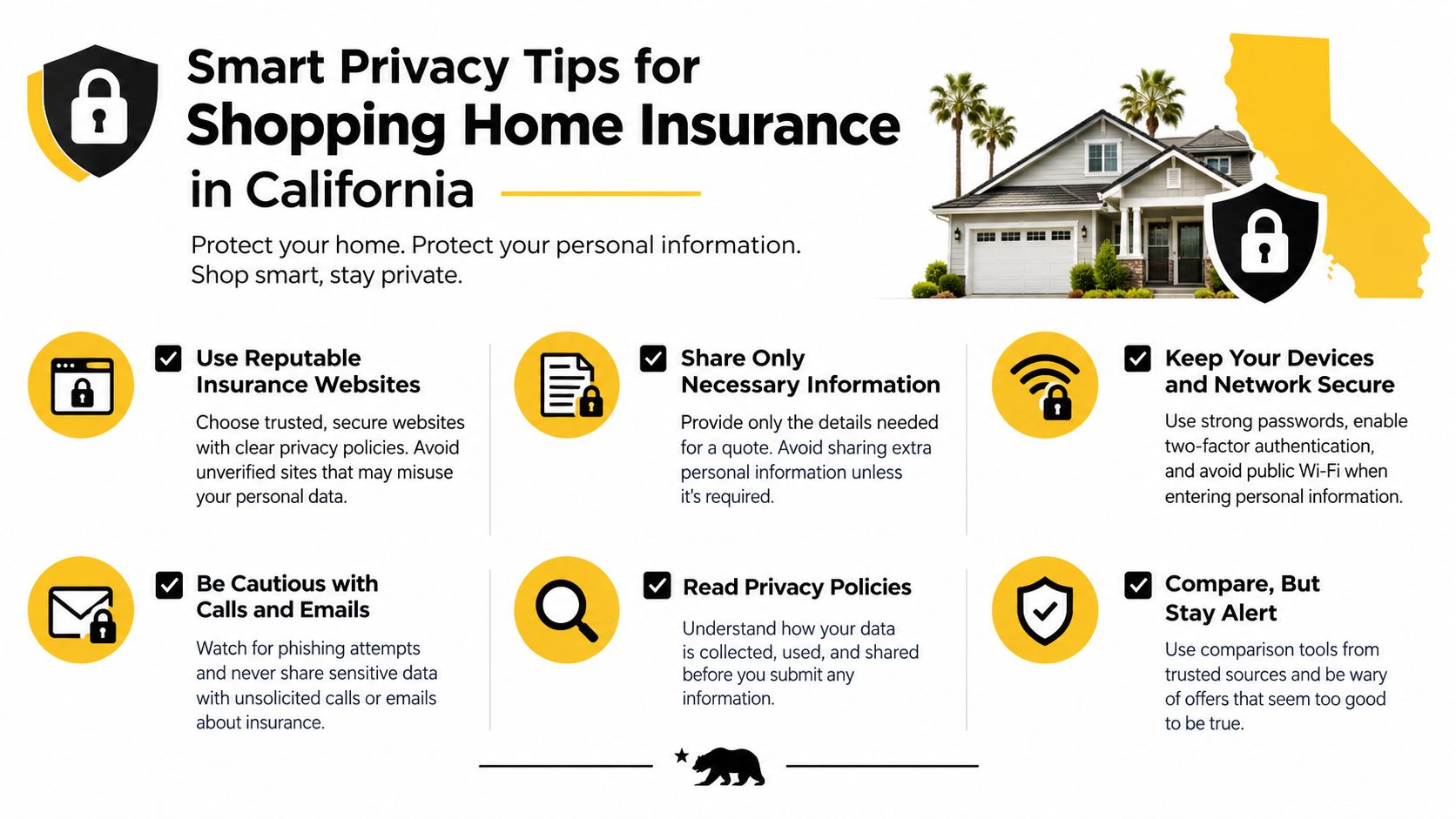
Smart Privacy Tips for Shopping Home Insurance in California
Good privacy practice isn't hiding everything. It's sharing the right information in the right order.
California homeowners should be selective, not secretive. The property has to be identifiable and rateable. The person doesn't need to surrender every sensitive identifier on the first screen.
Start with property matching
California's Department of Insurance notes that property-location data can be forwarded to insurers on behalf of consumers, and it explicitly warns consumers not to include unrequested sensitive data such as Social Security numbers, driver's license numbers, or credit card information when using a locator workflow, as summarized in this guidance on a privacy-conscious homeowners insurance cost calculator workflow.
That principle is solid far beyond locator tools.
A privacy-preserving quote flow should begin with:
- Property address
- Basic location details
- Dwelling characteristics
- Occupancy
- Any material risk details already known
If those items are complete, the system can often match the home without over-collecting personal information.
Delay sensitive identifiers until the file is serious
This is the simplest rule in the process.
Don't volunteer highly sensitive data early unless the service clearly needs it for a specific function. If the goal is comparison shopping, identity-heavy fields often add more risk than value.
A clean workflow usually follows this sequence:
- Identify the home
- Confirm prefilled property facts
- Review estimate options
- Share more personal data only when moving toward purchase
Don't hide the wrong details
Some shoppers protect privacy by deleting useful property facts. That backfires.
If a home has an older roof, unusual occupancy, prior claims, or wildfire-facing conditions, leaving those details out doesn't protect the consumer. It only makes the estimate less trustworthy. California's own guidance warns that if required property specifics are withheld, insurers may not have enough information to locate or assess the applicable policy.
Key takeaway: Hold back sensitive identity data early. Don't hold back material home-risk facts.
A quick screening checklist
Before using any quote tool, a California homeowner should ask:
- Does it ask for the property first or the person first
- Does it explain why sensitive data are needed
- Can the shopper review prefilled home details before moving on
- Does it avoid collecting payment details at estimate stage
- Does it let the shopper stop at the estimate stage without forcing a binding workflow
Those questions usually reveal whether the platform is built for quoting or built for lead capture.
Get Your Tailored Quote Without the Hassle
The practical answer is simple.
Use anonymous or near-anonymous estimates when the goal is budgeting, comparison, or early house hunting. Move to a fuller profile when the goal is real pricing, real eligibility, and a policy that can be purchased.
California homeowners can't afford to confuse those two stages. A basic estimate may be enough for a tract home with ordinary characteristics. It's often not enough for a property in a wildfire-prone area, a home with unusual construction, or a house that may already be difficult to place with admitted carriers.
That doesn't mean shoppers should give up privacy. It means they should use privacy intelligently.
The best quote flow starts with the house, confirms the important dwelling facts, and waits to collect deeper personal identifiers until the consumer is ready to buy. That keeps the process efficient without pretending that underwriting doesn't exist.

For home insurance quotes without giving personal information, the right benchmark isn't total anonymity. It's whether the estimate is useful, whether the data request is proportional, and whether the final quote process stays manageable once the home moves into underwriting.
That's the standard that matters.
DwellQuote lets California homeowners start with basic property details, uses address-first prefill to cut manual entry, and helps compare available carrier options without the usual back-and-forth. For shoppers who want a smarter path from private estimate to real coverage, visit DwellQuote and request a home insurance quote.