

A Sacramento homeowner opens a renewal notice and sees a premium that looks nothing like the one across the street. Another buyer is days from closing, the lender needs proof of coverage, and one carrier declines the home while another quotes a much higher price. That is the Sacramento insurance market right now.
Home insurance in Sacramento, California is priced house by house, not city by city. ZIP code, wildfire exposure, prior claims in the area, distance to brush, roof age, rebuild cost, and even whether a carrier is still writing new business in that pocket of the region can change the result fast. Averages miss the point. What matters is why your property lands where it does and what options you still have if a standard carrier says no.
California also conditioned homeowners to expect long stretches of relative pricing stability. That long calm period shaped homeowner expectations, and many people still judge today's quotes by outdated standards. That leads to bad decisions, especially when owners focus only on premium and ignore coverage gaps, exclusions, or the possibility that they may need a FAIR Plan paired with separate policies to fill in what it does not cover.
The smart approach is simple. Start with your home's actual risk profile, not a statewide average. Then compare standard market options first, and if those are limited, evaluate the FAIR Plan carefully instead of treating it like a direct substitute for a full homeowners policy. In Sacramento, that difference can save you money, prevent coverage mistakes, and keep a hard-to-insure home protected.
Table of Contents
- Navigating the Sacramento Home Insurance Maze
- Understanding Your Core Home Insurance Coverage
- Sacramento-Specific Risks Wildfire Flood and Seismic
- Decoding Home Insurance Costs in Sacramento
- Actionable Ways to Lower Your Insurance Premium
- How to Get and Compare Quotes the Smart Way
- Frequently Asked Sacramento Home Insurance Questions
Navigating the Sacramento Home Insurance Maze
A buyer in East Sacramento, a longtime owner in Pocket, and a landlord in Natomas can all shop for coverage on the same week and come away with completely different outcomes. One gets a routine quote. One gets a higher premium than expected. One gets pushed toward a narrower set of options. That isn't random. Sacramento's market now rewards homeowners who understand how insurers think.
The old advice was simple. Get three quotes, pick a deductible, move on. That advice isn't enough anymore. Underwriters now care far more about property condition, exact location, replacement cost, flood exposure, wildfire sensitivity, and loss history than many owners realize. Two homes with similar sale prices can produce very different insurance offers.
Practical rule: A Sacramento homeowner shouldn't ask only, “What's the average price?” The better question is, “What is this address telling insurers about risk?”
That shift matters because many owners still assume Sacramento is one uniform market. It isn't. River-adjacent areas, older neighborhoods, and homes with deferred maintenance can all trigger different pricing or eligibility results. Even inside city limits, the underwriting logic changes block by block.
The good news is that this isn't guesswork if the homeowner uses a disciplined approach.
What a smart homeowner focuses on first
- Address-level risk: The ZIP code matters, but the property itself matters more.
- Rebuild cost: Insurance pays to repair or rebuild covered damage, not to mirror market value.
- Coverage gaps: Flood and earthquake decisions need separate attention.
- Carrier appetite: A home can be acceptable to one insurer and unattractive to another.
- Fallback planning: If standard options tighten, the homeowner needs to know the next move quickly.
Sacramento homeowners don't need more vague shopping tips. They need a clean decision process. That starts with understanding what the policy covers.
Understanding Your Core Home Insurance Coverage
A home policy is a financial safety net with several separate parts. If a homeowner doesn't know which part does what, comparing quotes becomes almost impossible. The declarations page may look clean, but its true value sits in the structure behind it.
What each core coverage part actually does
Dwelling coverage pays to repair or rebuild the house itself after a covered loss. This is the foundation of the policy. It should reflect realistic rebuilding exposure, not a rough guess or a purchase price shortcut.
Personal property coverage protects belongings inside the home. Furniture, clothing, electronics, and household items usually fall here, subject to policy terms and limits. Owners who have upgraded their home over time often forget they've also upgraded what's inside it.
Personal liability coverage responds when someone claims bodily injury or property damage for which the homeowner is legally responsible. That can include incidents on the property, but liability exposure isn't limited to a dramatic backyard accident. Smaller incidents can still become expensive.
Additional living expenses helps pay for temporary living costs if a covered loss makes the home uninhabitable. This is the part many homeowners ignore until displacement becomes real.
A cheap policy that skimps on dwelling accuracy or living expense protection can cost far more after a serious claim.
Homeowners should also pay attention to exclusions. A standard policy generally doesn't handle every hazard affecting Sacramento properties. Flood is the most common blind spot. Earthquake is another.
HO-3 and HO-5 are not interchangeable
Most homeowners comparing policies will run into HO-3 and HO-5 forms. Both are common. They are not the same product.
| Coverage Feature | HO-3 Special Form | HO-5 Comprehensive Form |
|---|---|---|
| Dwelling coverage | Broad protection for the house, subject to policy terms | Broad protection for the house, subject to policy terms |
| Personal property coverage | Typically more limited than HO-5 | Typically broader than HO-3 |
| Claims handling expectations | Often more dependent on stated limitations and policy wording | Usually designed for fewer gaps on covered personal property |
| Fit for homeowner | Common choice for many standard homes | Often considered by homeowners wanting broader protection |
An HO-3 is often the baseline option. It can be perfectly workable. An HO-5 usually appeals to owners who want broader protection and are willing to pay for it. The right decision depends on the home, the belongings inside it, and the owner's tolerance for claim friction.
What a homeowner should review on every quote
- Dwelling limit: Does it look realistic for rebuilding?
- Personal property amount: Is it too low for the household?
- Liability limit: Would it still feel adequate after a serious claim?
- Loss of use wording: Is temporary housing protection clearly stated?
- Exclusions and endorsements: What major risks are outside the base contract?
A Sacramento homeowner who understands these building blocks is far less likely to overpay for the wrong policy or underinsure the right home.
Sacramento-Specific Risks Wildfire Flood and Seismic
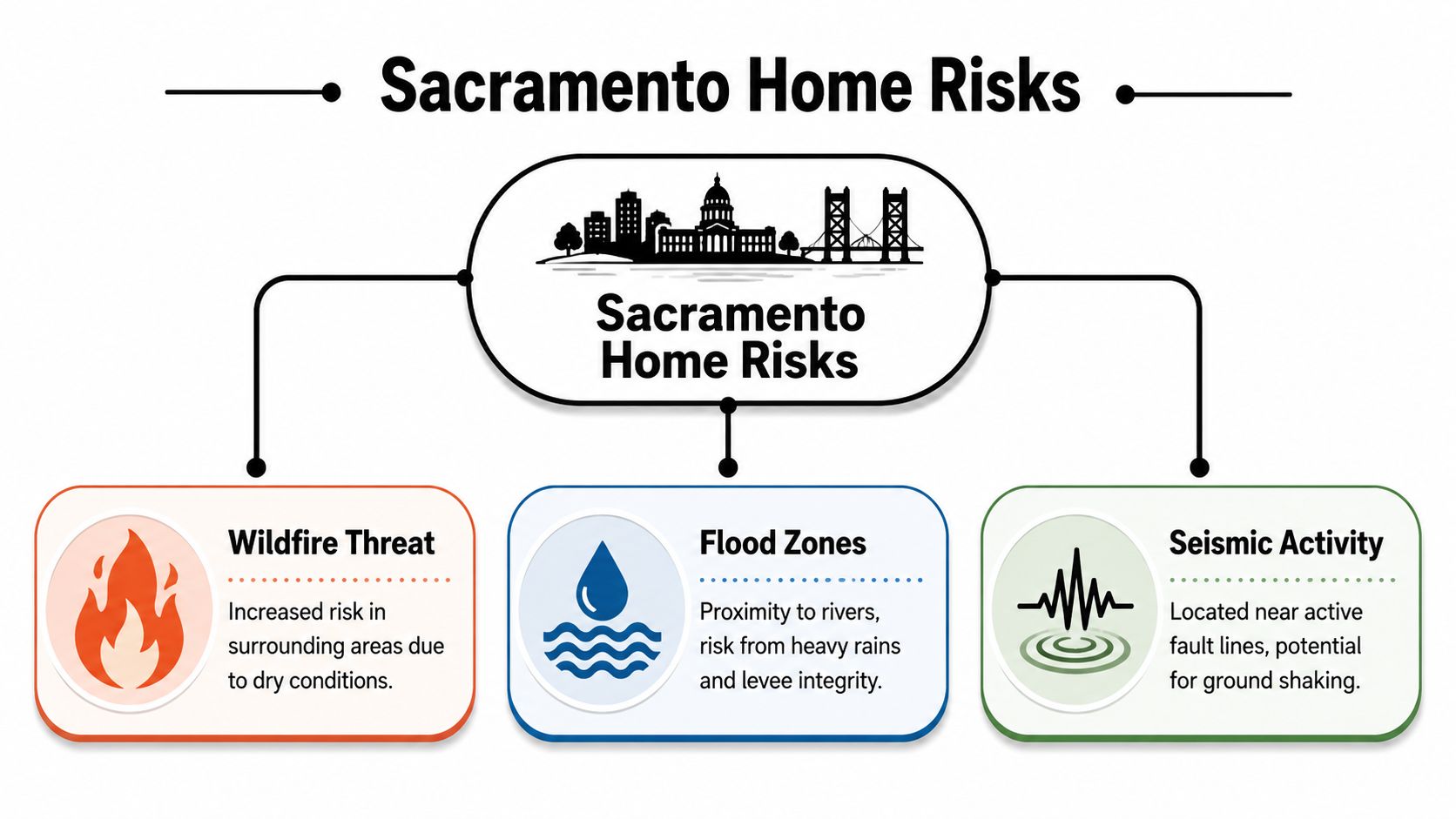
Sacramento homeowners don't live in a one-risk market. They live in a layered-risk market. Wildfire pressure shapes underwriting even when a home isn't sitting deep in the foothills. Flood risk matters because rivers and water systems define much of the region. Seismic exposure remains part of California homeownership whether an owner wants to think about it or not.
This visual sums up the major categories homeowners should evaluate before accepting a quote.
Wildfire pressure reaches farther than many owners expect
A common mistake is assuming wildfire only affects remote or mountain properties. Insurers don't see it that narrowly. They evaluate regional exposure, vegetation, access, surrounding conditions, and portfolio concentration. That means a Sacramento address can feel the effects of broader California wildfire stress even if the house sits in a relatively urban setting.
This is why some homeowners see stricter underwriting, tighter inspection standards, or fewer carrier options. It's also why a homeowner should clean up obvious exterior hazards before shopping. Carriers notice deferred maintenance, combustible material near the home, and anything that suggests higher fire severity.
Flood risk is separate from standard home coverage
Standard homeowners insurance generally doesn't replace flood insurance. That distinction trips up buyers every year. In Sacramento, that matters because local geography makes water risk a practical issue, not a theoretical one. Properties near the American River, Sacramento River, or lower-lying areas deserve a closer flood review.
A homeowner shouldn't assume that a lender's requirements tell the whole story either. A property can have meaningful flood exposure even when the buyer didn't expect a flood policy conversation. The smart move is to ask directly whether flood should be evaluated as a separate purchase.
Sacramento owners near rivers, levees, or historically water-sensitive areas should treat flood insurance as a decision item, not an afterthought.
Seismic risk needs a deliberate decision
Earthquake coverage usually requires a separate decision as well. Many homeowners skip it because they focus on more visible risks. That's understandable, but it's still a choice with consequences. California homeowners should at least review what earthquake protection would look like for the property and budget.
For some households, the answer will be to buy it. For others, the answer will be to decline and self-insure that risk. The mistake is not making a conscious decision at all.
When standard insurers pull back
Some Sacramento homeowners won't have a smooth path through the standard market. When that happens, confusion gets expensive. The California Department of Insurance explains that consumers who can't obtain residential insurance after shopping the market may need to contact the California FAIR Plan.
That matters because the FAIR Plan is a fallback route, not a normal shortcut. Homeowners should treat it as a last-resort option when standard carriers say no or when available standard terms no longer make sense. It often becomes part of the conversation for harder-to-insure properties, and owners need to understand that possibility early, not after closing is a week away.
Decoding Home Insurance Costs in Sacramento
A homeowner in Pocket gets a quote that feels reasonable. A week later, a buyer looking at a similar-sized house in another Sacramento ZIP code gets hit with a much higher premium. That gap is normal here. Sacramento insurance pricing changes fast by address, rebuild cost, and how each carrier views wildfire spillover, flood exposure, and older housing stock.
What the Sacramento average tells homeowners
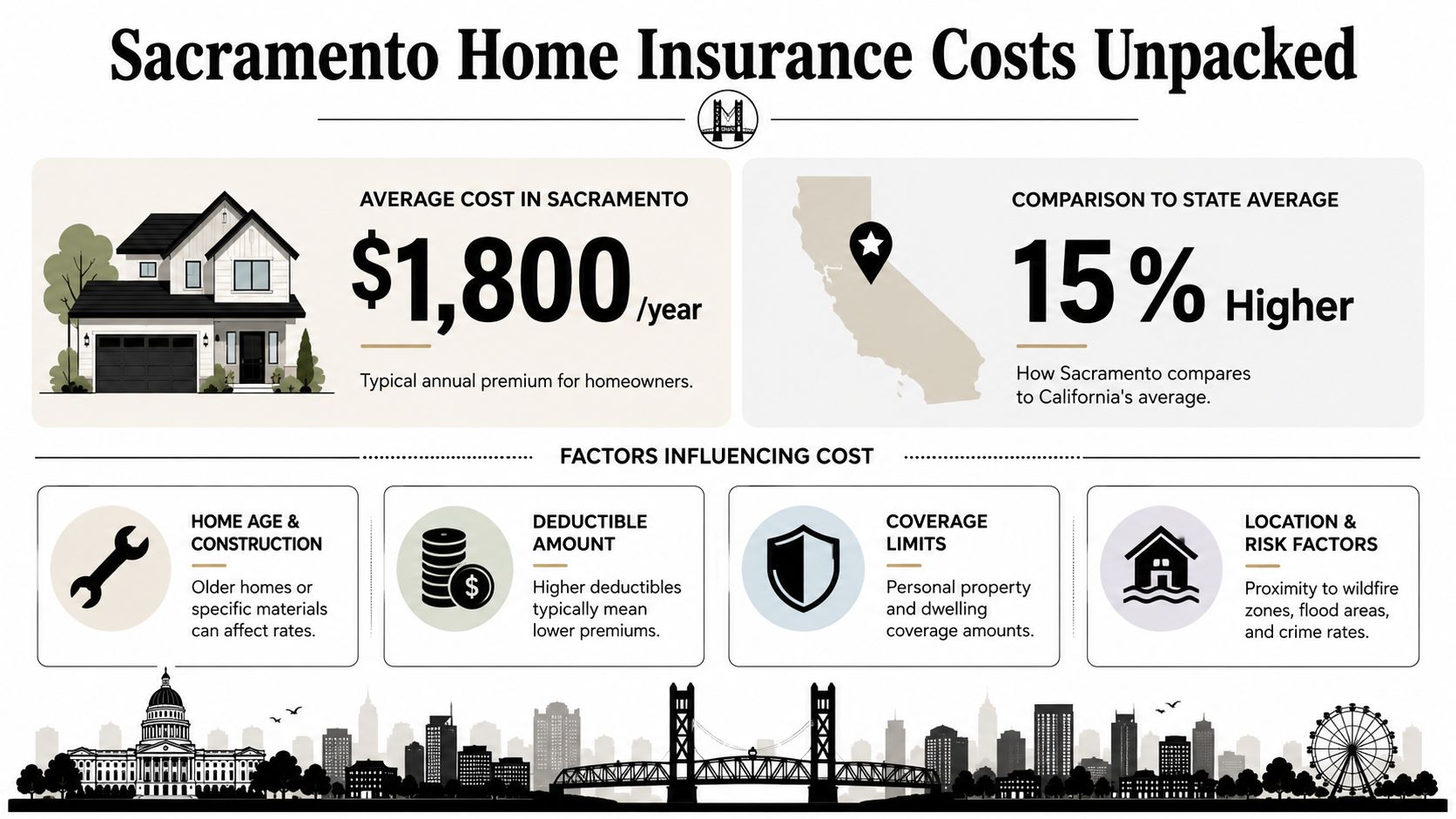
For a policy with $300,000 in dwelling coverage, Sacramento's average homeowners insurance premium is about $1,237 per year, which is roughly 11% below California's average of $1,383 and about 29% below the national average of $1,754, according to Policygenius' Sacramento homeowners insurance analysis.
Use that number as a benchmark only. Do not use it as your budget.
A city average hides the part that matters most to your wallet. Sacramento is not one insurance market. It is a patchwork of micro-markets, and insurers price them that way.
Why one quote jumps and another stays reasonable
The biggest driver is usually dwelling coverage, because insurers are pricing the cost to rebuild, not the price you paid for the house. Analysts at The Zebra's Sacramento home insurance pricing breakdown found average premiums of about $1,008 per year for homes with $200,000 in dwelling coverage and about $1,240 per year for $400,000 in dwelling coverage. If your dwelling amount is off, your premium will be off too.
ZIP code matters more than many homeowners expect. In Sacramento, pricing can change even between neighborhoods that feel similar on paper. Local hazard patterns, distance from higher-risk brush areas, flood concerns, housing age, and carrier appetite all show up in the quote. One local market summary notes examples such as 95831 at $1,199 per year and 95823 at $1,269 per year, and also shows how wide carrier pricing can run across the city, from the low hundreds to well above two thousand dollars depending on assumptions and policy structure, according to Goosehead's Sacramento home insurance overview.
Carrier spread is where smart shoppers save real money. Policygenius reports several Sacramento carrier averages in the $814 to $996 range. That is a strong reminder that one quote proves almost nothing.
The cost drivers that deserve your attention
- Dwelling limit: This is the main pricing lever for many Sacramento homes.
- ZIP code and exact property risk: Insurers rate the address, not just the city.
- Flood and wildfire exposure: Even when a policy excludes certain hazards, nearby risk still affects underwriting and pricing.
- Deductible: Higher deductibles can lower premiums if you can afford the out-of-pocket hit.
- Home age and upkeep: Older roofs, wiring, plumbing, and deferred maintenance can raise costs or shrink your options.
- Construction details: Roof type, building materials, and rebuild complexity all affect rate decisions.
Bottom line: If standard coverage is easy to get, compare multiple carriers on the same dwelling limit and deductible. If standard coverage is hard to get, stop chasing random quotes and build a plan around the FAIR Plan plus any needed supplemental coverage. In Sacramento, the right answer depends on your ZIP code and risk profile, not a citywide average.
Actionable Ways to Lower Your Insurance Premium
The fastest way to overpay is to shop passively. Sacramento homeowners who want lower premiums need to change the inputs that insurers use, not just hope a different logo produces a miracle.

Savings moves that usually help
- Raise the deductible carefully: This can reduce premium, but only if the homeowner has enough cash reserves to absorb a loss comfortably. A deductible should feel manageable on a bad day, not just acceptable during quote shopping.
- Bundle where the total package makes sense: Home and auto bundling often improves pricing. The right comparison is total household insurance cost, not whether one line item alone looks cheaper.
- Fix underwriting red flags before applying: Roof issues, peeling exterior surfaces, unmanaged brush, and obvious repair neglect can push a home into a worse pricing bucket or out of eligibility entirely.
- Ask whether the home qualifies for protective-device discounts: Smoke alarms, security systems, and other protective features can matter. The homeowner should verify that the quote reflects the home's actual features.
- Review the dwelling amount instead of guessing: Some owners are overinsured because an old estimate never got revisited. Others are underinsured because they chose a round number. Both problems are fixable.
Cuts that often backfire
A lower premium isn't always a better deal. Some reductions create ugly claim outcomes.
- Slashing liability too far: That may save money upfront but leaves the homeowner exposed if a serious claim happens.
- Ignoring flood because the base policy feels expensive already: Flood gaps don't become harmless just because a standard quote was frustrating.
- Choosing the cheapest quote without reading exclusions: Cheap coverage with narrow protection can become expensive after a loss.
- Skipping annual review: Home improvements, added belongings, and changing market conditions can all make an older policy a poor fit.
A homeowner should also compare policy forms, not just premium totals. A low price with weaker coverage terms often isn't savings. It's deferred pain.
How to Get and Compare Quotes the Smart Way
You get three Sacramento home insurance quotes for the same house. One looks cheap, one looks inflated, and one comes back with odd coverage gaps. The problem usually is not the house. The problem is the quote setup.
Sacramento owners get into trouble when they compare premiums without matching the coverage details underneath. In this market, small input changes can swing pricing fast. A Midtown bungalow, an Elk Grove tract home, and a foothill-edge property near higher wildfire exposure do not get priced the same way. Even within Sacramento, ZIP code, roof age, prior claims, and brush or flood concerns can push one carrier toward a standard policy and push another toward a fallback option.
Start with a clean quote request. If the inputs are sloppy, the comparison is useless.
Use this checklist before you ask any agent or platform for pricing:
- Keep the dwelling amount the same on every quote.
- Use the same deductible across all quotes.
- Match liability limits.
- Confirm the roof age, square footage, and update history are accurate.
- Ask how wildfire, flood, and earthquake are being handled. Covered, excluded, or offered separately.
- Confirm whether the quote is standard market coverage or a FAIR Plan setup with a companion policy.
Good quote comparisons are built. They do not happen by accident.
A Sacramento buyer in escrow sees this all the time. One insurer uses a replacement estimate that is too low. Another strips out water backup. A third sends back a FAIR Plan path because the property falls into a tougher underwriting bucket. If you only look at the premium, you miss the reason the prices differ.
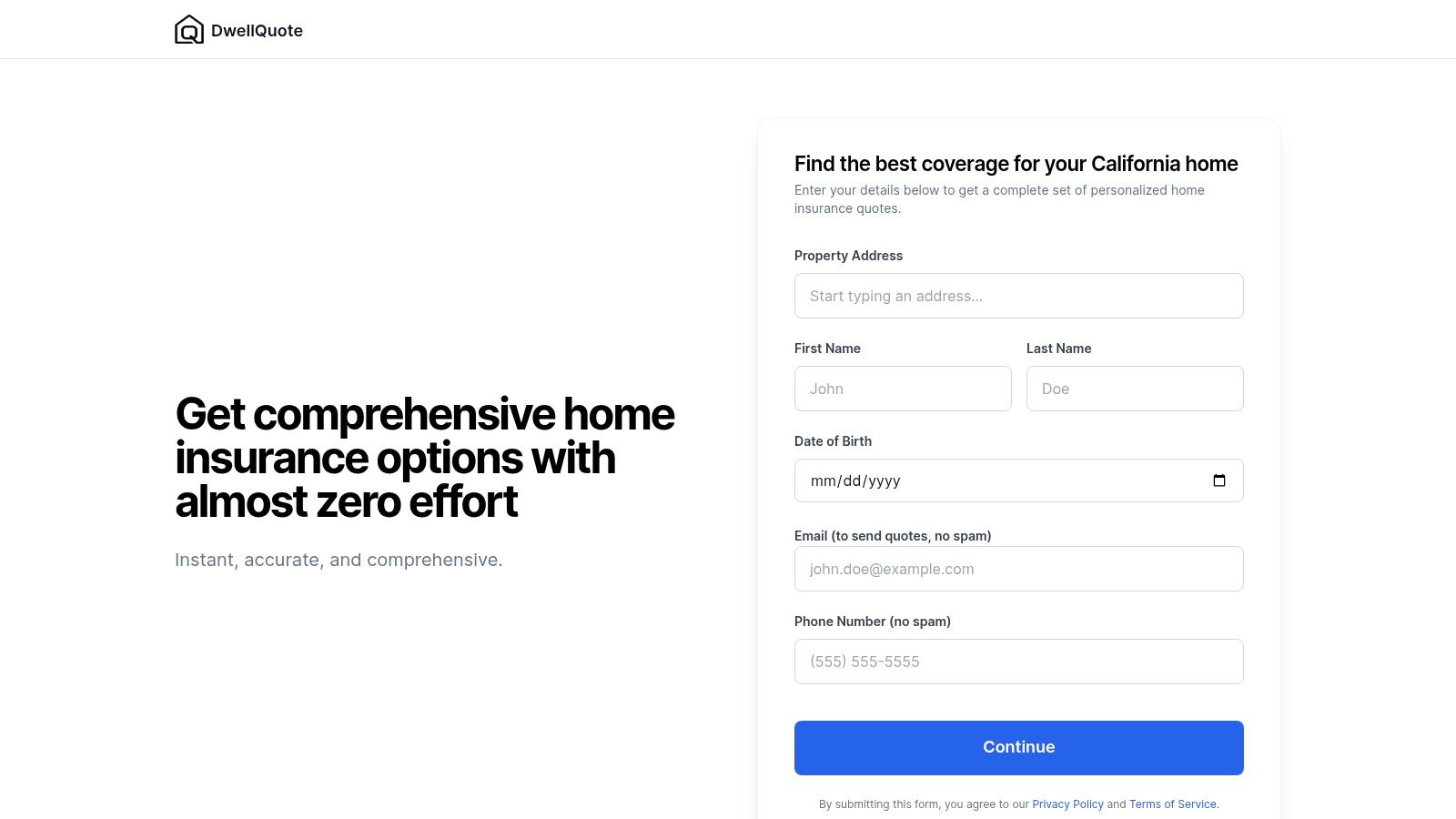
Technology can speed this up if it keeps the coverage visible. A platform such as DwellQuote helps by pulling property data, prefilling much of the application, and showing available quotes side by side so the homeowner is not re-entering the same facts over and over.
Review each quote with four blunt questions:
- Is the dwelling limit believable for current rebuild costs?
- What important risks are excluded or split into separate policies?
- Can the household absorb the deductible after a loss?
- Is this a normal admitted-market quote, or a harder-to-place situation that may require the FAIR Plan plus supplemental coverage?
That last point matters more in Sacramento than many homeowners expect. Costs do not vary only because one company is cheaper than another. They vary because insurers view risk differently by ZIP code, property condition, and exposure. If a standard carrier declines the home, do not freeze and do not grab the first last-minute option. Compare the full structure carefully, especially if the FAIR Plan is involved, because a bare-bones fix can leave major gaps.
The smart approach is simple. Standardize the inputs, compare coverage line by line, and treat unusually low quotes with suspicion. That is how Sacramento homeowners avoid overpaying without buying a policy that falls apart when they need it.
Frequently Asked Sacramento Home Insurance Questions
Why is one Sacramento quote so much higher than another
A homeowner in Natomas can get one price, then see a very different number for a similar house in Pocket or near the foothill edge. That spread is normal in Sacramento.
Insurers do not price this market by city average. They price by address, ZIP code, wildfire exposure, flood concerns, prior local losses, roof age, home condition, and rebuild cost. Two homes can look similar on a real estate site and still price far apart for insurance because carriers see different claim risk and different replacement cost risk.
Is home insurance required in California
California does not require homeowners insurance by law. Mortgage lenders usually require it, and any homeowner without coverage is taking a reckless risk.
A paid-off house still faces the same threats. House fires, burst pipes, theft, liability claims, and storm damage do not care whether you have a loan. In Sacramento, that risk is even harder to ignore because some owners also need to think about wildfire exposure, flood-prone areas, and the possibility that a standard carrier may refuse the property later. Keep coverage in place.
What should a homeowner do after a non-renewal notice
Act immediately.
Start by finding out whether the insurer is exiting for broad underwriting reasons or because your home has a fixable issue such as roof age, tree overhang, deferred maintenance, or prior claims. Then pull together the facts every carrier will ask for, including year built, square footage, roof age, updates to plumbing and electrical, and any recent inspection documents.
Shop the standard market first. If you hit resistance, do not assume every option is the same. In Sacramento, the decision is often whether you still qualify for a standard policy or need to piece together a FAIR Plan plus a supplemental policy. That choice affects both price and coverage quality.
What matters more in Sacramento, location or coverage limit
Location often decides whether you can get a standard policy at all.
Coverage limits still matter because higher rebuild costs raise premiums. But in Sacramento, carrier appetite by ZIP code can matter just as much. A modest home in a tougher area can be harder to insure than a more expensive home in a ZIP code the carrier likes. That is why citywide averages are not very useful here. The address drives the starting point.
When does the FAIR Plan make sense
The FAIR Plan makes sense when standard insurers will not write the home and the remaining alternatives are weak, expensive, or both.
Use it as a fallback, not as a substitute for a normal homeowners policy. The FAIR Plan usually handles only part of the risk, so homeowners often need a separate difference-in-conditions policy for liability, theft, water damage, and other gaps. Review both policies together before you buy. A cheap patchwork setup can fail badly at claim time.
If you want a faster way to sort through options, DwellQuote can help you compare quotes and spot the difference between a standard policy and a fallback setup without repeating the same property details across multiple applications.