
The lender has asked for the homeowners insurance declaration page, and closing is approaching. The document may look like a dense sheet of abbreviations, coverage labels, and dollar figures, but it carries unusual practical weight. It gives the lender, agent, and homeowner a quick way to confirm that a policy exists and that its basic details match the home being financed.
A careful homeowner treats the page as more than paperwork. It works as a proof-of-coverage document, but it also acts as an audit sheet for the policy's limits, deductibles, mortgagee information, and endorsements. A wrong address, missing lender clause, or separate wildfire policy can create problems before a claim or delay a closing.
That matters particularly in California, where one property may involve a standard homeowners policy, a separate fire arrangement, or layered protection. The page deserves a line-by-line review before binding and at renewal, not a quick download followed by filing it away.
Table of Contents
- Introduction What Your Declaration Page Really Proves
- Understanding the Homeowners Insurance Declaration Page
- Breaking Down Every Section on Your Dec Page
- How to Read and Verify Your Declaration Page Before You Bind
- California Considerations and Wildfire Coverage on Your Dec Page
- Common Pitfalls and What the Dec Page Does Not Show
- Final Checklist and Getting Your California Quote With Confidence
Introduction What Your Declaration Page Really Proves
A buyer may receive a request for the dec page while finalizing a purchase, refinancing a loan, or changing carriers. The lender isn't asking for a general statement that the home is insured. It needs evidence that the specific property has an active policy with the required configuration.
The page usually identifies the named insured, property address, policy number, effective dates, coverage sections, limits, deductibles, premium, and mortgagee or loss-payee details. Morty's explanation of standard homeowners insurance documents notes that the lender checks whether the address matches the loan property, whether the policy starts on or before closing, and whether the lender appears under the correct mortgagee or loss-payee clause.
Practical rule: A dec page proves the policy's stated structure. It doesn't prove that every possible loss is covered.
For a first-time buyer, the distinction can feel technical. A page might show a substantial dwelling limit, active dates, and a paid premium, yet the full policy could contain exclusions, conditions, or endorsements that change how a claim works. The summary is therefore both a third-party verification tool and a personal risk review.
A lender focuses on whether its security interest is protected. An agent uses the page to confirm what was quoted and issued. The homeowner should ask a broader question: does this document describe protection that fits the home, the belongings, the liability exposure, and the local hazards?
The document's role at closing
If the property address is abbreviated incorrectly, the effective date begins after closing, or the lender's information is absent, the lender may reject the evidence until someone corrects it. That can hold up the transaction even when an insurer has already issued the policy.
At renewal, the same page helps identify changes from the prior term. Consumer guidance describes the dec page as the document most commonly used as proof of insurance and notes that policyholders generally receive a new page at each renewal. Insurance Geek's guide to declaration pages explains that the current page is often delivered through an insurer's portal or email.
The safest habit is simple. Download the current page, compare it with the quote and prior term, then ask the agent to explain every material change before the homeowner relies on it.
Understanding the Homeowners Insurance Declaration Page
The easiest analogy is a cover sheet and table of contents combined. A book's cover tells a reader what it is, while the contents page shows where the important subjects appear. The homeowners insurance declaration page does something similar for an insurance contract, summarizing who and what the policy covers, when protection applies, and what financial settings govern it.
The document has a longer history than many homeowners realize. Early marine insurance used handwritten declarations of facts about the insured risk. As insurance forms became more standardized in the late 19th and early 20th centuries, declarations became a distinct policy summary. The history of the declarations page and its modern sections identifies the New York Standard Fire Policy of 1886 as a major milestone in formally separating declarations from policy conditions. By the mid-20th century, Insurance Services Office standard forms further formalized the layout.
Summary, not the complete contract
Modern forms usually place the dec page at the front of the policy. It compresses the insured name and address, policy number, policy term, property and liability limits, deductibles, mortgagee details, endorsements, discounts, and premium into a short document. That compression makes the page convenient, but it also creates the central reading mistake: assuming a summary contains the full legal answer.
It doesn't. The policy forms, exclusions, definitions, conditions, and endorsements elsewhere in the contract explain how coverage operates. The declaration page tells a homeowner where to look and what structure was issued, while the full policy supplies the rules.
A lender may only need the page to verify active coverage and its mortgage interest. A homeowner needs to use it as a map, then inspect the policy language behind unusual deductibles, endorsements, or excluded perils. That distinction becomes particularly important when a California property has separate arrangements for wildfire protection.
Breaking Down Every Section on Your Dec Page
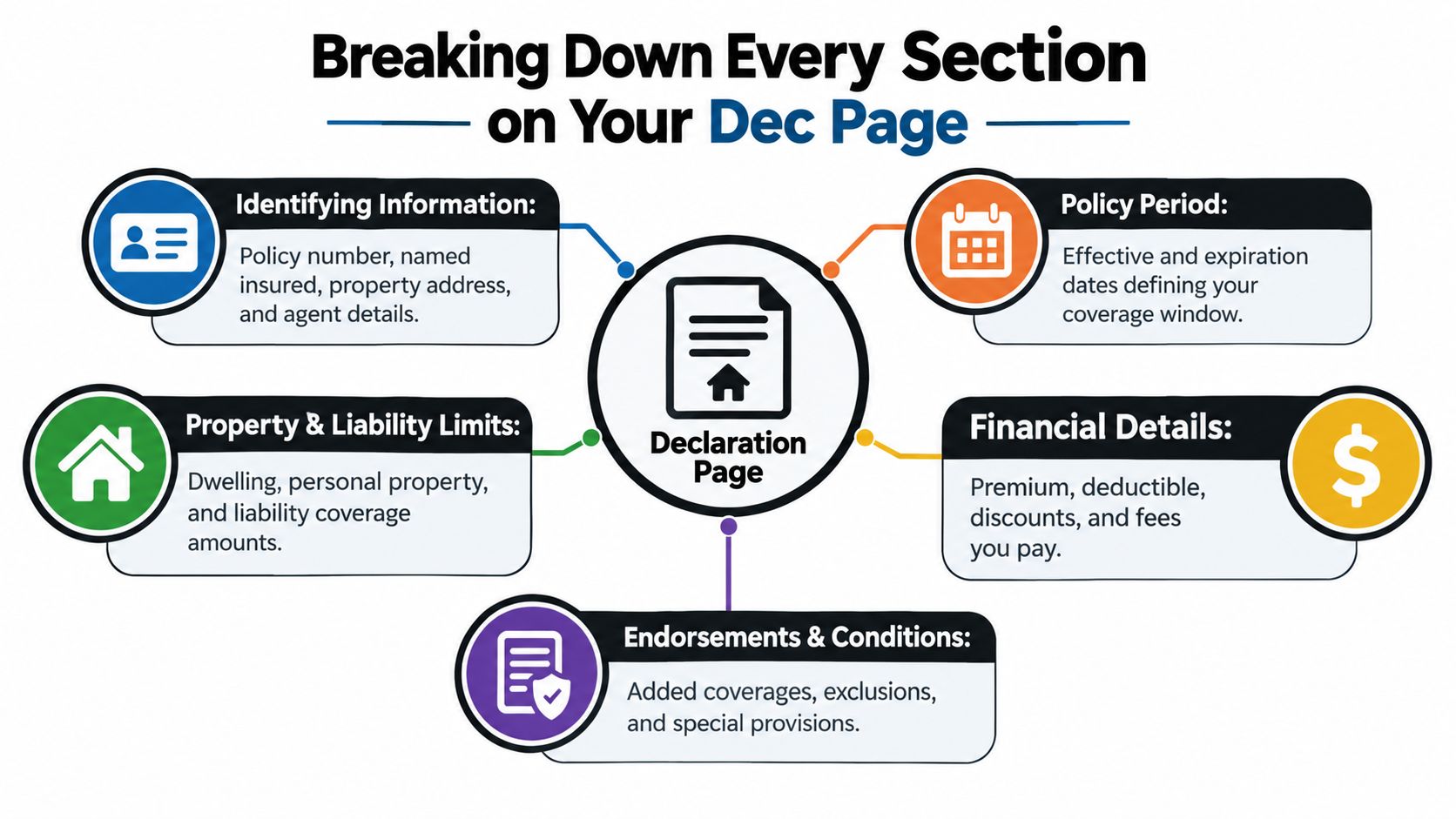
A field-by-field review works best from identity to timing, then from coverage to cost. The exact design differs by carrier, but consumer guidance consistently identifies the same core elements, including the insured address, limits, deductibles, premium, endorsements, discounts, and mortgagee information. The NAIC's homeowners policy guidance also notes that deductibles may appear as dollar amounts or percentages.
Identity and policy timing
Named insured. This is the person or people the policy identifies as insured. Names should match the ownership and loan documents. Spelling errors, omitted co-owners, or an incorrect entity name deserve correction before binding.
Property address. The insured location must identify the home being purchased or renewed. A mailing address can differ from the property address, so both fields should be reviewed separately.
Policy number. This is the carrier's account identifier. It helps the homeowner, lender, and agent locate the correct contract when requesting changes, submitting documents, or reporting a claim.
Policy period. The effective and expiration dates define the coverage window. A closing package should show an effective date on or before closing, not merely a future date selected during the application.
Coverage limits and what they represent
The coverage schedule usually separates the home from other property and personal exposures:
- Dwelling coverage: The limit associated with the insured home structure. It should be evaluated against the estimated cost to rebuild, not the property's market price.
- Other structures: Protection for structures separate from the main residence, subject to the policy's terms and stated limit.
- Personal property: Coverage for belongings such as furniture, clothing, and electronics. The homeowner should ask whether valuation and special category limits require closer review.
- Loss of use: Support for eligible additional living expenses when a covered loss makes the home unlivable, subject to the policy language.
- Personal liability: Protection for covered claims alleging bodily injury or property damage for which an insured is legally responsible.
- Medical payments: A separate coverage section that may respond to certain injury-related expenses under its own terms.
These labels describe the architecture, not an automatic promise that every loss qualifies. A limit can be correct while an exclusion or condition narrows the response.
Deductibles, endorsements, and financial details
The deductible is the amount or percentage the homeowner may need to absorb before insurance responds to a covered loss. A standard deductible may appear beside separate wind, hail, hurricane, or wildfire deductibles. Percentage deductibles are tied to the applicable coverage basis, so the wording beneath the figure matters.
Endorsements modify the base policy. They may add, remove, or reshape coverage, including protection for water backup or scheduled personal property. Discounts, fees, payment information, and total premium show how the policy was priced and what the homeowner is expected to pay.
Finally, inspect the mortgagee or loss-payee section. The lender's legal name and clause need to match its instructions. Nationwide's declaration page guidance also points homeowners to the page for checking interested parties, purchased limits, and current policy information.
How to Read and Verify Your Declaration Page Before You Bind
Reading identifies fields. Verification tests whether those fields are accurate, complete, and consistent with the transaction. A homeowner can perform the audit in a fixed order so that an attractive premium doesn't distract from a missing protection.
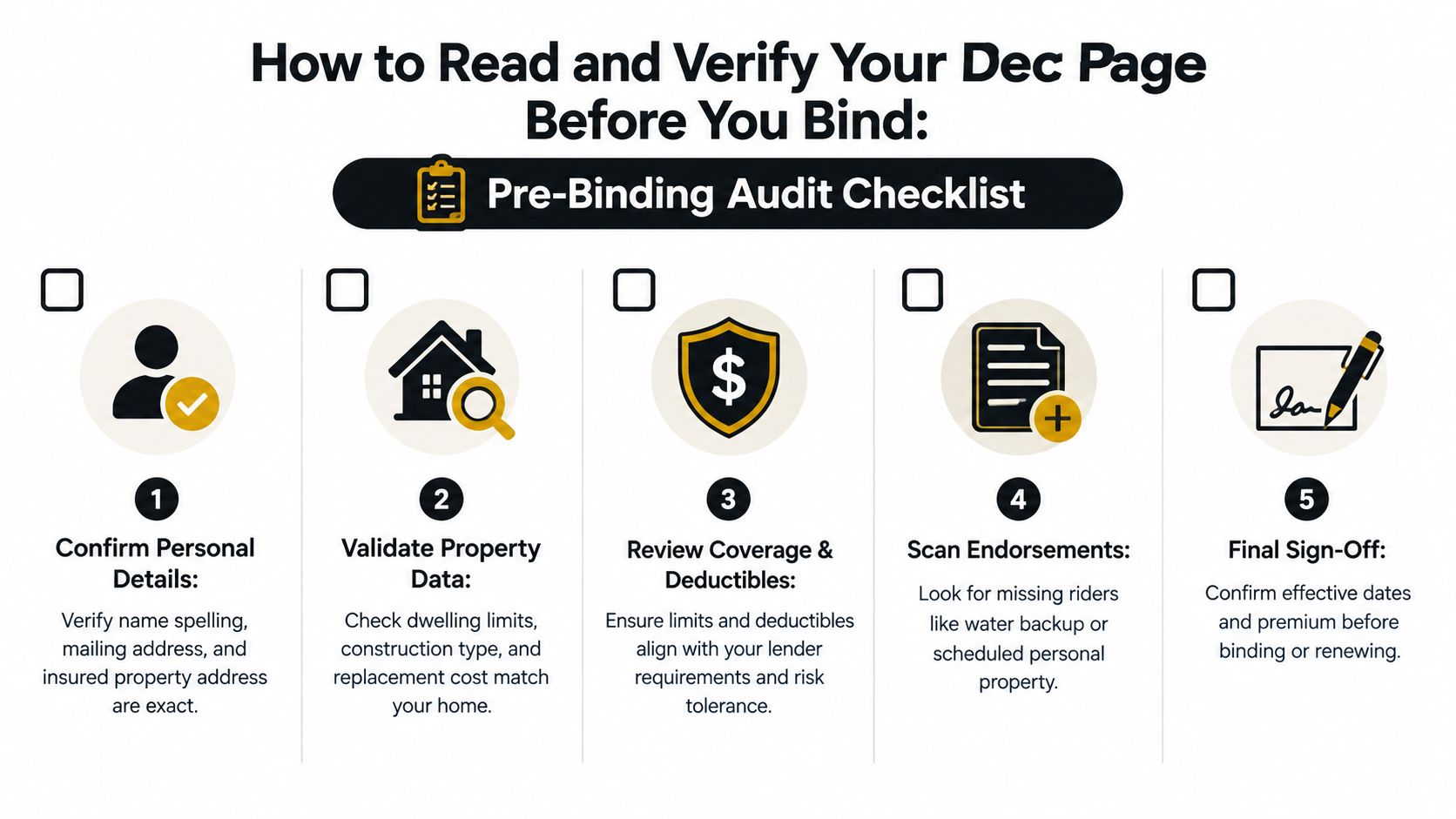
Start with the address and dates. Compare the insured property address with the purchase contract and lender file, including unit, direction, street suffix, and any other identifying detail. Then confirm that the effective date covers closing and that the expiration date belongs to the intended policy term.
Next, compare the named insured with the ownership documents. The lender's mortgagee or loss-payee information should appear exactly as requested. If the lender is missing or listed under an outdated name, the evidence may be rejected until the carrier issues a correction.
The pre-binding audit
The dwelling limit deserves a separate review. It should reflect the home's estimated reconstruction need and relevant property characteristics, not just the loan balance or market value. Construction details, roof information, additions, and major renovations can affect whether the quote describes the actual risk.
Then compare the selected deductibles with the quote. Look for separate catastrophe deductibles, percentage figures, and endorsements that were discussed but don't appear on the page. A missing water backup endorsement, for example, isn't a formatting issue. It may indicate that the purchased policy doesn't include the option the homeowner expected.
| Field to Check | What Correct Looks Like | Red Flag to Fix |
|---|---|---|
| Named insured | Names match ownership and loan documents | A co-owner is missing or a name is misspelled |
| Property address | Address matches the insured home exactly | Unit, street detail, or property location is wrong |
| Policy period | Effective date covers closing or the renewal term | Coverage begins after closing or dates are unclear |
| Mortgagee | Lender appears under the requested clause | Lender information is absent or outdated |
| Coverage limits | Limits match the home profile and selected protection | Dwelling, liability, or personal property limits differ from the quote |
| Deductibles | All applicable deductibles are shown clearly | A catastrophe deductible is missing or unexpected |
| Endorsements | Agreed additions appear on the page or policy schedule | A requested rider isn't listed |
| Premium and discounts | Amount and pricing adjustments match the issued quote | The premium changed without an explanation |
Side-by-side quote review
When comparing carriers, the premium belongs in the final column, not the first. A lower price may reflect a higher deductible, a narrower endorsement package, a different dwelling limit, or separate wildfire arrangements. A clean comparison uses identical rows for limits, deductibles, policy dates, exclusions, endorsements, and mortgagee details.
The same audit applies at renewal. Save the prior page, place it beside the new one, and mark every changed field. If a change isn't clear, the homeowner should ask the agent for the revised form or endorsement rather than guessing from the summary.
California Considerations and Wildfire Coverage on Your Dec Page
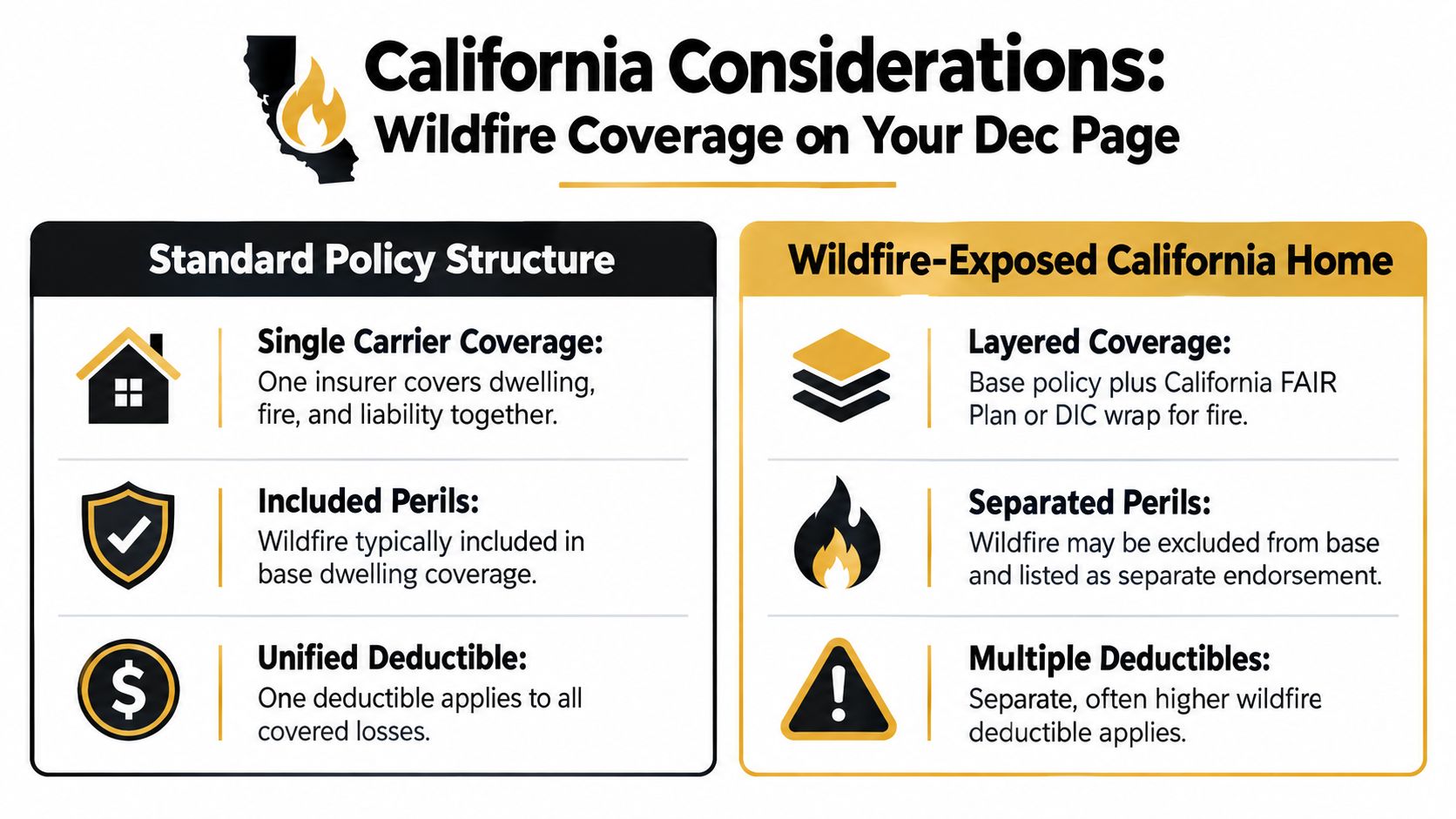
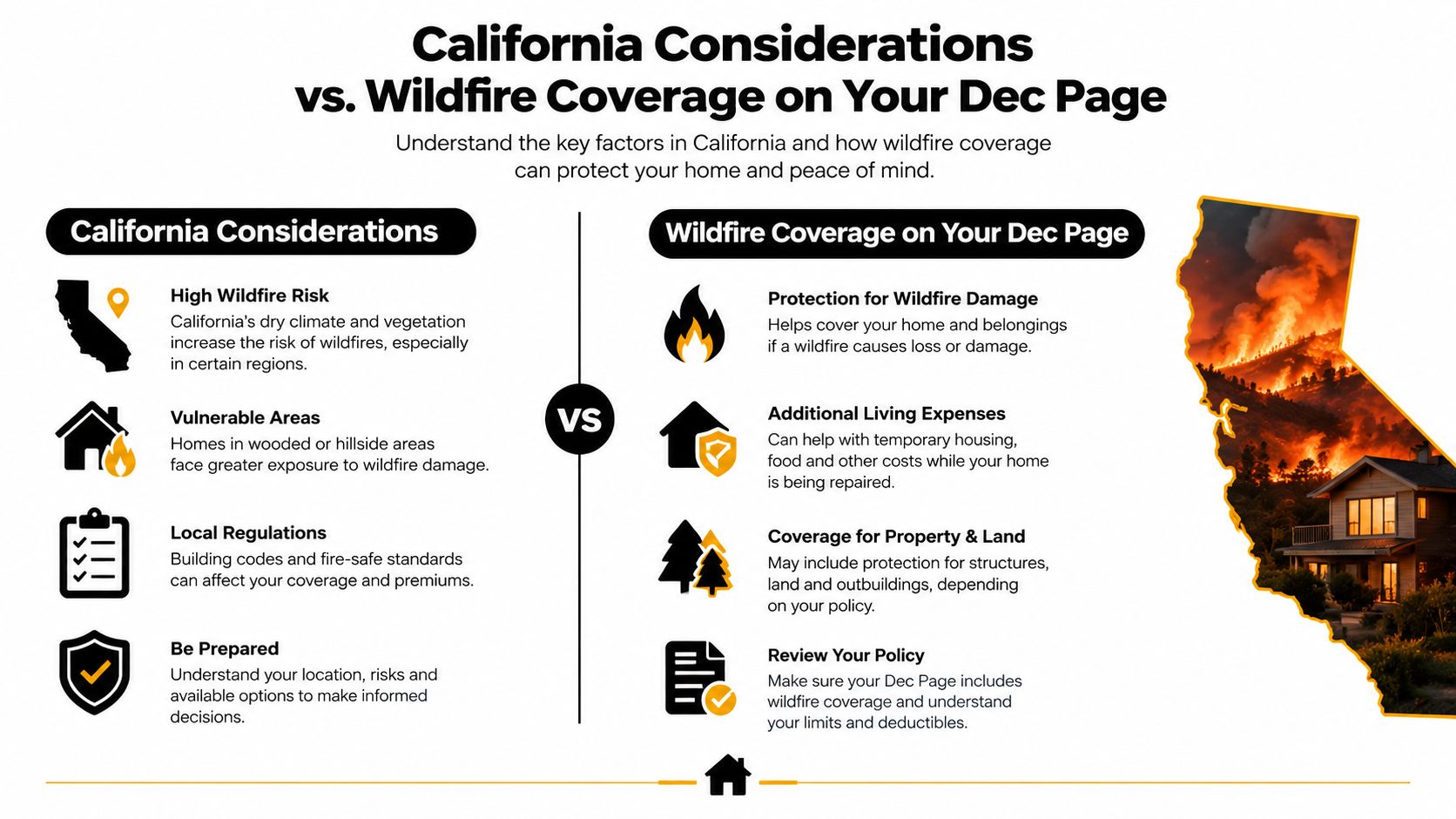
California homeowners in fire-exposed areas may need to read more than one declaration page. A standard policy may sit beside a California FAIR Plan policy or a wraparound difference-in-conditions arrangement, often called a DIC policy. Each layer can have its own policy number, effective dates, limits, and deductible.
That structure changes the basic question from “Is the home insured?” to “Which policy covers which peril, and which deductible applies?” The base policy may handle liability and non-fire protections while a separate arrangement addresses fire-related risks. A homeowner who reviews only one page can misunderstand the total protection.
Single policy versus layered coverage
A single-carrier structure is easier to follow because one declaration page may show dwelling, fire, liability, and other purchased coverages. A layered setup requires a packet-level review. The homeowner should collect every current dec page and place the policy numbers, terms, covered perils, and deductibles in one comparison sheet.
The key questions are practical:
- Where is wildfire listed? It may appear as included coverage, a separate endorsement, or an exclusion from the base policy.
- Which limit applies to the dwelling? A FAIR Plan or wrap may not mirror the limits and conditions of the standard policy.
- Which deductible applies first? Separate policies can create different out-of-pocket obligations, especially when a loss involves more than one covered cause.
- Do renewal dates match? Mismatched terms can leave a layer outdated while another policy renews.
Catastrophe-specific deductibles can be percentage-based. Guidance from the Maryland Insurance Administration's declaration page explanation states that wind, hail, or hurricane deductibles in exposed regions can range from about 1% to 5% of Coverage A. Because the percentage is applied to the dwelling coverage basis, a higher dwelling limit can increase the amount the homeowner must pay before insurance responds.
Changes after wildfire disruption
California's Department of Insurance posted a 2026 one-year moratorium on certain non-renewals tied to declared wildfire disasters in its official moratorium notice. The notice doesn't remove the need to inspect a policy. A new dec page can still show changed limits, exclusions, endorsements, or a different coverage layer.
After a carrier change or renewal, homeowners should ask for every policy number and read the wildfire language in the full forms. A page that appears complete may represent only one part of the protection.
Common Pitfalls and What the Dec Page Does Not Show
The most dangerous misunderstanding is treating the dec page as the entire insurance contract. It summarizes limits, deductibles, premium, and selected endorsements, but it generally doesn't reproduce the detailed exclusions, definitions, conditions, and claims language that determines whether a particular loss qualifies.
That means a high dwelling limit doesn't answer every question about wildfire, wind, hail, water, matching materials, ordinance requirements, or personal property. The answer may sit in an endorsement or exclusion several pages away from the summary.
Three gaps to test
Limit gaps occur when the stated amount isn't enough for the property or exposure. A homeowner should compare the dwelling limit with the reconstruction assumptions, review personal property and liability limits, and account for major renovations or valuable belongings.
Exclusion gaps appear when a peril is removed or narrowed. Wildfire may be handled under a separate policy or endorsement, while water backup and other common concerns may require specific additions. The dec page can signal that an endorsement exists, but the full wording explains its boundaries.
Condition gaps arise when the policy imposes duties after a loss or requirements before coverage applies. Notice, documentation, maintenance, occupancy, and cooperation provisions can matter even when the declarations page looks correct.
A declaration page tells a homeowner what was selected. The policy forms explain how that selection works.
For a first-time buyer, the best follow-up questions are concrete. Which document covers fire? Is the deductible a flat amount or a percentage? Are there separate deductibles for different perils? Does the personal property limit reflect the household's belongings? Which endorsements were included, and what exclusions should receive special attention?
California's Department of Insurance also advises keeping a copy of the current declarations page with home-inventory records. That pairing gives the homeowner a current snapshot and an organized record of possessions, but neither replaces the full policy language.
Final Checklist and Getting Your California Quote With Confidence
Before binding, review the quote and policy as one record. Use this checklist:
- Confirm identity: Names, mailing information, and property address match the transaction.
- Confirm timing: The effective date covers closing or the renewal period.
- Confirm the lender: The mortgagee or loss-payee clause follows the lender's instructions.
- Confirm limits: Dwelling, other structures, personal property, loss of use, liability, and medical payments match the protection you selected.
- Confirm deductibles: Standard and catastrophe deductibles are shown and understood.
- Confirm endorsements: Requested additions appear, and unusual exclusions are checked in the full policy.
- Confirm layers: For a California home using the FAIR Plan, DIC coverage, or another supplemental policy, compare every declaration page.
- Confirm cost: Premiums, discounts, and fees match the quote or renewal explanation.
Pay special attention to dates on layered policies. If the FAIR Plan and DIC declaration pages show different effective or renewal dates, ask the agent or carrier to confirm which dates control before binding. Keep the written response with your policy records.
The homeowners insurance declaration page provides proof of insurance and a quick audit of what was issued. It can help a lender verify the property and help an agent correct an error, but it cannot replace the full policy language. The policy forms determine how exclusions, conditions, and endorsements apply, especially for wildfire-exposed California homes.
DwellQuote can prefill property information, show available home insurance quotes for comparison, and support coverage selection and binding through Somerset Agency, including options for California homes in high fire risk areas. Compare the quote with each declaration page before choosing coverage.
Request a home insurance quote through DwellQuote, then check the address, wildfire arrangements, deductibles, policy dates, and lender requirements before binding. If a declaration page is wrong, request a corrected copy through the carrier portal or from the agent, and keep the replacement with the final policy documents.