

You're under contract on a Massachusetts home, your lender wants proof of insurance, and the first few quotes don't even seem to describe the same policy. That's a common first-time buyer problem here, especially when one home is a Boston condo, another is a South Shore colonial, and a third is a century-old two-family with updated wiring but an aging roof.
Average pricing can give you a rough benchmark, but it will not tell you what you will pay in Massachusetts. Premiums here often shift based on where the home sits, how close it is to the coast, how old the structure is, what it would cost to rebuild, and whether private carriers are comfortable with that specific risk.
Massachusetts has a few quirks that make quote shopping more technical than many buyers expect.
Older housing stock changes the conversation fast. Carriers look closely at roofs, electrical systems, plumbing, and heating updates. Coastal exposure can narrow your options or change deductibles. If private insurers decline the risk, some homeowners may need to look at the Massachusetts FAIR Plan as a backup rather than assuming every carrier will compete for the home.
The buyers who usually get better results follow a clear process. They collect accurate property details before requesting quotes, they check what is covered instead of comparing price alone, and they pay attention to Massachusetts-specific issues that can make one quote look cheap up front but expensive at claim time.
Table of Contents
- Navigating the Massachusetts Home Insurance Market
- Prepare for Your Quotes Like a Pro
- Decoding Massachusetts Home Insurance Cost Drivers
- Comparing Your Homeowners Insurance Quotes Side-by-Side
- Advanced Strategies for Massachusetts Homeowners
- Finalizing Your Policy and Avoiding Common Pitfalls
Navigating the Massachusetts Home Insurance Market
A first-time Massachusetts buyer often hits the same moment of confusion. The inspection is finished, closing is coming up fast, and the lender wants proof of insurance. Two quotes come back for the same house, but the prices are far apart and the coverage details are not lined up in a way that is easy to compare.
That happens for good reason.
Massachusetts insurers are not pricing a street address alone. They are pricing coastal storm exposure, winter weather risk, rebuilding costs, the age of the home, and the condition of major systems. In many parts of the state, older housing stock adds another layer. A house with knob-and-tube wiring, an aging roof, or an older heating system can move a quote noticeably or limit which carriers will offer one at all.
A statewide average can help with rough budgeting, as noted earlier, but it does not answer the question a buyer needs answered. What will this specific home cost to insure, with this carrier, under this set of underwriting rules?
Why the average rarely matches the quote
Two Massachusetts homes with similar sale prices can produce very different insurance quotes. A newer home west of I-495 may be viewed very differently from a Cape or South Shore property with higher wind exposure. An older triple-decker or colonial near Boston may raise separate concerns about replacement cost, electrical updates, or prior renovations.
Carrier appetite matters too. Some insurers are comfortable with older homes if updates are well documented. Others get cautious quickly, especially near the coast or with signs of deferred maintenance. That is why buyers sometimes see one competitive quote, one expensive quote, and one declination.
Generic guides usually stop at the average premium. That leaves out the part that matters in Massachusetts. How carriers judge risk on older homes, how they treat coastal properties, and what options remain if the standard market says no.
Practical rule: Use the average premium as a starting point for your budget, not as a target price.
What buyers should expect in Massachusetts
The smoothest quote process starts with realistic expectations.
Quotes for a straightforward inland home can move quickly. Quotes for an older house, a coastal property, or a home with unusual construction often take more back-and-forth. Underwriters may ask follow-up questions, request update details, or revise terms after they review the property more closely.
That does not mean something is wrong with the house. It usually means the carrier wants a clearer picture of claim risk.
A few habits help:
- Start earlier than you think you need to. This matters most for coastal homes, older homes, and properties with recent renovations.
- Expect underwriting scrutiny. Massachusetts homes often need closer review because age, weather exposure, and rebuilding costs vary widely by location and construction type.
- Read past the premium. A lower quote may come with higher deductibles, tighter water damage terms, or exclusions that only become obvious after a claim.
- Have a backup plan. If private carriers decline the home, buyers may need to look at the Massachusetts FAIR Plan and then compare the coverage carefully against standard-market options.
The goal is not just to get a binder to satisfy the lender. It is to put a policy in place that will still look reasonable after a winter pipe burst, a coastal wind claim, or a serious fire loss.
Prepare for Your Quotes Like a Pro
Accurate homeowners insurance quotes in Massachusetts depend on the quality of the information submitted. If the details are incomplete, the quote may come back low at first and then change later when underwriting reviews the property.
Massachusetts is stricter than many buyers expect. Massachusetts guidance on understanding home insurance says carriers need specific property data including square footage, distance to the nearest fire hydrant and fire department, and the presence of security devices for risk assessment.
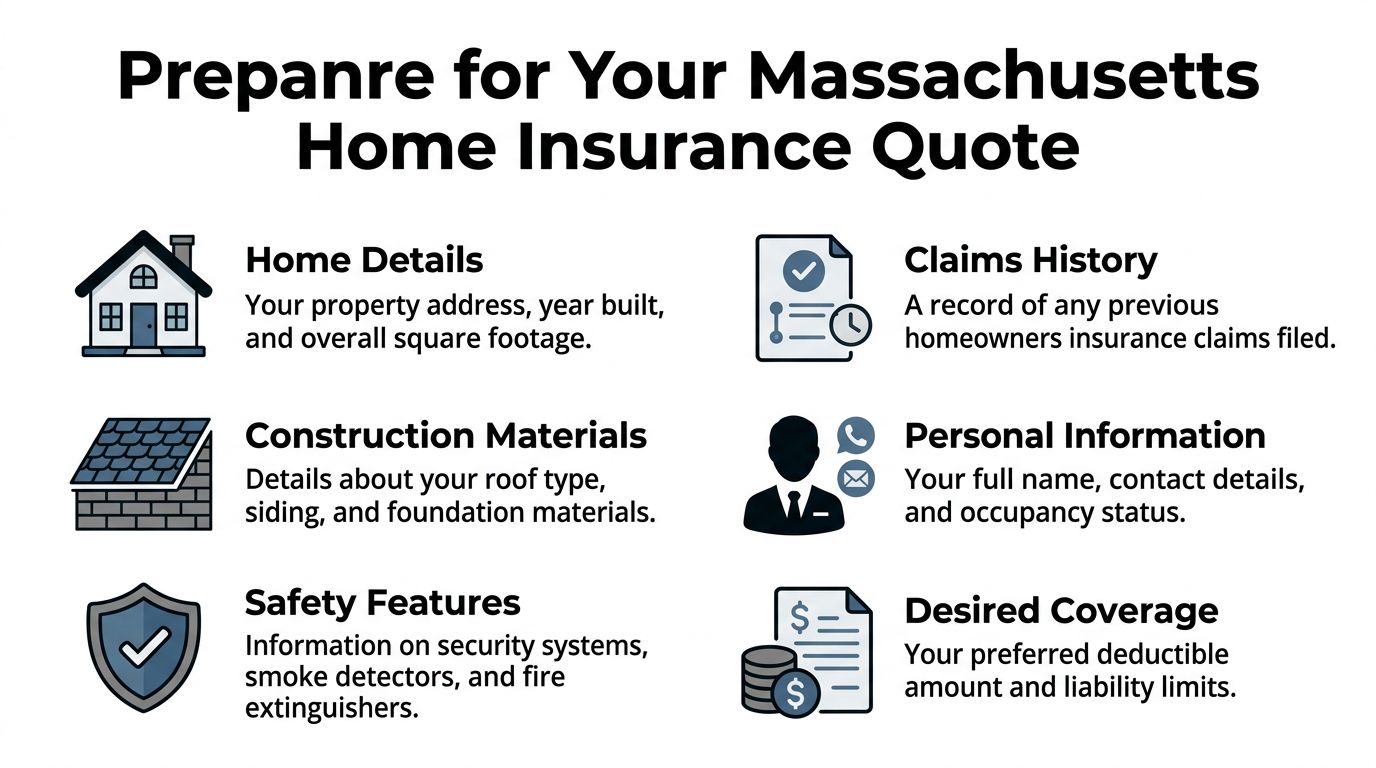
The quote checklist that matters
Buyers should have the following ready before requesting quotes:
- Property basics: Street address, year built, and overall square footage. These are the starting points for rebuilding estimates and underwriting review.
- Construction details: Roof type, siding, foundation, and updates to major systems if known. Older Massachusetts homes often need closer review because construction style can affect claims severity and repair costs.
- Fire protection information: Distance to the nearest fire hydrant and fire department. This is a Massachusetts-specific quoting detail many buyers don't expect, but carriers use it directly in rating.
- Safety features: Alarm systems, smoke detectors, and other protective devices. If a house has them, they should be disclosed from the start so the quote reflects the actual risk profile.
- Occupancy details: Whether the home will be owner-occupied, and when occupancy begins. Carriers price owner-occupied homes differently from other situations.
- Claims history: Prior property or liability losses should be disclosed fully. Leaving them out can create problems later if the carrier discovers them before binding.
Why these details change the price
Insurers don't ask for this information to make the process harder. Each item tells them something practical about loss potential.
A newer roof may suggest lower immediate repair risk than an aging one. A nearby hydrant may improve the home's fire protection profile. Security devices can help reduce certain types of claims. Prior claims history can signal a higher likelihood of future losses or a need for closer underwriting review.
This is also why buyers should avoid mixing rough estimates with exact figures from another quote. If one insurer is quoting the home with a different roof age, different occupancy date, or different protection details, those quotes aren't comparable.
A short prep routine before shopping
A clean quote file usually includes:
- The listing sheet or property record for core home details.
- A recent exterior photo if the carrier asks for one.
- Any record of updates such as roofing, wiring, plumbing, or heating.
- Loss history information for both the property and the applicant when available.
- Preferred deductible and liability choices so every quote starts from a similar base.
Buyers save time when they prepare like underwriters think. The more complete the property profile, the fewer surprises show up at binding.
Decoding Massachusetts Home Insurance Cost Drivers
A first-time buyer in Massachusetts can tour two well-kept homes in the same price range and still get very different insurance quotes. In practice, the biggest drivers are usually location, the home's age and condition, and the applicant's recent claims history.
NerdWallet's Massachusetts home insurance rate analysis shows how wide the spread can be. It reports Boston at $2,395 per year and New Bedford at $3,205 per year. At the county level, Bristol County averages $3,174, compared with Middlesex County at $2,809 and Worcester County at $2,610.
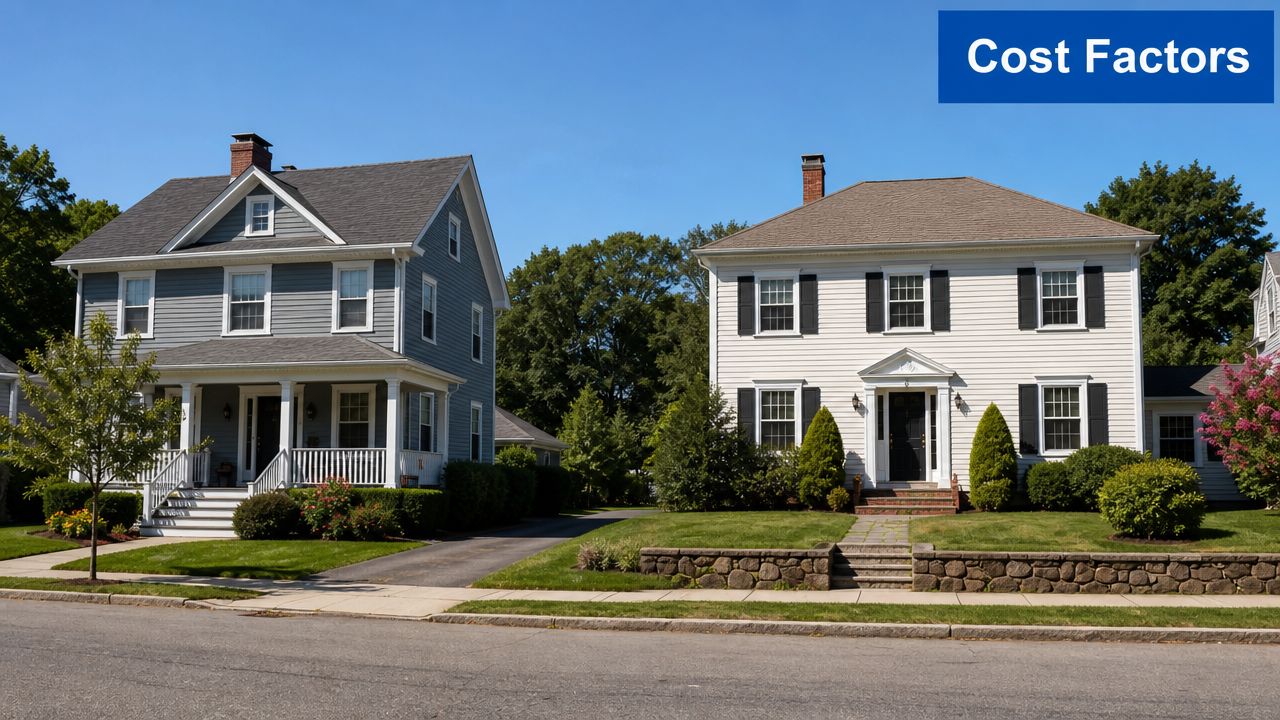
Location changes everything
Massachusetts is not a flat-rate insurance market.
Carriers price for local risk. That includes coastal storm exposure, wind-driven rain, winter weather, neighborhood fire protection, and how difficult or expensive claims tend to be in that area. A home near the shore may face stricter underwriting than a similar home farther inland. In some cases, buyers near the coast may find that private-market options are limited, which is one reason the Massachusetts FAIR Plan sometimes becomes part of the conversation.
The location spread in the NerdWallet data gives buyers a realistic starting point:
| Area | Average annual premium |
|---|---|
| Boston | $2,395 |
| New Bedford | $3,205 |
| Bristol County | $3,174 |
| Middlesex County | $2,809 |
| Worcester County | $2,610 |
That does not mean every home in Worcester County is cheaper than every home in Bristol County. It means geography sets the baseline, and the house itself either improves or worsens that risk profile.
Older homes can be harder to place
Older housing stock is one of the biggest Massachusetts-specific quote issues. Many homes are attractive, well-built, and historically interesting. They also may have aging roofs, older electrical systems, original plumbing, fieldstone foundations, or deferred maintenance that makes underwriters pause.
The trade-off is straightforward. Older homes often need more underwriting review, and some carriers are much more comfortable with them than others. A buyer who can document updates usually gets farther, faster. A buyer who cannot confirm the age of the roof, the type of wiring, or whether the plumbing has been replaced may see fewer options, higher premiums, or coverage conditions before binding.
This is also where replacement cost can surprise people. Older homes can cost more to rebuild than their market value suggests, especially if materials or workmanship are less standard.
An older Massachusetts home is often insurable at a fair price, but the quote improves when the buyer can show what has been updated, when it was done, and whether major systems are still serviceable.
Claims history follows the applicant
Claims history affects price even when the new home looks clean on paper. NerdWallet notes earlier in its Massachusetts pricing data that homeowners with one recent claim pay an average of $2,370 annually, a 14% increase over homeowners with no recent claims.
For buyers, the practical lesson is simple. A recent water, liability, or weather claim can change eligibility, not just premium. Some carriers will still quote competitively. Others will surcharge, limit options, or decline the risk depending on how recent the loss was and what caused it.
That is why full disclosure matters. Underwriters usually find prior claims during the process anyway.
What buyers can control
Some cost drivers are fixed. You cannot change a home's ZIP code, move it farther from the coast, or make a 1920s house become new construction before closing.
Buyers still have room to improve the outcome:
- Document major updates clearly. Roof, wiring, plumbing, heating, and window replacement can all affect underwriting.
- Choose a deductible you can afford. A higher deductible may cut premium, but it only helps if the out-of-pocket amount is realistic after a loss.
- Ask about wind, water, and endorsement details. In Massachusetts, a lower premium is not a bargain if coastal or older-home risks are being handled with tighter terms.
- Keep backup options in mind. If private carriers decline the property, the Massachusetts FAIR Plan may provide a path to coverage while the buyer works on longer-term improvements or placement options.
That is the real pricing picture in Massachusetts. Geography sets the tone, older homes require closer review, and claims history can follow the applicant longer than many first-time buyers expect.
Comparing Your Homeowners Insurance Quotes Side-by-Side
Once the quotes are in hand, the important task is comparison. During this process, many buyers lose money. They look at premium first, assume the cheapest offer wins, and miss the fact that the policies don't match.
Massachusetts makes this especially important because pricing variation can be dramatic. ValuePenguin's review of low-cost Massachusetts homeowners insurers states that Norfolk & Dedham can be 67% to 69% cheaper than the state average, and gives an example of $521 per month on average for a policy with $350,000 of dwelling coverage.
Build a comparison sheet
A basic spreadsheet is enough. Each quote gets its own column. Each major coverage line gets its own row.
The rows should include:
- Dwelling coverage
- Personal property coverage
- Liability coverage
- Loss of use
- Deductible
- Named endorsements or special conditions
- Quoted premium
- Any underwriting notes or subjectivities
That layout keeps the buyer from comparing a broad policy to a stripped-down one as if they were equals.
What to check before looking at premium
Start with the structure of the policy, not the final price.
| Comparison point | What to look for |
|---|---|
| Dwelling coverage | Is the house insured at a level the buyer is comfortable with for rebuilding? |
| Deductible | Is it realistic to pay after a storm, fire, or water loss? |
| Liability | Does the limit fit the household's exposure, visitors, and lifestyle? |
| Endorsements | Are any important protections included by one carrier and missing from another? |
| Conditions | Did one quote assume facts about the home that another quote did not? |
A lower quote sometimes comes from a higher deductible. Sometimes it comes from thinner coverage. Sometimes the carrier is more competitive for that kind of property. The buyer needs to know which one it is.
Decision shortcut: If two quotes aren't built on the same home details and similar coverage limits, the price difference doesn't mean much.
Why multiple quotes matter in Massachusetts
Massachusetts has enough carrier variation that one quote rarely tells the full story. A regional insurer may be very competitive for a certain type of suburban home. Another carrier may do better with newer construction. A coastal property may produce a narrower field.
That's why shopping broadly matters. The point isn't to collect endless estimates. The point is to identify whether a quote is competitive or just the first number that came back.
A practical buyer usually does better by comparing a manageable set of serious options than by chasing every possible insurer. The useful question is not “who is cheapest?” It's “which policy gives the right protection at a price that still makes sense?”
Watch for apples-to-oranges differences
Several details deserve a second look before binding:
- Coverage assumptions: One carrier may have built the quote with different home characteristics than another.
- Deductible comfort level: A premium can look attractive right up until a claim arrives.
- Special limitations: Some policies are more restrictive around certain property features or risks.
- Underwriting follow-up: A quote that still depends on inspection findings or updates isn't fully settled.
Buyers should also keep notes on who asked the most precise questions. That often signals a better quality quote, not a worse experience. Thorough underwriting upfront usually means fewer surprises later.
Advanced Strategies for Massachusetts Homeowners
Some Massachusetts buyers do everything right and still run into trouble. The home may be coastal, older, or difficult for standard carriers to place. In those cases, buyers need more than ordinary shopping advice. They need fallback options and smarter ways to manage risk.
One of the most important is the FAIR Plan, formally the Massachusetts Property Insurance Underwriting Association. MAPFRE's Massachusetts home insurance guide highlights it as a critical last resort for homeowners denied by private carriers, and notes that 12% of Massachusetts homeowners in high-wind or flood zones reported difficulty securing coverage in 2025.
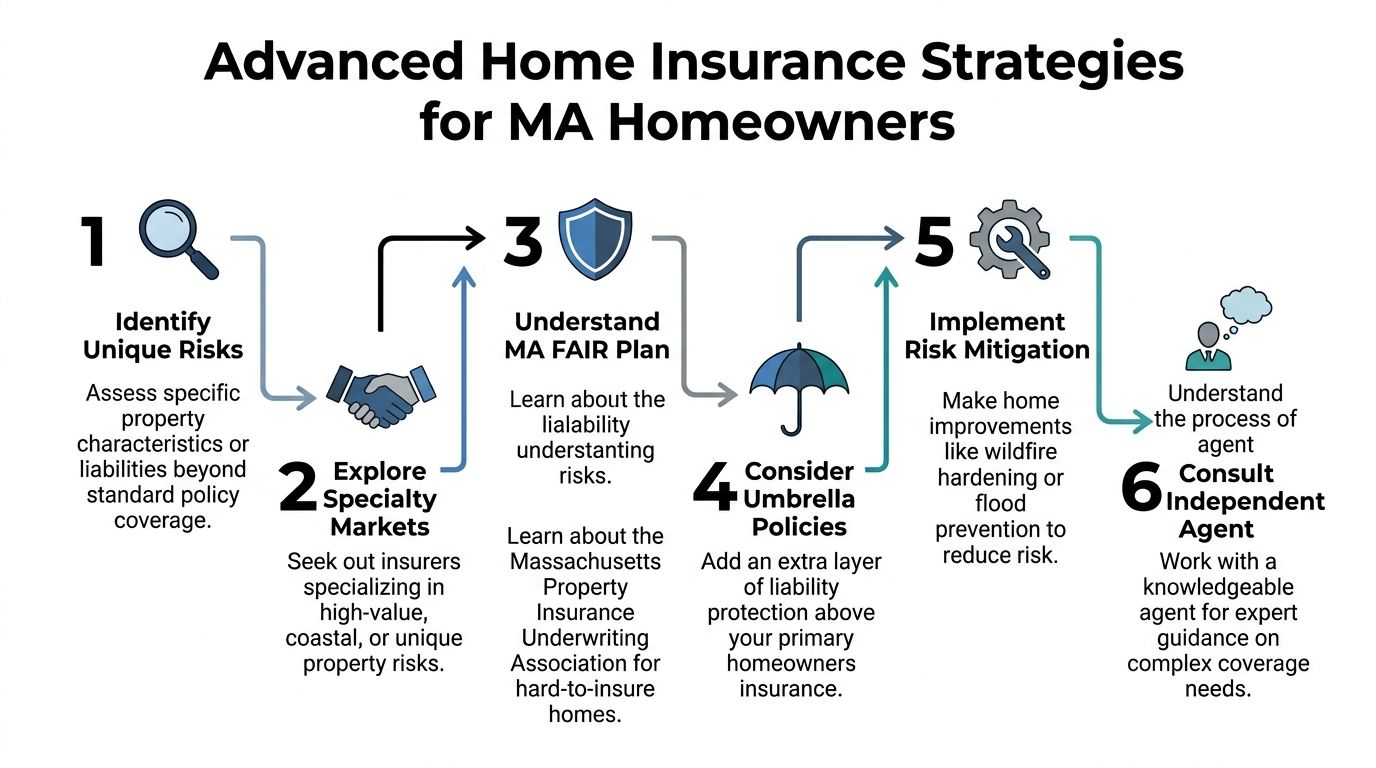
When the FAIR Plan becomes relevant
The FAIR Plan isn't the first stop for most buyers. It's the safety net when private market options become limited or unavailable. That makes it especially relevant for harder-to-insure homes, including some properties with heavy weather exposure or underwriting challenges.
A first-time buyer should know two things about it. First, it exists for a reason. Second, using it may involve different coverage boundaries than a standard private-market policy, so it should be reviewed carefully rather than treated as interchangeable.
This is one area where many online guides stay too shallow. Buyers in difficult placements need to ask early whether they are shopping the private market normally or preparing for a fallback route.
Some homes don't fit neatly into standard underwriting boxes. Knowing the backup option before closing can keep a tough property from becoming a last-minute crisis.
Don't overlook endorsements and layered protection
Massachusetts buyers with higher weather exposure should also ask about policy options that change how losses are handled after a storm. Generic quote comparisons often miss these details because they focus on premium first.
The most useful strategy here is to think in layers:
- Core homeowners policy: The base contract for dwelling, property, and liability.
- Targeted endorsements: Added protections that may address gaps or reduce the financial sting of specific claims.
- Extra liability protection: For households that want more protection than the base homeowners policy provides.
Even when the home isn't hard to insure, this layered approach creates better decision-making. A buyer can keep the core policy competitive while making deliberate choices about where more protection is worth paying for.
Homes that need a more careful approach
The properties most likely to need advanced planning usually share one or more of these features:
- Coastal exposure: Higher wind concerns and tighter underwriting.
- Older construction: More scrutiny around systems, materials, and repair complexity.
- Unique rebuilding profile: Homes that may be costlier or more complicated to repair than a standard suburban property.
- Prior insurance difficulty: Any property or applicant history that has already produced nonstandard results.
For those buyers, timing matters. Insurance shouldn't be left until the final days before closing. A difficult placement often takes extra follow-up, and the right solution may require more than one path.
Finalizing Your Policy and Avoiding Common Pitfalls
Choosing a quote isn't the same thing as finishing the job. The last review matters because at this stage small oversights become expensive problems.
The buyer should confirm the policy effective date, verify that the named insured information is correct, and make sure the mortgage lender receives proof of insurance in time for closing. If the home has unusual features or underwriting conditions, those should be reviewed one more time before payment is made.
The mistakes that cause the most trouble
The most common pitfalls are avoidable:
- Buying on premium alone: A cheap policy can become a bad deal if the deductible or coverage setup doesn't fit the buyer's real risk.
- Skipping a final document review: Even a good quote can contain assumptions that need correction before binding.
- Underestimating rebuild concerns: Massachusetts homes vary widely in age and construction, so buyers should make sure the policy reflects the property they are insuring.
- Treating lender requirements as the full standard: The lender needs proof of insurance. The homeowner needs coverage that will still make sense after a loss.
A final buying standard
A sound policy should meet three tests. It should satisfy the lender, match the home, and leave the owner with a deductible and coverage structure they can realistically live with.
If any one of those is off, the quote needs another look before it becomes a policy.
The best Massachusetts homeowners insurance quote isn't the one that arrives fastest or costs the least. It's the one that stands up under pressure, especially on an older home, in a coastal area, or after a difficult weather event.
Request a Massachusetts home insurance quote through DwellQuote to compare options more efficiently and move toward closing with confidence.