

The renewal email lands on a Tuesday afternoon. The premium is up again, the deductible looks different, and the language about inspections and mitigation sounds more demanding than last year. In parts of Southern California, that scene has become routine. For some homeowners, the shock is the price. For others, it's the non-renewal notice.
That pressure isn't random. Wildfire losses, stricter underwriting, higher rebuilding costs, and carrier pullbacks have changed how homeowners insurance works across Los Angeles, Orange County, Ventura, San Bernardino, Riverside, and San Diego. A house isn't priced only by square footage anymore. It's priced by exposure, construction details, terrain, and whether the property fits an insurer's current appetite.
The good news is that homeowners can still make smart moves. The strongest results usually come from treating insurance as a financial protection plan, not just a bill to cut. That means understanding the base policy, identifying true gaps, and matching coverage to the actual risks attached to the address.
Table of Contents
- Navigating the Southern California Home Insurance Market
- What Standard Homeowners Insurance Actually Covers
- Wildfires Earthquakes and Mudslides Oh My
- Building a Bulletproof Policy with Endorsements
- Why Is Home Insurance So Expensive in Southern California
- Get Accurate Home Insurance Quotes Without the Hassle
- Securing Your Southern California Home and Future
Navigating the Southern California Home Insurance Market
A common Southern California scenario looks like this. A homeowner in a hillside neighborhood opens a renewal and sees a much higher premium, a new wildfire-specific deductible, or a request for updated photos of the roof, vents, brush clearance, and siding. The home hasn't changed much, but the insurer's view of the risk has.

That shift has been building for years. Homeowners insurance costs in Southern California have risen sharply. In Pacific Palisades, the average annual premium went from $5,025 in 2007 to $6,689 by 2023, a rise of 33% above inflation, according to key California premium statistics. The same source ties those increases to repeated wildfire events and higher construction costs.
What changed in the market
Several of California's largest homeowners insurers have reduced capacity or pulled back from parts of the state since 2022, especially in higher-risk areas, as described in PPIC's look at California's homeowner insurance challenges. For homeowners, that usually shows up in three ways:
- Fewer quote options because some admitted carriers won't write new business in certain neighborhoods.
- Stricter underwriting with inspections, vegetation requirements, and more scrutiny on roof age and materials.
- Less forgiving renewals when a property no longer fits a carrier's wildfire model.
The hardest part of homeowners insurance Southern California shoppers face isn't understanding that risk is high. It's seeing how that risk changes the policy terms line by line.
What a practical response looks like
The strongest approach is methodical. Start with the base policy. Check where the major exclusions sit. Review whether the dwelling limit still matches current rebuilding reality. Then compare carriers based on both price and fit for the property.
That matters because the cheapest quote can become the most expensive mistake if it leaves out the coverage that matters for a Southern California home. A strong policy doesn't try to eliminate every cost. It puts money toward the exposures most likely to create a serious loss.
What Standard Homeowners Insurance Actually Covers
A standard HO-3 homeowners policy is the starting point for most owner-occupied single-family homes. It's best understood as a financial safety net with several layers. Each layer handles a different kind of loss. That structure matters because many homeowners focus only on the premium and miss how the policy is built.
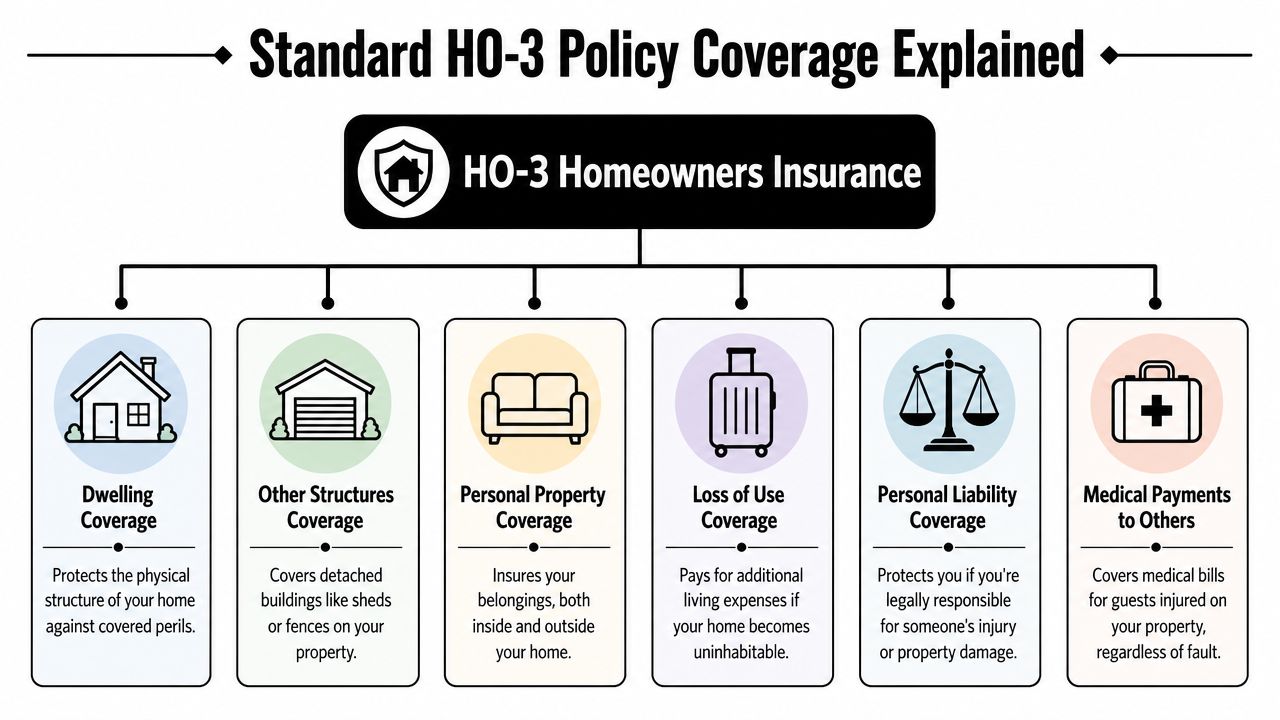
The six core parts of an HO-3 policy
The usual HO-3 framework includes these coverage areas:
- Dwelling coverage protects the house itself against covered causes of loss.
- Other structures coverage applies to detached garages, fences, and similar structures.
- Personal property coverage insures belongings inside the home and often beyond it, subject to policy terms.
- Loss of use coverage helps with additional living expenses if a covered loss makes the home uninhabitable.
- Personal liability coverage responds if the homeowner is legally responsible for injury or property damage.
- Medical payments to others covers smaller guest injury expenses regardless of fault.
Why this baseline still matters
Even though California doesn't require homeowners insurance for a person who owns a home outright, lenders generally do require fire and hazard coverage as a condition of the loan, as explained in the California Department of Insurance Residential Insurance Guide. For most buyers, that makes insurance part of the financing structure, not an optional afterthought.
A useful way to think about an HO-3 policy is this:
| Policy area | What it does | Why it matters in practice |
|---|---|---|
| Dwelling | Protects the main structure | This is the core limit that determines rebuilding funds after a covered structural loss |
| Property | Covers belongings | Furniture, electronics, clothing, and household items add up fast |
| Liability | Protects against legal claims | One accident on the property can create a large financial problem |
| Loss of use | Pays for temporary living costs | Hotel stays, meals, and temporary rent can become expensive quickly |
Practical rule: An HO-3 policy is the foundation, not the finished product, for most Southern California homes.
Where homeowners get tripped up
The confusion usually starts when people assume “homeowners insurance” means “everything that can happen to a home.” It doesn't. Standard coverage handles many common property and liability losses, but it doesn't automatically solve every regional hazard.
That distinction matters more in Southern California than in many other markets. A homeowner can have a valid, lender-approved policy and still carry major gaps tied to local environmental risks. That's why reading only the declarations page isn't enough. The exclusions, endorsements, deductibles, and limit structure matter just as much as the premium.
Wildfires Earthquakes and Mudslides Oh My
Southern California insurance decisions get expensive when homeowners assume all major disasters sit inside one standard policy. They don't. Some losses are covered by the base homeowners form. Others require a separate endorsement, separate policy, or a different strategy entirely.
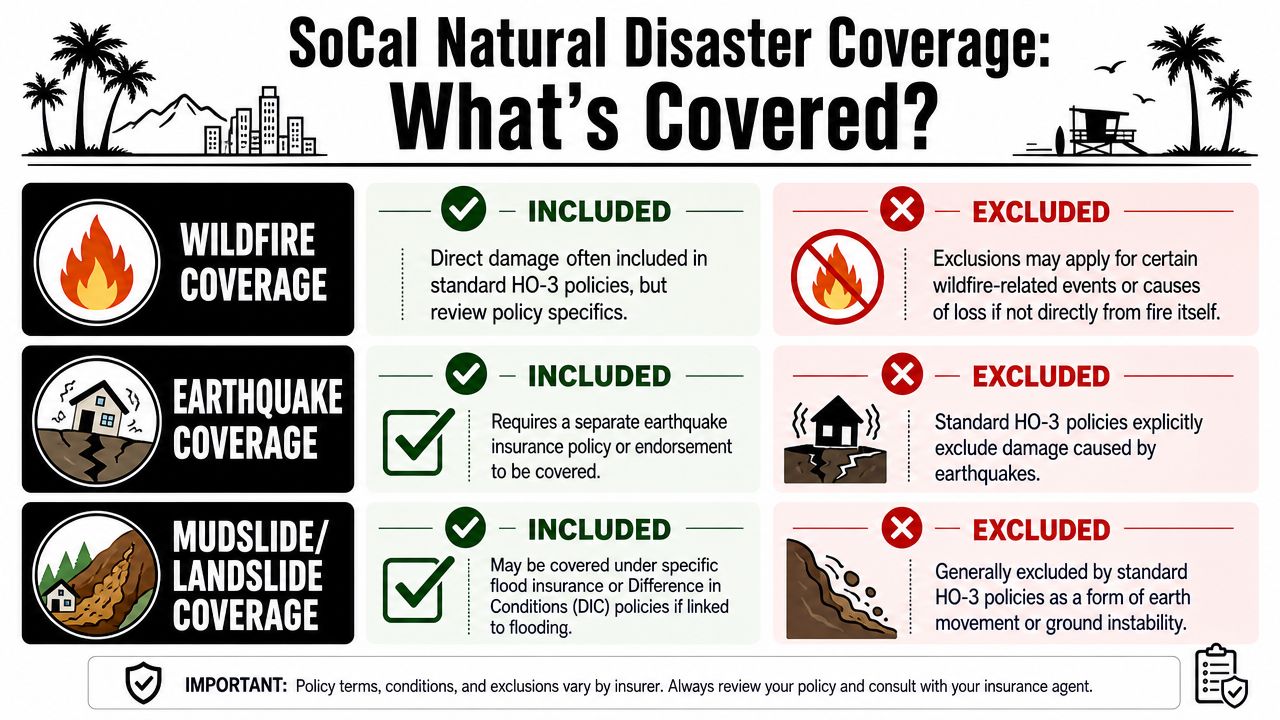
Wildfire is covered but underwriting is tougher
For many homeowners, the first surprise is that wildfire-related structural damage is typically covered by a base policy. The second surprise is that getting or keeping that policy has become harder. Southern California insurers now condition renewal on mitigation items such as ember-blocking attic vents and Class-A roof materials, and underwriting often turns on specific construction details and defensible space.
That's one reason two similar homes can price very differently. A hillside property near wildland interface conditions may be treated very differently from a home in a denser urban core, even if the homes are otherwise comparable.
Earthquake is a separate decision
Earthquake is where many homeowners carry false confidence. Standard homeowners policies generally don't cover earthquake damage. In Southern California, that means the homeowner has to make an active choice to add separate protection.
Premiums for that coverage are heavily influenced by a home's proximity to fault systems such as the San Andreas. Soil conditions, structure type, and rebuilding cost also shape the underwriting decision. For some homes, earthquake premiums can rival or exceed major parts of the base homeowners premium.
A quick decision guide helps:
- Older home near known fault activity usually deserves a serious earthquake review.
- Recently purchased home with substantial equity often needs protection beyond the lender's minimum interest.
- Homeowner with liquid reserves set aside for major structural repair may choose a higher deductible approach rather than broad first-dollar protection.
A homeowner can be well insured for fire and still be almost uninsured for seismic loss.
Mudslide and flood are where assumptions fail
Mudslide, landslide, and flood create some of the biggest misunderstandings in homeowners insurance Southern California planning. A homeowner may be covered when wildfire directly burns the structure, but the later ground movement or water-driven event can fall outside the standard homeowners form.
That distinction is especially important for canyon properties, foothill homes, and houses below burn scar areas. If rain hits unstable terrain after a fire, the cause of loss analysis matters. Standard policies generally exclude earth movement, and flood-related protection is often handled separately.
The practical takeaway is simple. A homeowner shouldn't ask only, “Am I covered for wildfire?” The better question is, “Which part of the chain of damage is covered, and which part isn't?”
The real gap to watch
The most dangerous mistake isn't buying the wrong deductible. It's assuming one policy covers all three categories below:
| Peril | Typical treatment under standard homeowners insurance |
|---|---|
| Wildfire | Often included for direct fire damage |
| Earthquake | Typically excluded unless added separately |
| Mudslide or landslide | Generally excluded as earth movement, with some situations requiring specialty solutions |
That's why a Southern California policy review has to go beyond the declarations page. The local hazard profile determines whether the homeowner needs a stronger package than a plain base policy.
Building a Bulletproof Policy with Endorsements
A homeowner in Pasadena, Anaheim Hills, or the Santa Clarita Valley can carry a standard policy, pay a high premium, and still have a weak protection plan. The problem is rarely the declarations page alone. The problem is the gaps between what the base policy covers, what the property is exposed to, and what a rebuild would cost in Southern California.
That is where endorsements matter. They turn a generic policy into a financial plan built for the address.
The add-ons that matter most
The right add-ons depend on the house, the lot, and the owner's budget tolerance. In my experience, these are the endorsements and companion coverages that deserve the closest review for many SoCal properties:
- Earthquake coverage fills a major exclusion in the standard homeowners form. The right setup depends on foundation type, year built, fault proximity, and how much deductible the homeowner could realistically absorb after a loss.
- Flood coverage deserves review for homes near channels, below burn areas, on low-lying streets, or anywhere runoff can move fast during heavy rain. A standard homeowners policy usually does not handle that exposure.
- Extended replacement cost gives the dwelling limit more room when labor and material prices jump after a regional catastrophe.
- Building ordinance or law coverage helps pay for code upgrades required during reconstruction. Older homes in Southern California often need this more than owners expect.
- Water backup coverage can help with losses tied to drains, sewers, or sump-related backup, which is a different problem from outside floodwater.
Rebuild math needs close attention here. A policy can look adequate until you price debris removal, architectural plans, permit costs, code upgrades, and current contractor rates in Los Angeles, Orange County, or the Inland Empire. That is why the dwelling limit should be reviewed regularly, especially after renovations or sharp changes in local construction costs.
How to prioritize without overbuying
The best approach is to rank endorsements by loss severity, not by how often they get mentioned in a quote comparison.
Start with the exposures that could force a six-figure or seven-figure out-of-pocket hit. For many Southern California homeowners, that means dwelling limit accuracy, ordinance or law coverage, and any separate earthquake or flood solution that fits the property. Smaller add-ons can still help, but they should not crowd out the coverages that protect the balance sheet.
A practical review usually follows this order:
- Confirm the replacement cost basis for the dwelling, detached structures, and major upgrades.
- Check code-upgrade exposure if the home is older or has outdated systems.
- Review catastrophe gaps such as earthquake and flood based on the address, topography, and drainage pattern.
- Compare deductibles so the out-of-pocket amount is realistic across different types of loss.
- Add narrower endorsements last after the large financial gaps are addressed.
Where homeowners waste money
Money gets wasted when endorsements are chosen like a preset bundle instead of a property-specific plan.
Common mistakes include:
- Buying the package a neighbor bought even though the construction type, slope, and hazard profile are different
- Focusing on premium before limit adequacy, which often leaves the dwelling underinsured
- Relying on lender minimums even though mortgage requirements are designed to protect the loan, not the homeowner's full financial exposure
- Missing deductible differences between the main policy and any separate earthquake, flood, FAIR Plan, or difference-in-conditions coverage
Coordination matters too. A FAIR Plan paired with a companion policy can work well. So can separate earthquake and flood protection. But the forms need to be lined up carefully so the homeowner knows which policy responds first, which exclusions still apply, and where deductibles stack. If that review does not happen before a claim, the confusion shows up at the worst possible time.
Why Is Home Insurance So Expensive in Southern California
The premium isn't built from one factor. Insurers price a Southern California home using a layered risk model that goes far beyond market value or square footage. The property's location, hazard mapping, construction details, claims environment, and expected repair cost all shape the number.
Insurers price the property not just the homeowner
One of the clearest examples is wildfire scoring. In Southern California, two otherwise similar homes can see a 100 to 200 percent premium differential based on wildfire-zone location, and the growth of the FAIR Plan to about 3.7% of California homeowners policies reflects how many properties no longer fit traditional carrier appetite. Those figures appear in the verified market data provided for this topic.
A premium can also move because insurers evaluate details such as:
- Wildland-urban interface exposure and parcel-level fire mapping
- Roof rating and age including whether the home has Class-A materials
- Attic vent design and whether ember intrusion mitigation is present
- Siding and cladding type
- Slope, access, and surrounding vegetation
- Proximity to fault systems for earthquake-related underwriting decisions
- Local rebuilding cost pressure for the dwelling limit
The market-share picture matters too. California's leading homeowners writers include State Farm, Farmers Insurance, Mercury Insurance, Auto Club Exchange, and CSAA Insurance Group, according to the Insurance Information Institute's California writer rankings. When major carriers tighten their appetite, the remaining options can become more expensive or more selective.
What homeowners can influence
Some pricing drivers are fixed. A homeowner can't move a canyon wall or a fault line. But some underwriting inputs can improve with deliberate work.
The steps that often help most are practical, visible, and documentable:
- Clear defensible space and maintain it consistently.
- Upgrade the roof if the current material doesn't meet stronger fire-resistance expectations.
- Install ember-resistant vents and address openings where wind-driven embers can enter.
- Keep exterior condition strong because deferred maintenance makes underwriting harder.
- Prepare a clean property profile with accurate square footage, build year, roof details, and updates.
A useful comparison looks like this:
| Risk factor | Homeowner control |
|---|---|
| Fire-zone location | Low |
| Fault proximity | Low |
| Roof material | High |
| Defensible space | High |
| Exterior maintenance | High |
| Accuracy of property data on the application | High |
Bottom line: Carriers don't price only the house that exists on paper. They price the risk they see at the address.
That's why homeowners sometimes get better results by improving the submission quality before shopping than by calling more carriers alone. Clear data, current mitigation, and realistic coverage limits can produce a better underwriting outcome than bargain hunting alone.
Get Accurate Home Insurance Quotes Without the Hassle
A homeowner in Mission Viejo gets three quotes in one afternoon. One looks cheap until you notice the dwelling limit is light. Another includes a separate wind or fire deductible the owner did not expect. A third prices in endorsements the first two left out. On paper, it looks like progress. In practice, it is three different financial plans for the same house.
That is where quote shopping breaks down in Southern California. The issue is not getting quotes. The issue is getting quotes built on the same assumptions, so you can see which carrier is offering better value and which one is only cutting coverage.
Why the old shopping process breaks down
The old process is repetitive and messy. Homeowners give the same details to multiple agencies, answer the same questions about roof age, prior claims, pets, occupancy, and remodels, then get back proposals that are hard to line up side by side.
In Southern California, small input errors can create big pricing and coverage differences. If one quote uses stale square footage, misses a kitchen renovation, or understates finish quality, the dwelling limit can come in too low. That makes the premium look better than it should and leaves the homeowner carrying more rebuild risk than intended.
I see this often with hillside homes, older coastal properties, and houses that have been expanded over time. County records, MLS data, and what the carrier has in its system do not always match. If the quote is built on bad property data, the premium is only part of the problem.
How to compare quotes the right way
Start with the house, not the price.
A cleaner comparison process looks like this:
- Confirm the property facts first. Check square footage, year built, roof type, construction style, major updates, and any attached or detached structures.
- Review the dwelling limit before comparing premium. A low limit can make a quote look competitive while shifting rebuild cost back to the homeowner.
- Check deductibles line by line. In this market, deductible structure matters almost as much as rate.
- Identify what is missing. Ordinance or law, water backup, scheduled valuables, and other add-ons can change the quality of the policy fast.
- Match the carrier to the address. A carrier that works well for a condo near the coast may not be the right fit for a home near brush, slope, or limited fire access.
This is less about collecting more quotes and more about standardizing them. Once the property details, limits, and deductibles are lined up, the trade-offs become clear. One carrier may charge more but offer broader loss settlement. Another may save money up front but leave larger gaps after a claim.
For busy homeowners, speed matters. Accuracy matters more. A fast quote is useful only if the coverage is built for the specific house.
Securing Your Southern California Home and Future
Southern California homeowners face a tougher insurance environment than they did a few years ago. Premium pressure is real. Carrier appetite is narrower. Regional hazards create gaps that a standard policy doesn't automatically solve.
But this isn't a market where homeowners are powerless. Strong decisions usually come from a few disciplined moves. Know what the HO-3 policy covers. Identify which local risks sit outside that form. Add endorsements or separate policies where the financial exposure is serious. Keep the property insurable with documented mitigation and accurate home data.
The best coverage plan is the one built for the address, not the one copied from a neighbor or chosen only because it had the lowest premium. A coastal bungalow, a canyon home, a hillside property, and an Inland Empire subdivision house can all need different coverage emphasis even when their values look similar on paper.
Homeowners insurance Southern California decisions are part risk management, part rebuilding math, and part underwriting strategy. When those three pieces line up, the homeowner is in a much stronger position to protect equity, satisfy lender requirements, and avoid ugly surprises after a loss.
Ready to stop guessing and see real options side by side? Request a home insurance quote through DwellQuote to compare California coverage faster, check whether your dwelling limit reflects current rebuilding reality, and find a policy that fits your address without the usual back-and-forth.