

A renewal letter lands in the mailbox, and the premium is suddenly higher than expected. A Sacramento homeowner may be facing a 22% increase, while an Inland Empire homeowner may be holding a nonrenewal notice after another difficult wildfire season. The natural reaction is to search for a cheaper policy, but changing carriers is not a coupon hunt. It's a coordinated insurance, lender, escrow, and documentation workflow.
California homeowners need to protect two things at once: continuous coverage and the right coverage form for the property's actual risks. A lower premium can be a poor trade if it comes with a larger wildfire deductible, actual cash value roof coverage, weaker loss-of-use protection, or an exclusion that wasn't visible in the initial quote.
Table of Contents
- Why California Homeowners Switch and When It Actually Makes Sense
- Preparing to Switch Without Breaking Your Current Coverage
- Comparing Quotes the Right Way in a Wildfire State
- Binding the New Policy and Cancelling the Old One Safely
- Handling Escrow, Your Lender, and Refunds
- California-Specific Pitfalls Worth Knowing First
- Your Switch Timeline, Pre-Cancel Checklist, and Next Step
Why California Homeowners Switch and When It Actually Makes Sense
A nonrenewal notice arrives, the premium jumps, or the carrier demands property improvements before continuing coverage. That is a reason to review the policy, not a reason to cancel it immediately. California homeowners should treat the change as an operational workflow involving coverage, underwriting, the mortgage lender, escrow, and effective dates.
Other valid triggers include a completed roof replacement, documented wildfire mitigation, an escrow adjustment, or access to better deductibles and endorsements. A service record also matters. Repeated delays, poor communication, or difficult claims handling can justify a move even when the current premium remains competitive.
Price belongs in the decision, but it should not lead it. J.D. Power's reported homeowners insurance shopping data found that 6.8% of home insurance customers actively shopped in 2024 and only 2.2% switched, while 57% reported shopping during the prior year. Shopping does not complete a switch. The homeowner still has to match coverage forms, satisfy lender requirements, bind the replacement policy, and document cancellation correctly.
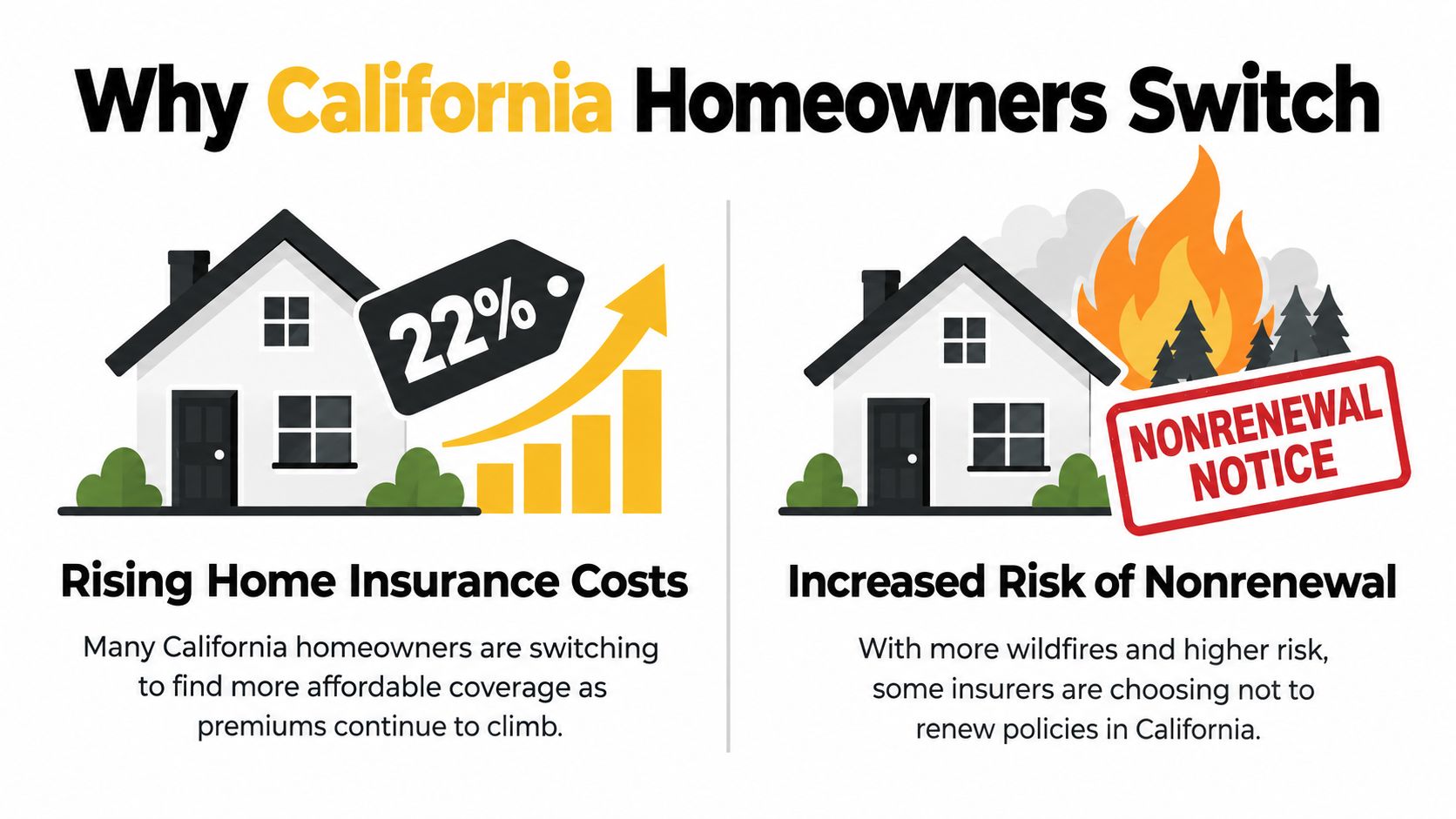
Triggers that deserve a serious review
Start promptly after receiving a nonrenewal or material coverage reduction. A premium increase beyond the household's budget also warrants comparison, especially if another carrier offers stronger deductibles or endorsements at a similar cost.
Review these conditions:
- Property improvements: A new roof or documented wildfire mitigation may change underwriting eligibility.
- Coverage gaps: The current policy may provide insufficient replacement cost, code upgrade coverage, loss of use, or personal property protection.
- Escrow changes: A new premium can change the mortgage payment and create an escrow shortage or adjustment.
- Service problems: Poor communication and claims delays can justify changing carriers.
When waiting is smarter
Do not switch while an active claim is still being handled unless the current policy is being canceled or cannot satisfy the lender. The existing carrier remains responsible for losses covered under its policy, and changing carriers can complicate documentation.
Review mid-policy cancellation terms before acting. They may affect fees or the refund calculation.
A closing within the next 30 days also calls for restraint. The lender, title company, and insurance agent are coordinating a time-sensitive transaction. Unless the current policy is being canceled or fails lender requirements, changing carriers immediately before closing creates avoidable administrative risk.
Practical rule: Treat the switch as a sequence of dates, coverage checks, and documents. Price is only one field in the decision.
Preparing to Switch Without Breaking Your Current Coverage
Preparation starts with the current policy, not with a quote form. The homeowner should download the declarations page and complete policy documents, then identify the expiration date, named insureds, property address, mortgagee information, dwelling limit, liability limit, deductibles, and endorsements.
Separate deductibles deserve special attention. A policy can contain an all-peril deductible plus distinct terms for wildfire, wind, hail, or earthquake-related losses. Those amounts can change the economics of a claim even when two quotes appear similar.
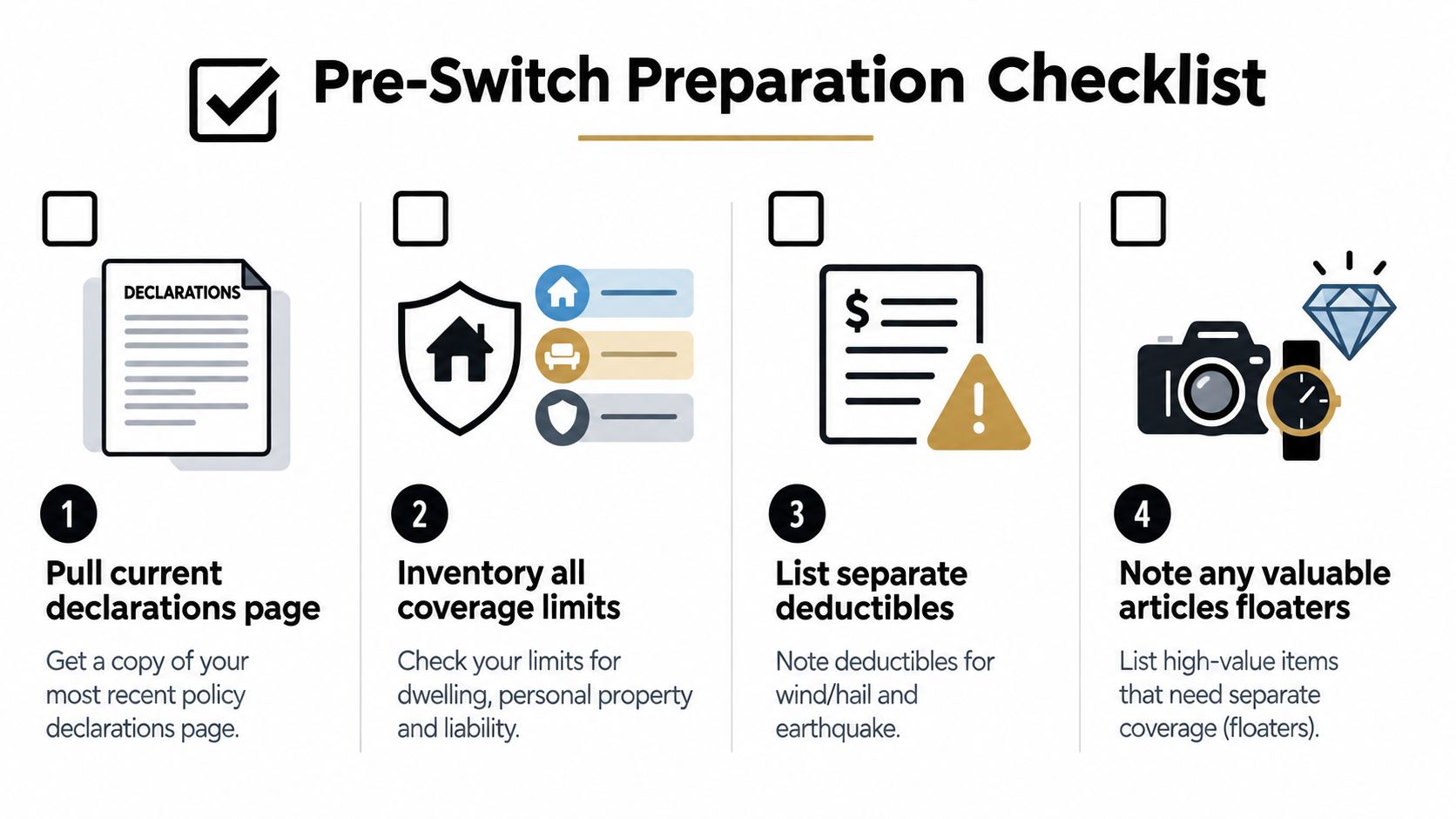
Build a coverage gap audit
The declarations page shows what the policy contains, but it doesn't automatically show whether the limits still fit the home. The homeowner should compare the dwelling limit with the likely replacement cost, not the property's market value or outstanding loan balance.
The audit should address:
- Dwelling coverage: Is the limit based on current reconstruction requirements and materials?
- Code upgrade coverage: Would the policy help pay for required updates after a covered loss?
- Loss of use: Would the limit support temporary housing if wildfire or another covered event makes the home unlivable?
- Personal property: Are contents covered at replacement cost or actual cash value?
- Valuable articles: Are jewelry, artwork, collectibles, or specialty items listed separately?
- Wildfire terms: Does the policy contain exclusions, sublimits, mitigation conditions, or special claim requirements?
Roof treatment is particularly important. A replacement cost basis and an actual cash value basis can produce very different claim outcomes because actual cash value accounts for depreciation. The homeowner should ask each carrier to state the roof settlement basis clearly rather than assuming the dwelling limit answers that question.
Put the calendar under control
The replacement policy should be bound before the existing policy is canceled. Consumer guidance on switching home insurance recommends reviewing the current policy, comparing at least three quotes, binding the replacement policy before canceling the old one, and notifying the mortgage servicer so escrow payments can be redirected.
California's early policy rules matter too. Insurers generally can't cancel a homeowners policy after the first 60 days except for limited reasons such as nonpayment, fraud, material misrepresentation, or physical changes that increase the hazard, as summarized in state cancellation guidance. A renewal or nonrenewal deadline can arrive before a homeowner has finished comparing coverage, so the process should begin well ahead of expiration.
The new carrier may require an inspection, photographs, roof documentation, defensible-space evidence, or repairs before binding. Those requirements should be known before the old policy is canceled.
Comparing Quotes the Right Way in a Wildfire State
A California quote is only useful when its coverage lines match the existing policy. Comparing annual premium first encourages the wrong decision, particularly in a wildfire-exposed area where the cheapest option may shift a larger share of loss risk back to the homeowner.
The first normalization point is the dwelling limit and settlement basis. A quote using replacement cost cannot be compared directly with one using actual cash value. The same problem arises when one policy includes broader code upgrade protection, personal property replacement cost, or more generous loss-of-use coverage.
Read each declarations page line by line
The comparison should include the standard all-peril deductible, the wildfire or other percentage-based deductible, liability limits, medical payments, personal property limits, and any separate roof settlement terms. A percentage deductible must be understood in relation to the dwelling limit because the potential out-of-pocket amount rises with that limit.
Wildfire forms also vary in ways that aren't obvious from the premium screen. One carrier may condition coverage on brush clearance, another may cap Ordinance or Law coverage, and another may attach a wildfire exclusion endorsement. In higher-exposure areas, the quote should be reviewed with the actual policy forms and endorsements, not just a summary page.
A homeowner should ask every carrier:
- Is the property subject to a wildfire underwriting moratorium?
- Are inspections required before or after binding?
- Could underwriting requirements change before renewal?
- Is brush clearance compliance a condition of coverage?
- Which deductible applies to wildfire damage?
- Are smoke, evacuation, debris removal, and code upgrade costs treated differently from ordinary covered losses?
Independent market commentary describes 2025-to-2026 pricing in higher wildfire-exposure zones as roughly 0.60 to 0.90, compared with about 0.45 in low-to-moderate exposure zones, and notes that rates may stabilize without becoming meaningfully cheaper. Those figures and the broader coverage context appear in the 2026 personal lines market overview. The practical conclusion is simple: a switch may improve access or coverage fit even when it doesn't produce a dramatic premium reduction.
Use a working comparison sheet
| Coverage Line Item | Current Policy | Quote A | Quote B |
|---|---|---|---|
| Dwelling limit and settlement basis | |||
| All-peril deductible | |||
| Wildfire deductible and form | |||
| Liability limit | |||
| Medical payments | |||
| Personal property basis | |||
| Loss-of-use limit | |||
| Code upgrade coverage | |||
| Roof settlement basis | |||
| Wildfire exclusions or conditions | |||
| Mortgagee clause |
The cheapest quote should not win until every blank is resolved. A premium comparison without a form comparison is incomplete.
Binding the New Policy and Cancelling the Old One Safely
At 4:00 p.m., you receive a cheaper quote and cancel your current policy. The new carrier still has not issued a binder. That timing mistake can leave a California home uninsured, create a lender violation, and cause problems if a wildfire loss occurs overnight.
Use one required order: bind the new policy first, confirm it is active, then cancel the old policy. Allstate's changing-policy guidance recommends checking effective dates, keeping the existing policy active until the replacement documentation is issued, and sending the lender the new records promptly.
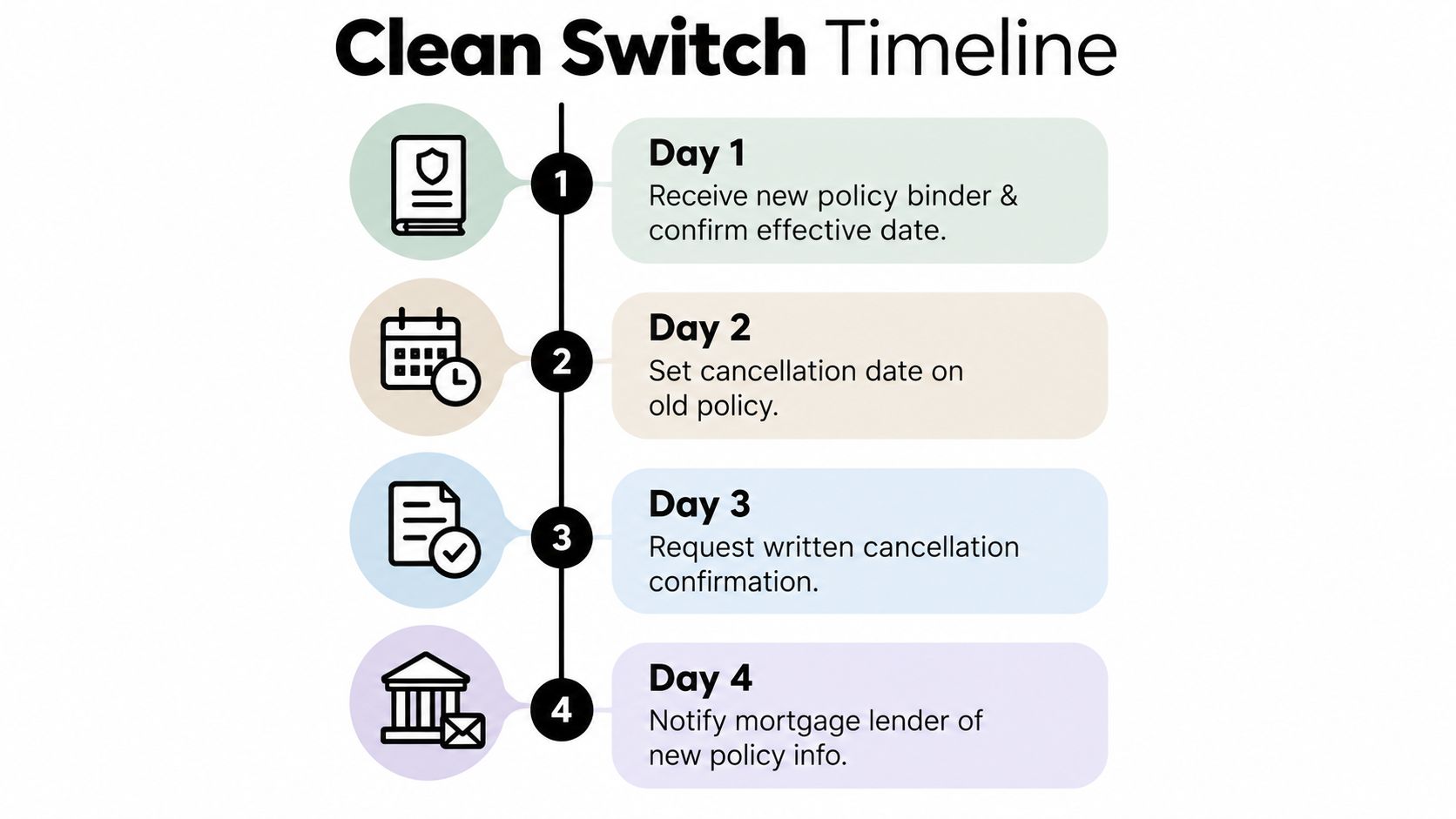
Verify the binder before cancelling
The replacement policy should start when the old policy ends, unless the carrier or lender requires a short overlap. A selected quote is not coverage, and an application is not necessarily a binder.
Before requesting cancellation, confirm the binder or declarations page shows the policy number, effective date and time, property address, named insureds, dwelling limit, deductibles, and correct mortgagee clause. For the cleanest handoff, confirm the binder shows 12:01 a.m. effective time, the mortgagee clause spelling supplied by the servicer's insurance department, and that the declarations page has been uploaded to the servicer portal.
The dwelling limit must satisfy the lender's requirements, but a lender-compliant minimum may still leave the home underinsured. In wildfire-prone California areas, check that the new policy's wildfire form, deductible, debris removal treatment, and code upgrade coverage match the coverage you selected.
Cancel the old policy deliberately
Request cancellation in writing and state the exact effective date. Follow this sequence:
- Confirm the replacement: Obtain the binder and verify its effective date and time.
- Set the cancellation date: Match the old policy's end date to the new policy's start, unless an overlap is intentional.
- Get written confirmation: Ask the former carrier to confirm cancellation and the effective date.
- Save the file: Keep the binder, declarations page, cancellation request, cancellation confirmation, and lender correspondence together.
Mid-term cancellation can affect the return of unused premium and may involve policy-specific terms. The old policy remains active until the carrier confirms the requested cancellation.
The safest cancellation date is the date confirmed in writing by both carriers, not a date assumed from a phone conversation.
Handling Escrow, Your Lender, and Refunds
Your mortgage servicer becomes part of the switch as soon as insurance payments run through escrow. The lender does not select your carrier, but the servicer must verify that the new policy meets the loan requirements and lists the mortgagee correctly.
Send the new declarations page to the servicer's insurance department with your loan number. Do not rely only on the carrier's electronic transmission. Submit it through the lender's portal or secure email, then document any phone call. That record gives you evidence if the servicer later reports missing coverage.
Why escrow causes confusion
Escrow changes the payment process, not the coverage workflow. The servicer may redirect future payments to the new carrier, recalculate the required balance, and change your monthly mortgage payment. A lower premium may not reduce that payment immediately if the account has a shortage. A refund from the old policy may also return to escrow rather than become cash you can spend.
The refund route depends on how the old premium was paid. Mortgage escrow refund guidance explains that a lender may require the refund to go back into escrow so the account stays funded for the replacement policy. The servicer can apply the money to the escrow balance and revise future payments after its review.
Ask the California carrier to confirm the written cancellation notice period and the unearned premium refund calculation. Those terms vary by policy and state requirements. Do not assume a refund will arrive quickly, or that it will be paid directly to you. If the servicer requires the funds for escrow, send the refund or cancellation documentation through its stated process and request written confirmation.
Keep proof until the account is settled
Retain the new declarations page, proof of payment, cancellation confirmation, refund correspondence, and every message exchanged with the servicer. Check the next escrow statement for the new premium, payment adjustment, and any shortage or surplus.
If the lender's records show a coverage gap, these documents can establish that coverage continued and that you reported the change properly. Keep the file until the servicer confirms the account is updated.
California-Specific Pitfalls Worth Knowing First
California homeowners must distinguish between a voluntary cancellation and a nonrenewal before taking action. A voluntary cancellation is requested by the policyholder. A nonrenewal comes from the carrier and ends coverage when the current term expires, often because underwriting rules changed or the property no longer fits the insurer's risk profile.
If you are past the first 60 days, do not assume a carrier can cancel mid-term solely because wildfire risk increased. Check whether the notice is a mid-term cancellation or a nonrenewal effective at the end of the policy term. Read the stated reason, confirm the exact final coverage date, and calendar every response and replacement-shopping deadline immediately. California's cancellation requirements depend on the reason and timing, so ask the carrier for the applicable written notice details rather than relying on a generic summary.
A nonrenewal notice requires an operational response. Ask whether completed repairs, defensible-space work, roof updates, or other mitigation could change the underwriting decision. Start replacement shopping at once, because waiting can leave you choosing between limited coverage and a lender-imposed policy.
Know the role of the FAIR Plan
The California FAIR Plan may provide a last-resort option when standard private coverage is unavailable. Treat it as a fallback, not an automatic substitute for a full homeowners policy. Its coverage can be limited, and many homeowners need a Difference in Conditions policy to address protections that the basic FAIR Plan structure does not include.
Review the combined arrangement for dwelling, personal property, liability, additional living expenses, and mortgage-lender requirements. A lower premium means little if the forms leave a major exposure or fail the lender's requirements. Have a broker or qualified insurance professional review the FAIR Plan and supplemental forms together.
Check earthquake and wildfire terms separately
Earthquake insurance requires a separate decision because ordinary homeowners coverage generally does not replace it. California homeowners can investigate coverage through the California Earthquake Authority, then compare deductibles, exclusions, and limits with the rest of the property program.
Wildfire deductibles may be percentage-based and can range from 5% to 25% of dwelling coverage, depending on the policy and property. Calculate the dollar amount from the dwelling limit, then compare the deductible wording line by line. Carriers use different forms, exclusions, and underwriting conditions, so similar premiums do not guarantee similar protection.
| Pitfall | What It Means for You | How to Avoid It |
|---|---|---|
| Carrier nonrenewal | Replacement coverage may be harder to secure near the deadline | Start shopping when the notice arrives |
| Voluntary cancellation | You may create a gap or complicate the refund | Bind replacement coverage first |
| Wildfire deductible | A percentage deductible can create substantial claim exposure | Calculate it from the dwelling limit |
| FAIR Plan alone | Basic protection may leave important gaps | Review a Difference in Conditions option |
| Earthquake omission | Standard homeowners coverage generally is not earthquake coverage | Evaluate separate CEA options |
| Form mismatch | Similar premiums can hide different exclusions and limits | Compare declarations pages and endorsements |
Your Switch Timeline, Pre-Cancel Checklist, and Next Step
A practical switch calendar begins 60 to 90 days before the current policy expires. The homeowner should pull the declarations page and review coverage first, request quotes early enough to handle inspections, bind the selected policy before the old one ends, and then complete the lender and escrow handoff.
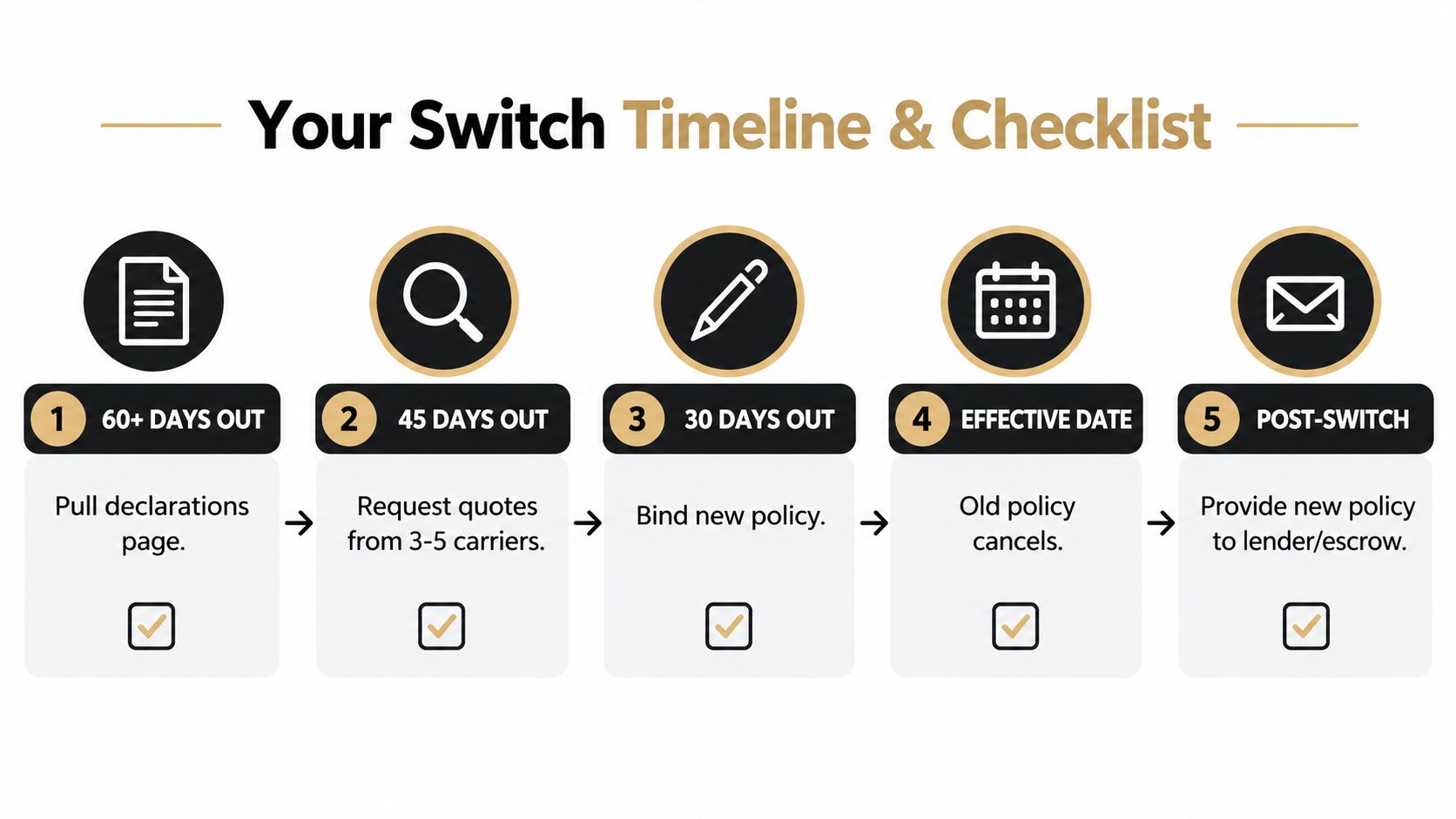
The operating calendar
- 60 or more days out: Pull the declarations page, policy forms, renewal notice, mortgagee clause, inspection history, and property inventory.
- 45 days out: Request and compare at least three quotes, then resolve wildfire, roof, deductible, and replacement-cost differences.
- 30 days out: Select the policy, satisfy underwriting requests, and obtain the binder with the correct effective date.
- Effective date: Confirm the new policy is active, then cancel the old policy according to the written schedule.
- After the switch: Send the declarations page and policy number to the mortgage servicer, confirm escrow routing, and retain all correspondence.
The pre-cancel check
Before cancellation, the homeowner should confirm:
- The new effective date matches or precedes the old policy's end date.
- The mortgagee clause is exactly correct.
- The dwelling limit uses an appropriate replacement-cost basis.
- Wildfire deductibles, exclusions, and mitigation conditions are understood.
- Liability, personal property, loss-of-use, and code upgrade limits are acceptable.
- The lender has received lender-ready proof of insurance.
DwellQuote lets California homeowners submit basic property details, review prefilled property information, compare available policy options side by side, and select a policy through its quote workflow. It can be used as one practical way to organize the comparison before the documentation is sent to the lender.
To request a California home insurance quote through DwellQuote, submit the property details and compare available coverage options side by side. Use the resulting policy documents to coordinate the effective date, old-policy cancellation, and lender or escrow notification without creating a coverage gap.