
A California homeowner may return from a wildfire evacuation to find a smoke-damaged living room, ruined clothing, unusable electronics, and a kitchen full of belongings that can't safely be kept. The structure may be insured for rebuilding, but the family still needs money to replace the things that made the house livable.
That's where personal property replacement cost matters. It determines whether a claim pays only the depreciated value of old belongings or the current cost of buying comparable new items. The difference can shape how quickly a household recovers, especially when rebuilding costs, local labor prices, and replacement demand are moving upward.
Table of Contents
- What Personal Property Replacement Cost Actually Means
- Replacement Cost vs Actual Cash Value in Plain English
- How Insurers Calculate Replacement Cost Today
- How Replacement Cost Claims Get Paid in Practice
- Coverage Options and Endorsements Worth Knowing
- California and Wildfire-Specific Replacement Cost Issues
- Practical Steps to Set the Right Personal Property Limit
- Getting the Right Coverage Without the Hassle
What Personal Property Replacement Cost Actually Means
After a California wildfire, a homeowner may sort through smoke-damaged furniture, ash-contaminated clothing, and electronics that no longer work. Personal property replacement cost determines how those belongings are valued. It generally means paying the amount needed to repair or replace a covered item with a new one of like kind and quality, without subtracting depreciation. The National Association of Insurance Commissioners' disaster claims guide describes replacement cost as replacing an item without reducing payment for age, condition, or wear.
The word “replacement” can cause confusion. It refers to the belongings inside the home, not to rebuilding the house itself. Homeowners insurance separates these categories:
- Dwelling coverage applies to the physical structure, including walls and permanently installed systems.
- Personal property coverage applies to movable belongings, such as furniture, clothing, electronics, appliances, tools, and household goods.
- Replacement cost coverage changes how the insurer values those belongings after a covered loss. It does not convert contents coverage into structural coverage.
A smoke-damaged sofa and ruined television are personal property claims. A damaged roof, wall frame, or built-in cabinet falls under the dwelling portion of the policy. One wildfire can affect both categories, while each still has its own limits and settlement rules.
Why the distinction matters after a loss
A homeowner can carry enough dwelling coverage to rebuild the structure and still have too little personal property coverage to replace everything inside. Standard homeowners policies commonly set personal property coverage at 50% to 70% of the dwelling coverage limit, according to Insurance.com's explanation of personal property replacement cost and Policygenius's personal property coverage guide. In California, rising rebuild costs and wildfire losses make that separate contents limit worth reviewing rather than assuming it is adequate.
Replacement cost also has boundaries. The replacement usually must be reasonably comparable in type, function, and quality. A discontinued laptop may qualify for a similar current model, while a substantially upgraded version can leave the homeowner responsible for the price difference.
Practical rule: The policy limit answers “how much is available,” while the valuation method answers “how each item is priced.”
Actual cash value may produce a payment that appears fair but does not cover a comparable new purchase. Replacement cost is designed to reduce that gap, subject to the policy limit, deductible, exclusions, sub-limits, and proof requirements. A one-click quote comparison on DwellQuote can help connect this coverage choice with a policy that fits the household's actual recovery needs.
Replacement Cost vs Actual Cash Value in Plain English
Consider a stolen laptop originally purchased for $1,800 three years ago. A comparable new laptop now costs the same amount for this example. Under actual cash value, the insurer reduces the replacement price for age, condition, wear, and obsolescence. If the depreciation calculation reduces the laptop's value to about $900, the initial claim payment may be based on that lower figure.
Under replacement cost, the insurer evaluates the current price of a comparable new laptop without applying that depreciation deduction. If the policy limit and claim conditions are satisfied, the covered value is based on $1,800, usually subject to the policy deductible and any applicable terms.
| Valuation Method | Calculation | Insurer Payout | Out-of-Pocket Cost |
|---|---|---|---|
| Replacement Cost | Comparable new price, with no depreciation deduction | $1,800, less the deductible and subject to policy terms | Usually limited to the deductible or any upgrade difference |
| Actual Cash Value | $1,800 replacement price minus depreciation | About $900, less the deductible and subject to policy terms | The depreciation gap, plus the deductible and any price difference |
The North Carolina Department of Insurance explanation of actual cash value and replacement cost summarizes the central distinction: replacement cost pays to repair or replace most damaged belongings with new items at current prices, while actual cash value subtracts depreciation.
Why ACV can feel affordable until the claim
Actual cash value coverage often costs less up front because the insurer promises a smaller settlement after a loss. That lower premium can appeal to households managing a tight budget, but it transfers more financial responsibility to the homeowner when old belongings need to be replaced.
A three-year-old laptop may still perform well, yet its insurance value can fall because newer models have arrived and the original device has experienced use. Clothing, furniture, phones, and televisions can face the same problem. The payment reflects what the item was worth immediately before the loss, not necessarily what the household must spend to restore its daily life.
Replacement cost may also involve a two-stage payment. The insurer can initially pay the depreciated amount and release the remaining recoverable depreciation after the homeowner replaces the item and submits acceptable proof. The full “new-for-old” result therefore depends on both the policy wording and the claims process, not just the endorsement name.
How Insurers Calculate Replacement Cost Today
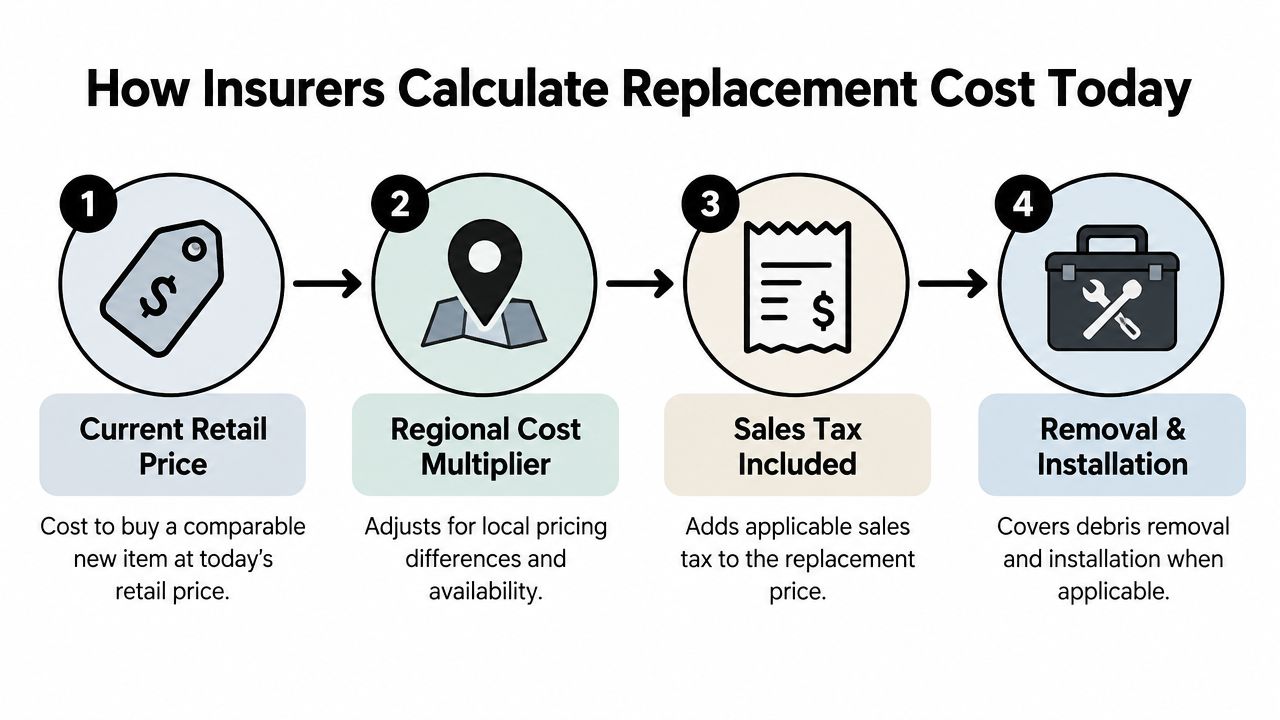
Insurers usually estimate personal property replacement cost from what a comparable new item costs now, rather than what the homeowner originally paid. A valuation system may review current retail prices, availability, sales tax, and regional conditions. An old receipt can show what an item cost, but it may not show what replacing it would require after a California wildfire or a period of rising local prices.
Verisk's 360Value personal property information explains that accurate valuation depends on region-specific pricing. Insurers and valuation systems can account for local material and labor conditions across hundreds of U.S. regions, including ZIP-level factors such as sales tax, permit fees, and professional costs.
For household belongings, the process commonly follows four steps:
- Identify the item. The insurer reviews its brand, model, age, features, condition, and property type.
- Find a comparable current item. The replacement should provide similar function and quality, not merely resemble the original.
- Adjust for location. Regional pricing, availability, and applicable taxes can change the replacement figure.
- Apply the policy terms. The personal property limit, deductible, exclusions, and category sub-limits still control the claim.
A household inventory is a better reality check
A percentage-based limit can provide a quick starting point, but a room-by-room inventory shows whether it fits the household. For a two-bedroom California home, the list might include bedroom furniture and mattresses, living-room furniture, kitchen appliances and cookware, clothing, televisions, computers, phones, a home office, outdoor furniture, and personal items. Pricing each group at today's replacement cost can reveal gaps that a default limit leaves hidden.
That review matters after a widespread fire, when many households may need similar furniture, electronics, clothing, and appliances at the same time. Regional availability, delivery costs, and sales tax can affect the amount needed even when the items themselves seem ordinary.
Replacement-cost pressure has also grown in recent years. A 2024 CoreLogic study discussed by Claim the Policy reported that 65% of U.S. homes were insured for less than full replacement cost, with an average underinsurance gap of 27%. The same source reported homeowner replacement costs had increased by nearly 30% over the prior five years, while a Canadian insurance review found residential construction costs had risen 61% since January 2019. These figures concern broader replacement pressure, but supply chains, labor constraints, and pricing conditions can also affect household contents.
A default percentage is a starting point for review, not proof that the limit matches the belongings inside the home. A current inventory, followed by a one-click quote comparison on DwellQuote, helps connect the estimate to an adequate policy.
How Replacement Cost Claims Get Paid in Practice
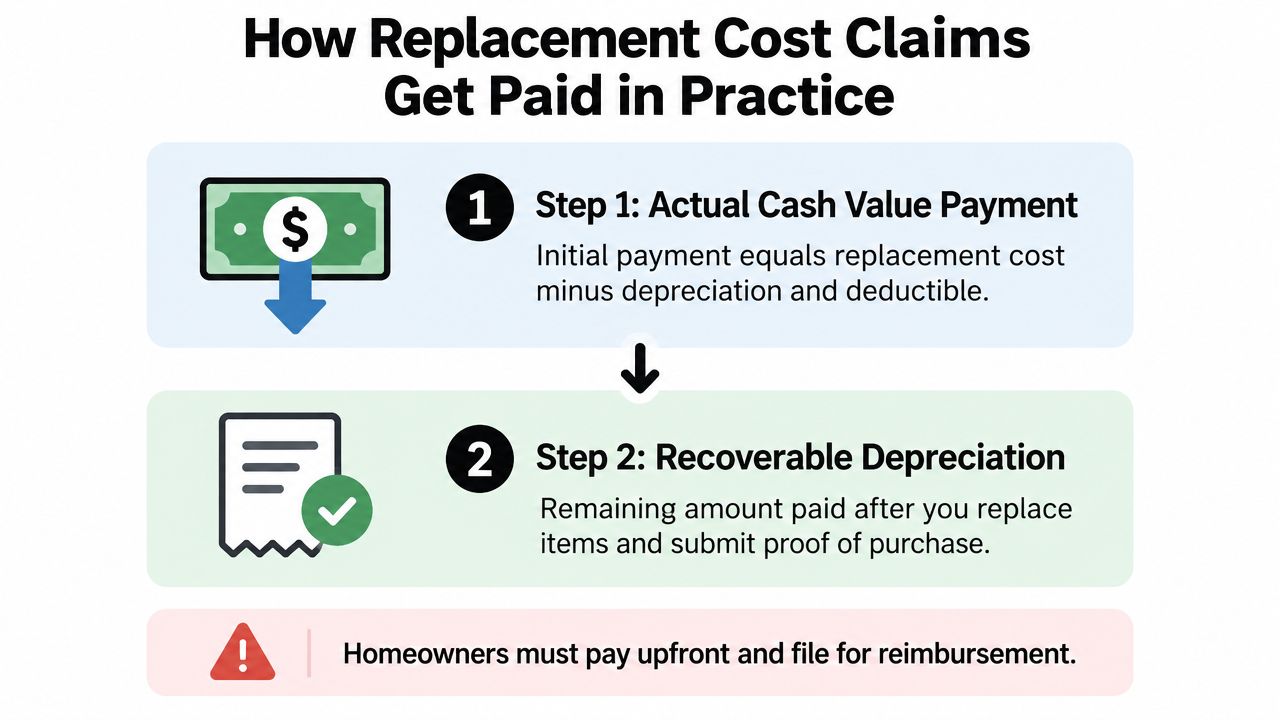
A homeowner expecting one full check can be surprised by the usual claims sequence. Replacement-cost claims are commonly paid in two stages, as Policygenius explains in its guide to recoverable depreciation.
Step one is the actual cash value payment. After a covered loss, the insurer calculates the replacement cost of the item, subtracts depreciation, and applies the deductible and policy terms. That initial payment gives the household funds to begin replacing essentials, but it may not equal the final replacement-cost amount.
Step two is recoverable depreciation. After the homeowner buys or replaces the item, the insurer can release the withheld depreciation when the policyholder provides proof. Acceptable documentation may include receipts, invoices, order confirmations, delivery records, or other evidence showing that the replacement occurred.
Details that can change the outcome
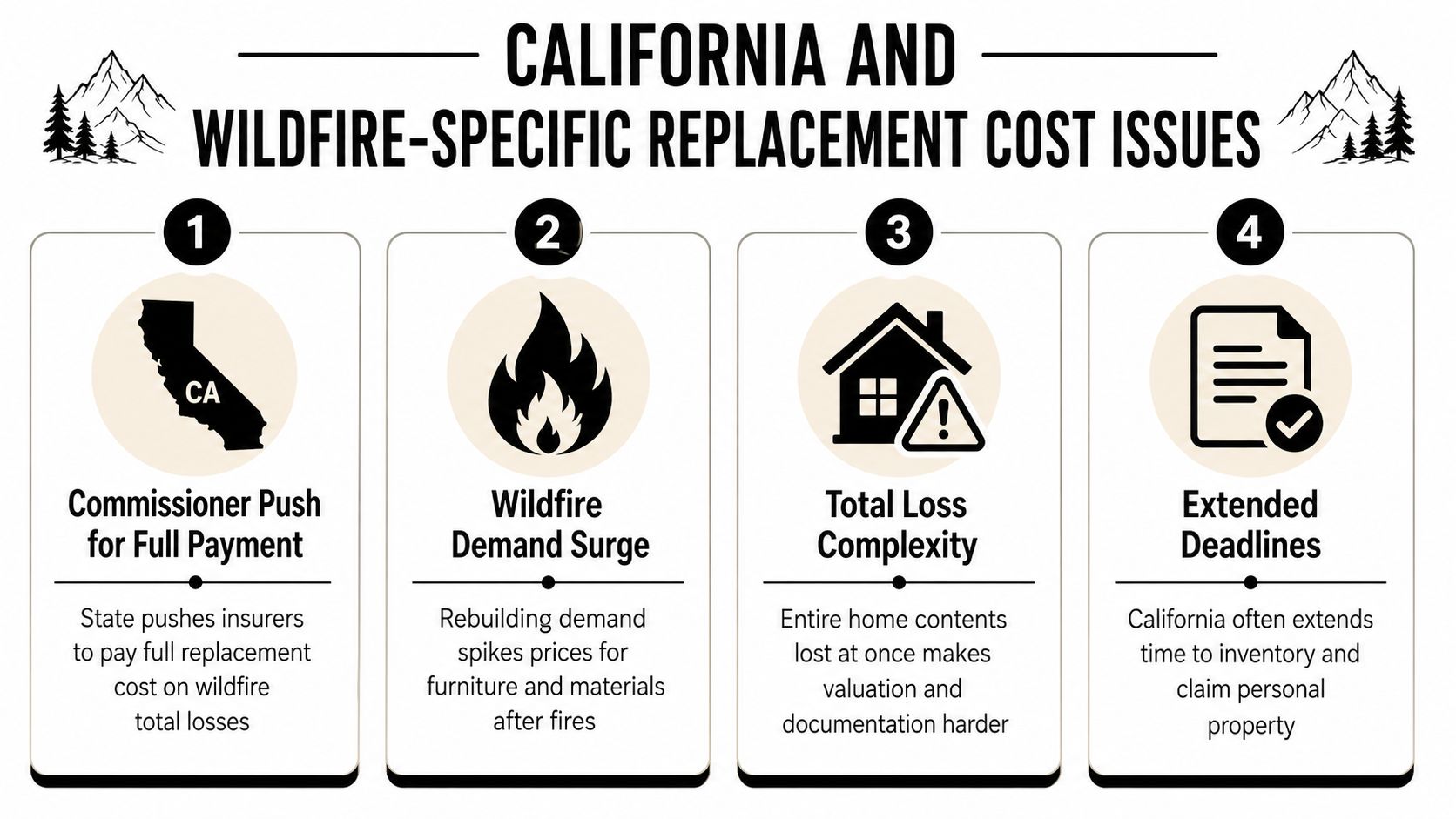
The policy usually sets a deadline for submitting proof of replacement. Deadlines can vary from 180 days to 24 months, depending on the policy and applicable claim rules, so a homeowner should ask the adjuster for the exact date in writing.
Common complications include:
- Discontinued products: A current comparable model may replace the original item when the exact product is no longer sold.
- Upgrades: A homeowner who selects a more expensive model may need to pay the difference unless the policy allows otherwise.
- Availability problems: The insurer may evaluate a reasonably available substitute when the original model is out of stock.
- Uncompleted replacements: If the homeowner doesn't replace the property within the applicable period, the settlement may remain limited to actual cash value.
- Cash-out provisions: Some policies allow a cash settlement in certain circumstances, but the amount and conditions depend on the contract.
The homeowner should keep damaged-item lists, photographs, receipts, and communications together. A clear file reduces confusion when the initial payment and later reimbursement don't arrive at the same time.
Coverage Options and Endorsements Worth Knowing
Personal property replacement cost is one part of the coverage decision. The policy also determines which belongings are covered, how much protection applies, and whether certain categories require special treatment. For a California homeowner, those details matter because a wildfire can destroy an entire household at once, while rebuilding and replacing belongings may become more expensive.
Many homeowners policies use replacement cost for the dwelling, but personal property coverage depends on the policy form and endorsements. Higher-protection forms such as HO-5 policies generally include replacement cost for personal property by default, as noted in Insurance.com's coverage overview. Other forms may require an endorsement to change belongings coverage from actual cash value to replacement cost.
| Coverage Type | Depreciation Applied | Typical Limit | Best For |
|---|---|---|---|
| Standard personal property coverage | Depends on the policy form, often ACV unless upgraded | A percentage of dwelling coverage or a selected limit | Ordinary household belongings |
| Personal property replacement cost endorsement | Generally no depreciation after policy requirements are met | Subject to the personal property limit | Furniture, clothing, electronics, and appliances |
| Blanket personal property limit | Depends on the valuation terms | One overall contents limit | Households with broadly distributed belongings |
| Category sub-limit | Depends on the valuation terms | A lower cap for a defined category | Jewelry, firearms, collectibles, or other restricted categories |
| Scheduled personal property | Often based on an agreed or specifically documented value | Item-specific | High-value jewelry, art, instruments, and specialty property |
| Guaranteed replacement cost endorsement | Policy-specific, with special limit protection | Contract-defined | Homeowners concerned that the dwelling limit could be inadequate after a severe loss |
Match the endorsement to the item
A blanket limit suits ordinary belongings distributed throughout the home. It may provide too little protection when the policy places a separate sub-limit on jewelry, watches, firearms, fine art, collectibles, or certain electronics.
Scheduled personal property identifies individual items and may require an appraisal or other valuation evidence. It fits an engagement ring, professional camera, valuable instrument, or art piece whose value cannot be represented by a general contents limit. Scheduling also makes the insurer's understanding of that item more specific before a loss occurs.
Guaranteed replacement cost serves a different purpose. It primarily addresses the dwelling limit and certain underinsurance concerns for rebuilding the structure. It does not automatically provide unlimited protection for personal belongings. Ask whether each endorsement applies to the building, contents, or both before assuming it broadens every part of the policy.
The added premium may make sense when replacing an item would strain the household budget, a category sub-limit is too low, or much of the household's value is concentrated in a few possessions. A DwellQuote one-click quote comparison can put these options side by side, helping a homeowner compare the personal property limit and endorsements instead of choosing from theory alone. The right combination depends on the inventory and the policy wording.
California and Wildfire-Specific Replacement Cost Issues
A wildfire can turn an ordinary personal property limit into a serious coverage gap. In a total loss, clothing, furniture, electronics, kitchen goods, tools, outdoor items, and personal documents may all need replacement at once. The household is not replacing one damaged television. It is recreating an entire inventory while local demand for labor and goods is already high.
California's Insurance Commissioner has pushed for full replacement cost on total losses after devastating wildfires. Homeowners in Palisades, Paradise, and Santa Rosa have faced a practical problem: contents limits tied to dwelling coverage may leave some households tens of thousands short when the default formula does not reflect what they owned.
Post-fire demand can push replacement costs 20% to 40% above normal, according to the supplied California wildfire guidance. The figure matters, but the inventory matters just as much. A homeowner may remember that the living room was destroyed while struggling to identify the exact television, sofa, computer, appliances, clothing, and tools that were there.
Coverage details beyond personal belongings
Loss Assessment coverage may address certain assessments connected to covered damage involving a homeowners association, subject to its terms and limits. Code-upgrade coverage addresses additional rebuilding requirements imposed by building regulations. Neither endorsement automatically increases the personal property limit, so review each one separately.
Defensible-space compliance also deserves attention. California's Cal Fire defensible-space guidance explains vegetation-management expectations around structures. Confirm how maintenance, access, exclusions, and claim conditions interact with the policy. Completing defensible-space work alone does not guarantee coverage.
A room-by-room inventory stored away from the home gives the adjuster a starting record after smoke or fire damage. It also helps the homeowner recall ordinary goods that are easy to overlook during a stressful total loss. A DwellQuote one-click quote comparison can then show whether the current personal property limit fits California's wildfire-related replacement-cost risk.
After a wildfire, memory is a poor inventory system. Photographs, model numbers, and receipts create a much stronger record.
Practical Steps to Set the Right Personal Property Limit
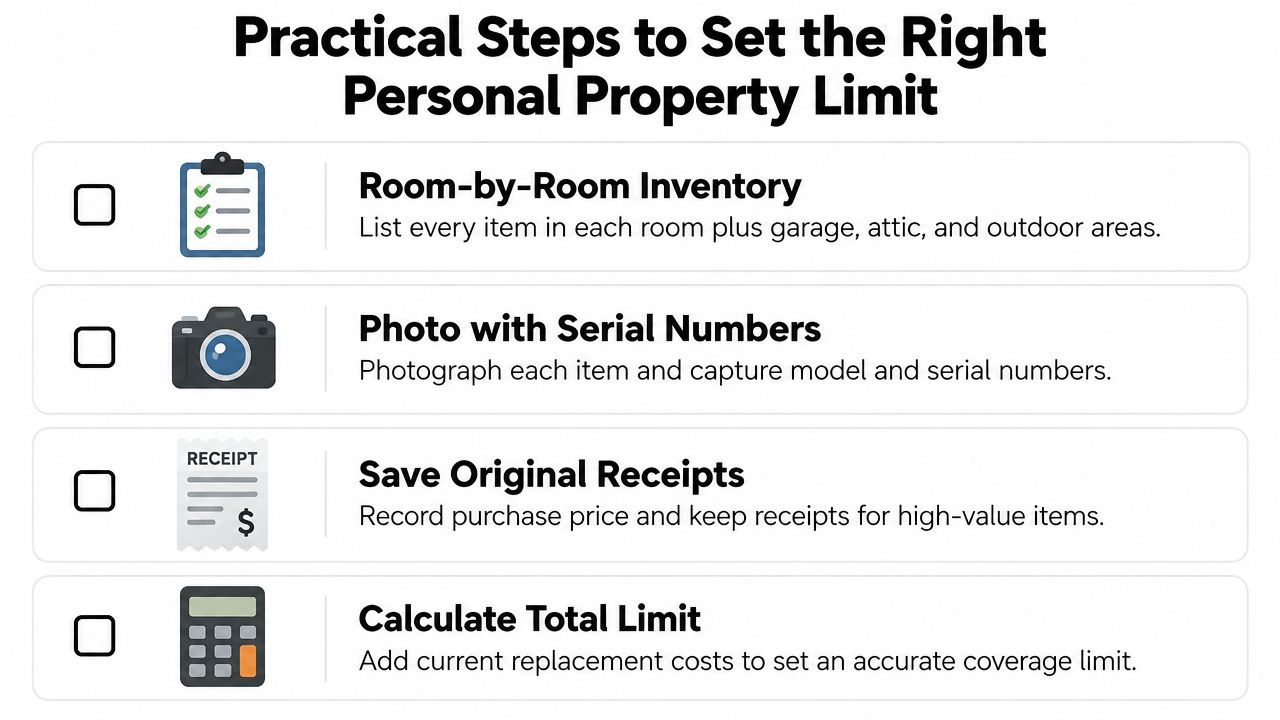
A California homeowner can make a useful inventory over a weekend without recording every item perfectly. The goal is a defensible estimate, a clear view of costly categories, and a comparison with the current personal property limit. That matters when rebuilding inflation and wildfire losses make replacement prices harder to predict.
Start with the home, not the policy
Walk through each room, including areas that are easy to overlook:
- Living areas: Record sofas, rugs, televisions, speakers, lamps, computers, and decorative items.
- Bedrooms: Include clothing, luggage, bedding, jewelry, watches, and personal electronics.
- Kitchen and laundry areas: List small appliances, cookware, utensils, coffee equipment, and cleaning tools.
- Garage and storage: Capture bicycles, tools, sports equipment, seasonal decorations, and stored furniture.
- Outdoor spaces: Include patio furniture, grills, garden equipment, cameras, and recreational property.
Photograph items where they sit. Capture brands, model numbers, and serial numbers when available. A video walkthrough shows the household's context, while close-up images record identifying details.
Put current value behind the list
Receipts show what an item originally cost. Replacement-cost coverage asks a different question: what would a comparable new item cost today? Use current retailer listings, a replacement-cost calculator, or a documented quote to estimate that amount. Local pricing can affect the result, particularly when California rebuilding demand raises costs after wildfire losses.
Total each category instead of relying on an overall impression. One shirt or pan may seem inexpensive, but replacing a full wardrobe or kitchen can produce a much larger bill.
Compare, then decide
Treat the insurer's default percentage as a starting point. Compare it with your inventory, then ask whether the policy should include:
- A higher base personal property limit.
- Replacement-cost settlement for contents instead of depreciation-based payment.
- Scheduled coverage for jewelry, firearms, art, instruments, or other high-value pieces.
- Updated category sub-limits and exclusions.
- A review after major purchases, renovations, or appraisals.
A DwellQuote one-click quote comparison can put those choices beside the current policy, helping show whether the limit reflects the household's actual replacement exposure. The review should continue after major lifestyle changes. New electronics, a home office, a remodel, or an inherited collection can raise the contents total even when the dwelling limit stays unchanged.
Getting the Right Coverage Without the Hassle
After a California wildfire, rebuilding demand can raise local prices while families replace everything from clothing to electronics. A practical coverage review starts with the inventory total, current dwelling limit, scheduled items, deductible, and confirmation that personal property is settled at replacement cost rather than actual cash value.
Enter those details into a one-click quote comparison through DwellQuote. It retrieves property information, lets California homeowners confirm the profile, and presents carrier options side by side. Compare the contents limit with the inventory total, then review the valuation method, category sub-limits, wildfire-related terms, and any default percentage rather than accepting it automatically.
The comparison does not replace reading the policy. It makes specific questions easier to ask: Is recoverable depreciation paid after receipts are submitted? How are discontinued electronics replaced? Do scheduled items require appraisals? Are high-value belongings subject to separate limits?
After purchase, set a 12-month calendar reminder. Update the inventory after major purchases or household changes, and rerun quotes when the property profile changes.
DwellQuote lets California homeowners compare options while checking replacement-cost coverage and whether the contents limit fits a real household inventory, including wildfire-related replacement needs.