

The lease is signed, the move-in date is close, and the property manager sends one last message asking for proof of renters insurance. For many first-time renters, that request feels bigger than it is. It sounds official, a little intimidating, and easy to get wrong.
In practice, it's usually simple. The landlord isn't asking for a stack of legal paperwork. They want a document from the insurance company that shows an active policy is in place and that it meets the lease requirements. In California, that small detail matters because landlords often pay close attention to liability coverage, landlord notices, and disaster-related coverage that shorter national guides barely mention.
Table of Contents
- Why Your Landlord Is Asking for Proof of Renters Insurance
- The Three Documents That Qualify as Proof
- What Landlords Check on Your Insurance Document
- How to Request and Deliver Your Proof of Insurance
- Special Requirements for California Renters
- Common Pitfalls and Frequently Asked Questions
Why Your Landlord Is Asking for Proof of Renters Insurance
That request is no longer unusual. In 2024, three out of four landlords in the United States now require tenants to provide proof of renters insurance before signing a lease, according to The Zebra's renters insurance market review. For renters, that means the ask is usually a standard move-in requirement, not a sign that something is wrong with the application.
Landlords ask for proof because renters insurance shifts some financial risk away from the building owner and onto the tenant's insurer. If a tenant causes accidental damage or a guest gets hurt in the unit, the policy's liability coverage may respond. That gives the landlord more confidence that one mistake won't turn into an unpaid dispute.
A good way to think about it is this. The policy is the coverage itself. Proof of renters insurance is the evidence that the coverage is active right now and attached to the correct rental home.
Practical rule: If a landlord asks for proof, they usually want a document that confirms four basics: who is covered, where the policy applies, when it starts, and whether the liability limit matches the lease.
This also helps the renter. A clear proof document can prevent move-in delays, last-minute leasing problems, and follow-up emails asking for missing details. In California, where many landlords also want specific wording or endorsements, reviewing the document before sending it can save time and stress.
The Three Documents That Qualify as Proof
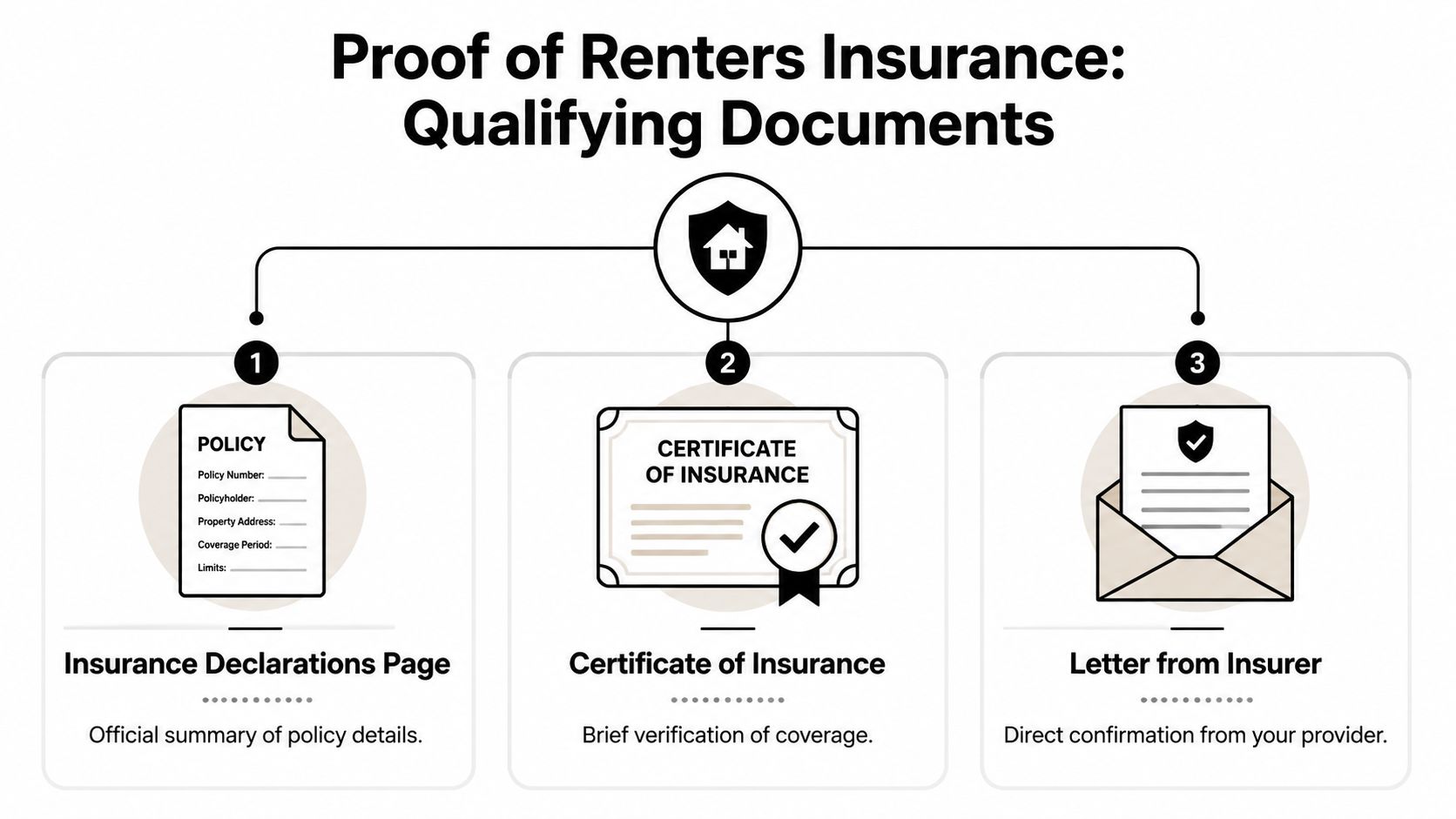
Some renters assume there's only one acceptable document. In reality, landlords usually accept one of a few standard forms of insurance verification. The key is that the document must show active coverage and match the lease requirements.
Why these documents work
The most common document is the declarations page. Azibo describes the declarations page as the policy summary landlords use to confirm details such as the insurer name, policy number, coverage amount, and enrollment status in its guide to proof of renters insurance documents. This is usually the fastest document to download from an insurer's portal or app.
The next common option is a Certificate of Insurance, often shortened to COI. A COI is designed to verify coverage for a third party, which is why property managers often like it. Standard renters insurance policies typically mandate a minimum of $100,000 in personal liability coverage, with proof formally documented via a Certificate of Insurance or declaration page that lists the landlord as an “interested party” before lease execution, according to FirstKey Homes' rental insurance requirements.
A third option is a letter from the insurer. Some landlords ask for this when they want direct confirmation of a special coverage detail that doesn't appear clearly on the declarations page. This can be useful if the lease mentions pet liability, loss of use, or another endorsement by name.
How to tell them apart
A simple comparison helps:
| Document | Best way to think about it | What it usually shows | When it helps most |
|---|---|---|---|
| Declarations page | The policy receipt | Core policy details and limits | Standard move-ins |
| COI | A landlord-facing verification sheet | Active coverage for a third party to review | When the landlord wants formal proof |
| Letter from insurer | A custom confirmation note | Specific coverage language or endorsement details | When lease wording is very specific |
The phrase “interested party” matters. When the landlord is listed this way, the insurer can send notice if the policy changes or lapses. That doesn't give the landlord ownership of the policy. It only gives them visibility.
A declarations page proves the policy exists. A COI or insurer letter can prove that the policy also matches the lease wording.
For a first-time renter, the safest move is to read the lease language carefully before downloading anything. If the lease asks only for proof of active renters insurance, the declarations page may be enough. If it asks for the landlord to be listed, or for a special endorsement, a COI or insurer letter may be the cleaner choice.
What Landlords Check on Your Insurance Document
You paid for a policy, downloaded the PDF, and sent it over. Then the leasing office replies that something is missing. That feels confusing the first time it happens, but the review process is usually pretty simple. A landlord is checking whether your document matches the lease, much like a gate agent matching your boarding pass to your ID.
The fields they verify first
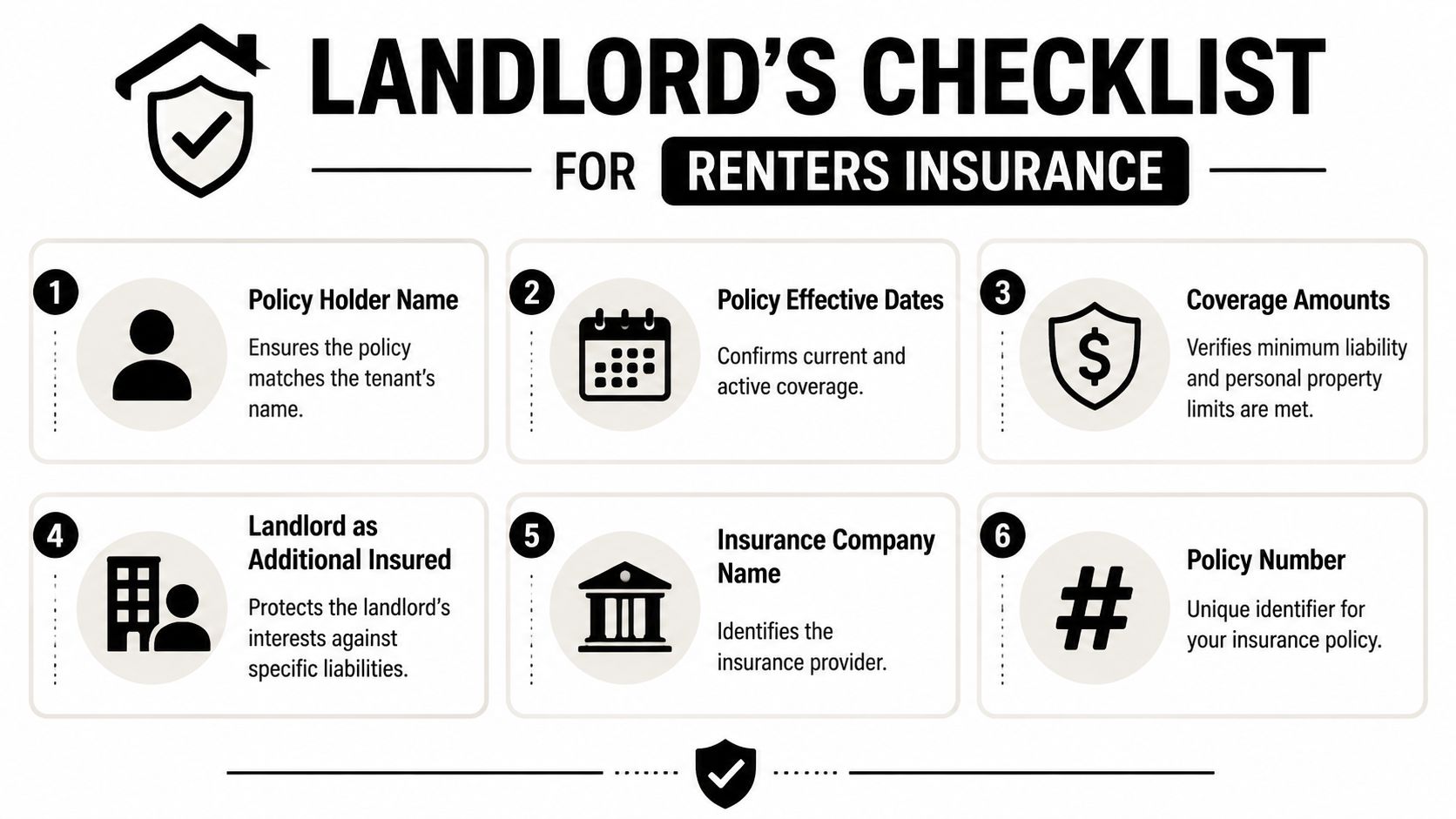
Property managers usually start with the basics. If any of these details are wrong or missing, they may ask for a corrected document before approving move-in:
- Tenant name: It should match the lease. If two roommates signed the lease, a landlord may question a policy that lists only one person.
- Rental address: The insured location needs to be the exact apartment, condo, or rental home.
- Effective dates: Coverage should begin on or before move-in and stay active for the lease period.
- Liability limit: The amount has to meet the minimum in the lease.
- Landlord listing: If the lease asks for it, the landlord should appear as an interested party or additional interest.
- Policy number and insurer name: These show the policy is active and tied to a real carrier.
For California renters, the liability line often gets the closest look. Many landlords want to see that the policy meets the lease minimum clearly on the page, and in California that minimum is often written into large apartment leases. The declarations page usually works well for this because it shows the renter's name, insurer, policy number, coverage dates, and coverage limits in one place.
California renters also run into a detail national guides often skip. In areas with higher wildfire risk or stricter property management rules, leasing staff may read the document more carefully to make sure the address, dates, and landlord listing are exact. They are not checking whether your personal belongings are protected well enough for your situation. They are checking whether your paperwork satisfies the lease.
What causes delays or rejection
Small mismatches create most problems. A nickname instead of a legal name, an old address from a previous apartment, or a start date that begins after key pickup can all lead to a follow-up email.
Another common issue is the landlord listing. From a renter's perspective, the policy may be valid and active. From the landlord's perspective, the file is still incomplete if the lease says the landlord must be listed for notice purposes.
A quick line-by-line review helps a lot. Compare the lease to the insurance document before you send it. Check names, address, liability amount, dates, and any special wording the lease requires.
Some California leases also mention special situations tied to local risk, such as water damage liability, pet liability, or earthquake-related questions. Standard renters insurance usually does not cover earthquake damage to your own property unless you add that protection, so a landlord may ask follow-up questions if the lease uses specific language. If the endorsement or requirement is not easy to see on the first document, the landlord may request a second document for clarification.
How to Request and Deliver Your Proof of Insurance
This part is usually faster than renters expect. Most insurers make proof available through an online account, mobile app, or customer service channel. The important part isn't finding a document. It's getting the right one.
A simple request process
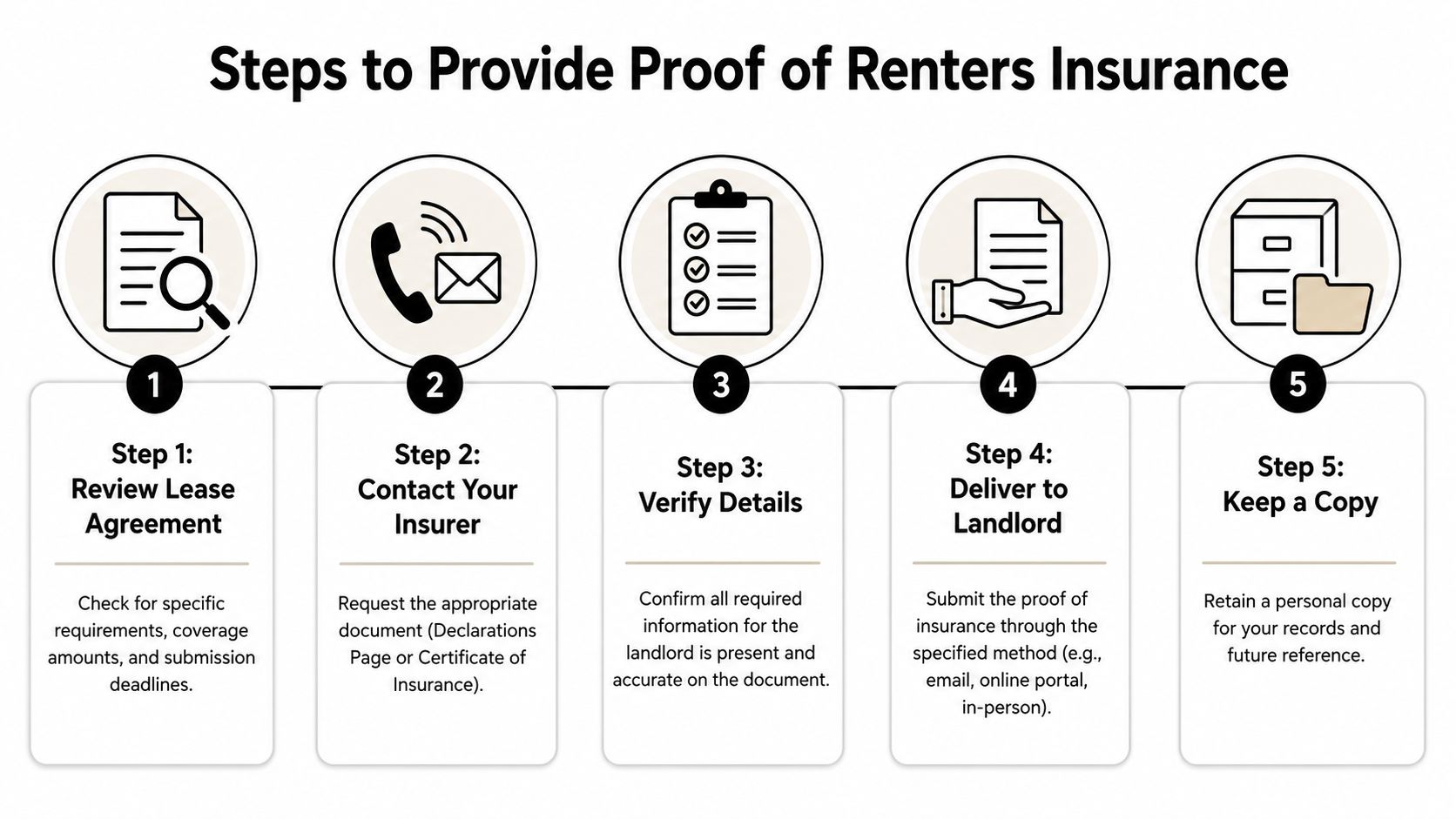
A clean process looks like this:
- Read the lease first. Check whether it asks for a declarations page, a COI, a landlord listing, or a special endorsement.
- Open the insurer portal or app. Many carriers place the declarations page in the documents section.
- Contact customer service if needed. A renter can say, “A landlord needs a PDF of the declarations page and confirmation that the landlord is listed as an interested party.”
- Review the document before sending it. Confirm the address, names, dates, and liability amount.
- Submit it in the format the landlord wants. That might mean email, a resident portal, or a leasing platform upload.
Some renters wait until the day before key pickup. That creates pressure for no reason. Requesting the document as soon as the application is approved gives time to correct mistakes, especially if the landlord wants a custom COI or insurer letter.
The safest way to submit it
The delivery step matters more than it seems. A PDF attached to an email is common, but many property managers prefer an online portal because it stores the file in the tenant record. If the landlord gives a portal link, using that method usually reduces back-and-forth.
A few habits make the process smoother:
- Save the final PDF locally: Keep the exact version that was sent.
- Use a clear file name: Something simple like “Renters Insurance Declaration Page” helps leasing staff find it.
- Send one short message with context: Note that the file includes the required proof and mention any special item such as the landlord listing.
- Ask for confirmation: A brief reply confirming receipt can prevent confusion later.
Quick check: If the landlord doesn't confirm acceptance, the task isn't finished yet. Receipt and approval aren't always the same thing.
Renters should also keep a copy for future use. The same proof may be needed again at renewal, after a policy change, or when switching property managers.
Special Requirements for California Renters
You sign a lease for an apartment in Sacramento, buy a renters policy the same afternoon, and send over the declarations page. Then the leasing office replies: they still need proof that your liability limit meets the lease, and they want the landlord listed for notice. That kind of follow-up is common in California because landlords here often pay close attention to the exact lease wording, not just whether a policy exists.
What California landlords can require
In California, the lease does a lot of the work. If the rental agreement says you must carry renters insurance and provide proof, the landlord can usually enforce that requirement as part of the tenancy terms, as noted earlier. For a first-time renter, the simplest way to read this is: if it is written into the lease, treat it like any other move-in requirement, such as the security deposit or utility setup.
The part that surprises renters is how specific the requirement can be. A landlord may ask for a minimum liability limit, proof that the policy is active on or before move-in day, and notice listing instructions for the property owner or manager. In California, a $100,000 liability limit is a common starting point, and some leases ask for more. Cost-U-Less Direct discusses these common California expectations in its overview of California landlord renters insurance requirements.
That liability number matters because it protects against claims involving injury or property damage for which a tenant may be responsible. Personal property coverage protects your belongings. Liability coverage protects you from a different kind of loss. Landlords often care more about the second piece.
Why disaster details matter more in California
California has risks that many national renters insurance guides barely mention. Wildfire displacement is the clearest example. If a covered fire makes the unit unlivable for a period of time, loss-of-use coverage may help with temporary housing, meals, and related costs. In a state where a covered disaster can force a fast move and create housing shortages nearby, that part of the policy is more than a technical add-on.
Water damage can create confusion too. Renters sometimes assume every kind of water problem is covered, but coverage depends on the cause of the loss and the policy terms. If your lease mentions waterbed restrictions, pet rules, or other special conditions, a basic summary page may not answer the landlord's questions. That is why California renters should read the insurance section of the lease line by line.
A good way to picture it is a school checklist. Having the right backpack is not enough if the teacher also asked for a signed form and a specific supply. In the same way, having a policy is only part of the job. The proof has to match what the lease asked for.
A California-focused checklist usually includes:
- Written lease language: Confirm the renters insurance requirement appears in the lease or renewal paperwork.
- Liability limit: Check that the proof shows the minimum the lease requires, often $100,000.
- Interested party or additional interest request: Add the landlord or property manager if the lease asks for notice of cancellation or changes.
- Loss-of-use coverage: Review whether the policy includes it, especially in areas where wildfire or fire-related displacement is a concern.
- Special endorsements or restrictions: Check for pet-related requirements, home business issues, or other lease-specific conditions that may need separate proof.
California renters usually run into trouble for one simple reason. They send proof of any policy, when the landlord asked for proof of a policy that meets specific California lease terms. Reading the lease and matching each requirement before you submit the document prevents most delays.
Common Pitfalls and Frequently Asked Questions
Most problems with proof of renters insurance don't come from buying the wrong policy. They come from assuming the landlord needs less detail than the lease requires.
Why a declarations page isn't always enough
Can a standard declarations page be rejected?
Yes. This surprises a lot of renters. Data shows 42% of landlords in California reject standard declaration pages because they lack explicit endorsement details, such as pet waivers, according to Policygenius guidance on getting proof of renters insurance. If a lease calls for specific endorsements, the landlord may want a COI or insurer letter that confirms them directly.
That's the biggest California-specific pitfall. A declarations page is often enough, but it isn't automatically enough.
If the lease names a special coverage requirement, renters should verify that the proof document shows it clearly. If it doesn't, asking the insurer for a second document is usually easier than arguing with the leasing office.
Other common questions
Can a landlord require a specific insurance company?
A landlord can require insurance that meets lease standards. Whether a landlord can insist on one exact insurer can depend on the lease terms and local legal considerations. In practice, renters should focus on meeting the written coverage requirements and asking for clarification if the property manager requests a specific carrier.
What happens if the policy lapses during the lease?
A lapse can create a lease compliance issue. If the landlord is listed as an interested party, they may be notified about the lapse. The renter may then be asked to restore coverage and provide updated proof.
What if the renter has roommates?
The landlord may expect the insurance document to line up with the lease. If multiple people are named on the lease, renters should confirm whether each tenant needs to be listed on one policy or whether separate policies are allowed.
What if the proof shows the wrong address?
It should be corrected before submission. Even if the coverage is active, the wrong insured address can lead to rejection because the proof doesn't match the leased unit.
Renters who slow down for one careful review usually avoid most of these issues.
While a renter may be focused on move-in paperwork today, insurance questions often grow with the next housing step. For California residents preparing to buy, DwellQuote makes it easy to request a home insurance quote and compare options built for California properties, including homes in higher fire risk areas.