
A California homeowner may be watching smoke gather beyond a dry hillside while a phone displays an evacuation alert. The immediate questions are practical: How quickly could the fire reach the property? Will flames touch the structure, or will embers arrive first? Does the current insurance policy cover the full cost of rebuilding and living elsewhere?
Those answers depend partly on the types of wildfires, but the labels alone aren't enough. Surface, crown, and ground fires describe where a fire burns. Homeowners also need to understand spot fires, wind, fuel continuity, evacuation timing, and the difference between ember exposure and direct flame contact.
Table of Contents
- Why Knowing Wildfire Types Matters for California Homeowners
- The Three Core Types of Wildfires Explained Simply
- How Wildfires Start Spread and Change Behavior
- Comparing Surface Crown Ground and Spot Fires Side by Side
- What Each Wildfire Type Means for Your Home and Evacuation Plan
- Wildfire Risk Insurance Gaps and Coverage Considerations in California
- Protect Your Home With the Right Coverage Today
Why Knowing Wildfire Types Matters for California Homeowners
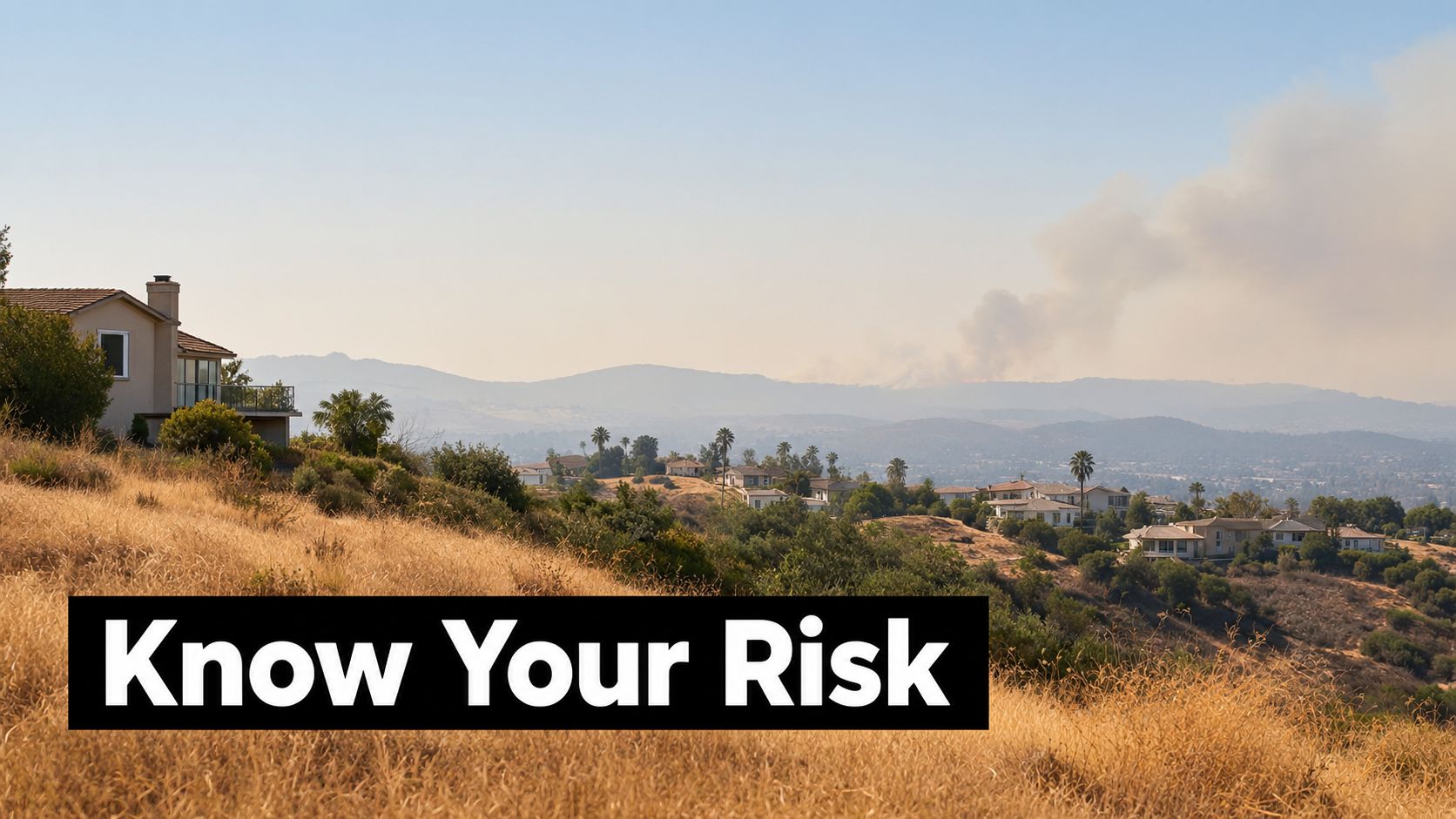
A homeowner near chaparral, grassland, woodland, or dry hillsides may see the same orange glow from a distance, yet the fire could be behaving in very different ways. A low surface fire can move through grass and leaf litter, while a crown fire can race through treetops and send burning material ahead of the main front. A ground fire may barely show itself while continuing to consume organic soil, roots, or peat below the surface.
The distinction matters because fuel location controls fire behavior. The U.S. Fire Administration describes the three foundational categories as surface, crown, and ground fires, based on the fuels involved and the fire's intensity. Two fires with similar footprints can behave differently and call for different suppression tactics when one burns through grass and another moves through canopy or underground organic layers. The U.S. Fire Administration's wildfire classification overview provides the underlying fire-science framework.
The homeowner consequences
Fire type affects the amount of warning available, the parts of a property that need attention, and the kind of damage a policy may need to address. Surface flames may threaten nearby vegetation, fences, decks, and lower portions of a home. Crown and spot fires can create an ember attack, allowing burning particles to enter vents, collect in roof valleys, or ignite combustible materials away from the main fire.
Ground fires create a different problem. Their slow, concealed movement can make detection and extinguishment difficult, particularly where roots and organic soil continue to smolder after visible flames have disappeared.
California homeowners also face a financial decision. A property may be exposed not only to direct flame contact, but also to smoke, evacuation costs, loss of use, debris, and rebuilding expenses. Defensible space and home hardening reduce physical vulnerability, while a careful coverage review helps identify limits and exclusions before an emergency.
Practical rule: Fire labels help explain behavior, but a property-level plan must account for flames, embers, smoke, evacuation, and the cost of returning home.
The Three Core Types of Wildfires Explained Simply
A simple way to remember the three core types is to think of a forest as a building with three fuel levels. Surface fuels are the floor, canopy fuels are the ceiling, and ground fuels are the material below the floor. Fire behavior changes when the heat moves from one level to another.
Surface fires burn across the landscape
A surface fire consumes fuels at or near the ground, including grass, fallen leaves, needles, dead branches, shrubs, moss, lichen, small trees, and saplings. It usually produces visible flames and can spread rapidly through light, dry fuels, often at relatively low intensity compared with a crown or ground fire.
Its behavior depends on continuity. A patch of dry grass connected to brush and low branches gives the fire a clear path. A managed break, moist vegetation, or an area with less connected fuel can interrupt that path. For homeowners, this is why vegetation near walls, fences, decks, and outbuildings deserves attention.
Crown fires use the treetops
A crown fire burns in the upper canopy, consuming live and dead foliage, branches, tree lichens, and tall shrubs above the surface layer. Once established, it can produce intense heat and throw embers or burning branches ahead of the main fire.
Crown fire isn't one uniform behavior. Some crown fires torch individual trees while the surface fire still controls the overall spread. Others form a continuous wall of flame through the canopy, while independent crown fires spread mainly through the crown fuel layer. The Northwest Territories wildfire terms guide describes these as intermittent, active, and independent crown fires.
Ground fires burn below sight
A ground fire consumes organic material beneath the surface litter layer, such as duff, peat, decayed roots, and other organic soils. It tends to smolder slowly with limited oxygen, making it less visible than a surface fire and difficult to extinguish completely.
Ground fires can persist after the visible fire front has passed. That lingering heat creates a re-ignition concern and may damage roots or soil structure without producing the dramatic flame column people associate with wildfires.
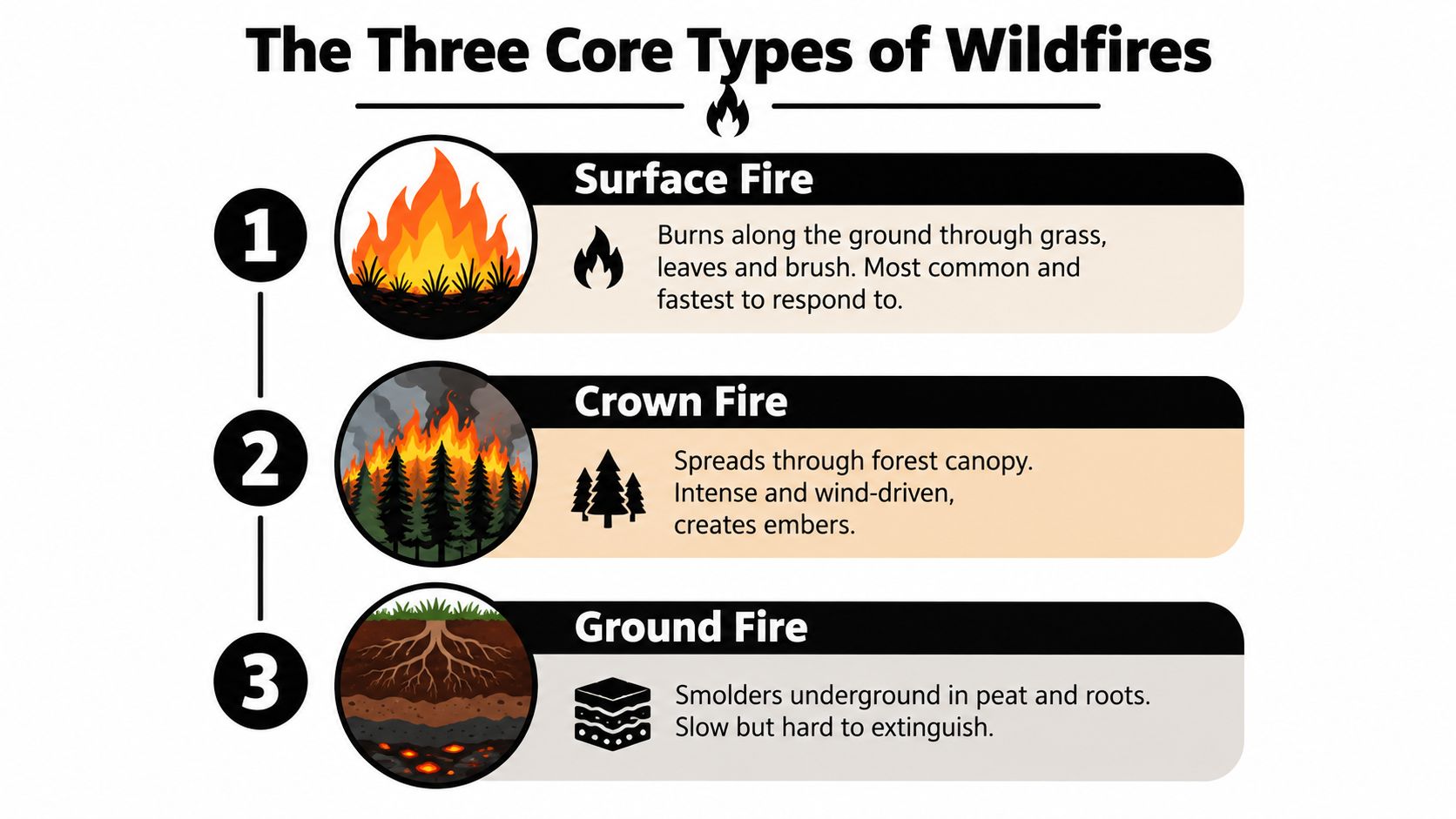
The key lesson is straightforward: surface fires burn across, crown fires burn above, and ground fires burn below. Fuel position explains why a fire's visible size doesn't always reveal its intensity, persistence, or danger to nearby homes.
How Wildfires Start Spread and Change Behavior
A wildfire begins when an ignition source supplies enough heat to dry and ignite available fuel. Lightning, sparks, equipment, escaped burns, and other human causes can start a fire, but the initial spark doesn't determine the final behavior. The surrounding fuel, weather, slope, and wind decide whether the fire remains a small surface event or develops into a fast-moving, ember-producing fire.
From ignition to movement
Once surface fuel ignites, the fire moves across connected material. Dry grass, leaves, needles, brush, and small branches can carry flames from one patch to the next. Wind bends flames toward unburned fuel, slope can help heat rise into vegetation above the fire, and continuous fuel gives the fire fewer natural interruptions.
Fire officials describe movement with rate of spread, which measures how quickly a fire travels across the terrain. The measure is commonly expressed in chains per hour, and the Northwest Fire Science Consortium's fire-behavior reference defines one chain as 66 feet.
Flame length provides another important clue. It measures from the flame tip to the base of the midpoint of the flame at ground level. It isn't the same as the height of smoke or the distance the fire travels. Instead, it helps describe heat output and the difficulty of controlling the fire.
How surface fire climbs into the canopy
A surface fire can transition upward when fuels form a continuous vertical path. Ground litter feeds low vegetation, low vegetation connects to shrubs and branches, and those ladder fuels carry heat toward the canopy.
Several conditions influence that transition:
- Surface fuel loading: More available fuel can create more heat near the base of trees.
- Foliage moisture: Dry foliage ignites more readily than vegetation with higher moisture.
- Flame length: Longer flames can reach higher fuels and increase the chance of torching.
- Crown base height: Lower branches reduce the distance between surface flames and canopy fuels.
- Crown bulk density: Compact crowns provide more connected fuel once fire reaches the treetops.
Oregon State University's fire-science curriculum explains this fuel continuum and the factors that affect crown fire initiation.
A homeowner can use the same mental model. Grass is not automatically harmless if it connects to shrubs, shrubs are not isolated if they touch tree branches, and a tree canopy can become part of the fire pathway when lower fuels remain continuous.
Comparing Surface Crown Ground and Spot Fires Side by Side
The phrase “wildfire type” can create confusion because spot fires aren't a fourth fuel-layer classification. A spot fire is a new ignition ahead of the main fire, commonly started when embers or burning material travel through wind. It can begin as a surface fire, but its location makes it especially important for homeowners.
| Fire Type | Typical Fuels | Speed and Intensity | Key Homeowner Risk |
|---|---|---|---|
| Surface fire | Grass, leaves, needles, dead branches, shrubs, and low vegetation | Often fast across connected light fuels, with relatively low intensity compared with crown or ground fire | Flames can reach grass, fences, decks, landscaping, and lower structures |
| Crown fire | Live and dead foliage, branches, lichens, and tall shrubs in the canopy | Highly intense, especially when wind and connected crowns support continuous spread | Embers and burning branches can travel ahead and ignite roofs, vents, decks, and other vulnerable areas |
| Ground fire | Duff, peat, organic soil, decayed roots, and material below surface litter | Slow, concealed, and persistent, with difficult suppression | Smoldering roots and organic layers can remain after visible flames and cause re-ignition |
| Spot fire | New fuel ignited by embers or burning material from another fire | Behavior varies according to the new fuel and local wind | A home can face ignition away from the main fire front, including from embers landing in small fuel pockets |
The National Park Service explanation of wildfire spread and suppression distinguishes ground, surface, and crown fires and notes that crown fires may be passive, active, or independent depending on their connection to surface fire.
Why the comparison matters
Surface fire is usually the easiest type to see developing across the ground. Ground fire is the least obvious because much of its activity occurs below the surface. Crown fire can become the most visually dramatic and can create dangerous ember exposure, but a homeowner shouldn't judge risk only by the tallest flames.
The most useful question is: Which fuel pathway connects the fire to the home? That pathway might be grass and brush, tree crowns and embers, or concealed roots and soil near a structure.
What Each Wildfire Type Means for Your Home and Evacuation Plan
Home protection starts with the property, not the fire name. A surface fire may arrive as a visible line through vegetation, while a crown fire may send embers ahead of that line. A ground fire may leave little visible warning but create persistent heat beneath the soil. Each scenario calls for a different emphasis.
Match mitigation to the attack
For surface fire exposure, homeowners should focus on the vegetation immediately around buildings and the connections that let flames reach structures.
- Create defensible space: Maintain the required 5 to 30 feet around the home according to CAL FIRE's defensible-space guidance, and remove dry leaves, dead vegetation, and grass that can carry flames.
- Break fuel continuity: Trim vegetation so grass, shrubs, and lower branches don't form a continuous route toward walls, decks, fences, or outbuildings.
- Harden vulnerable openings: Ember-resistant vents, enclosed eaves, protected gutters, and roofs made with fire-resistant materials reduce opportunities for embers to enter or settle.
Crown and spot fires require special attention because embers can cross areas that appear clear on the ground. Roof valleys, gutters, vents, attic openings, decks, patio furniture, mulch, and accumulated leaves can all become ignition points if burning material lands there.
Ground-fire preparation is less visible but still practical. Property owners should understand whether organic soils, heavy duff, or decayed roots exist near structures and should inspect for lingering smoke, heat, or smoldering material after a fire. Fire crews and local officials should guide any post-fire inspection, because concealed hot spots can remain dangerous.
Plan for evacuation before the alert
A fast, wind-driven fire can reduce the time available for decision-making, particularly when embers create separate ignitions ahead of the main front. A slower ground fire may provide more warning, but it can remain active and complicate re-entry. Neither scenario justifies waiting for visible flames at the property line.
A household plan should identify more than one route, account for pets and mobility needs, and assign responsibility for children, older adults, medications, documents, and essential equipment. A go-bag should support an immediate departure, while a communication plan should specify where household members will reconnect if phone service becomes unreliable.
Evacuation advice: An official evacuation order takes priority over personal estimates of fire speed, flame height, or distance.
Wildfire Risk Insurance Gaps and Coverage Considerations in California
Fire behavior affects more than emergency preparation. It also changes the way homeowners should review insurance, because a policy responds to financial losses rather than to a fire label alone.
Extreme wind-driven events and ember spread can produce structure losses even when the main flame front never reaches the property. A home may also face smoke damage, evacuation expenses, temporary living costs, debris removal, and rebuilding demands after a lower-intensity fire. The practical distinction is often ember-driven loss versus direct flame-contact loss, not surface fire versus crown fire.
Why geography isn't the whole underwriting story
California's insurance market increasingly considers property-level mitigation alongside broad location. The state's private-insurance coverage shortfall has been estimated at $1.35 trillion to $2.00 trillion, with $800 billion to $1.3 trillion connected to single-family wildfire exposure, according to the Stanford Center for Economic Policy and Research California wildfire report.
Those figures describe a market exposure problem, not the amount any individual homeowner will receive. For a property owner, the more immediate questions are whether the dwelling limit reflects current rebuilding needs, whether extended replacement cost is available, and whether mitigation documentation could affect eligibility or pricing.
California's recent reforms and wildfire-hardening discount changes also point toward more property-specific evaluation. Roof condition, vents, defensible space, access, and other hardening measures may matter when an insurer reviews risk.
The FAIR Plan is not a complete household policy
The California FAIR Plan provides a fire-only backstop. Homeowners who rely on it may need a separate Difference in Conditions policy for coverage that the FAIR Plan doesn't automatically provide, including liability, water damage, theft, and loss of use.
That gap can become costly after an evacuation or total loss. A dwelling may have fire protection while the household lacks sufficient support for temporary housing, personal liability, or other everyday risks. Coverage review should therefore examine the entire protection package, not just the fire limit.
A responsible comparison should check dwelling coverage, other structures, personal property, additional living expenses, debris removal, ordinance or law coverage, replacement-cost terms, deductibles, exclusions, and endorsements. Underinsurance can leave a homeowner with a policy in force but insufficient funds to rebuild.
Protect Your Home With the Right Coverage Today
The three types of wildfires provide a useful starting point, but a California property can face several attack paths at once. Surface fuels can carry flames toward a structure, canopy fires can send embers beyond the visible front, and ground fires can remain active below the surface. A strong plan connects those behaviors to defensible space, home hardening, evacuation readiness, and insurance limits.
Property owners should review the home from the outside in. Dry vegetation and connected fuels need treatment. Roofs, gutters, vents, windows, decks, fences, and outbuildings need an ember-focused inspection. The evacuation plan needs clear routes and responsibilities, and the insurance policy needs enough protection for rebuilding and temporary living costs.
Mitigation can also affect the insurance conversation. California insurers are increasingly evaluating property-level hardening, while homeowners need coverage that reflects the cost of recovery rather than the appearance of a basic fire policy.
A quote comparison can help identify whether current protection matches the home's location, construction, mitigation work, and wildfire exposure. DwellQuote is a California home-insurance comparison platform that uses property information to help homeowners review coverage options, including options for higher-risk areas, before selecting a policy through its licensed agency partner.
Request a home insurance quote through DwellQuote to compare California coverage options with wildfire risks such as ember spread, flame contact, evacuation costs, and rebuilding needs in mind. A property-specific comparison can help identify coverage gaps and support a more informed insurance decision before the next evacuation alert.